To Mr. Edward Tuck,
of the class of 1862, THE MAGAZINE, in behalf of all Dartmouth men, extends Christmas and New Year greetings freighted with gratitude. To him is the pledge of admiration, for his achievments; respect, for his character; affection, for his generous deeds. His large gifts to Dartmouth are esteemed not merely because of their magnitude, but, as well, because of the animating spirit of their giver, who, through his benefaction, has builded a monument to mark the opening of a new era of greatness for Dartmouth College.
The significance of Mr. Tucks gift is worthy of extended consideration. The object of this large addition to the College endowment is frankly to increase the teaching efficiency of the institution. In short, strength and support are brought to bear at the precise point where Dartmouth, in common with other American colleges is weakest. Given real teaching efficiency, and two-thirds of the criticism which has been directed against higher education would never have been raised. American undergraduates—whatever may be said of their European contemporaries—need to be taught, that is, they need to exercise their brains under expert guidance; guidance being a euphemism for all known means of promoting progress in a predetermined direction. The requirement can be fully met only where there can be provided instruction corps sufficient in respect to both quality and quantity. Quality means a good many things: learning, and sympathy with learning; grasp of a given subject, coupled with due understanding of its relation to the whole scheme of education; leadership such as is born of the knowledge of men; character that is incisively vital. It means, or should mean,much besides, if the college is to meet the manifold new demands which the last quarter century has increasingly made upon it. Yet at a time when the nation should be numbering its truly great men among its teachers, the widely advertised inadequacy of college salaries operates to frighten many of the most able and ambitious from entering the faculty ranks.
But even where, today, quality exists, as it frequently does, it may be diluted to the point of negligible operation. While there are some specific. exceptions both of personality and of circumstance, it is a general truth that the man who can teach fifty students well, could teach fifteen better. The larger the class the less the possibility of thoroughness: the greater the opportunity for the lazy or the immature to glide easily along mistaking mental titillation for real intellectual stimulation, just as the gouty bon vivant mistakes Swedish movement and massage for genuine gymnastics. Some college students are lazy; most of them, very properly, are immature: if real, training, is to be other than an accident of the curriculum which they pursue, they must, for the most part, be taught in small groups.
That President Nichols was keenly alive to the importance of these considerations with particular reference to their application at Dartmouth has been evident from the day of his inauguration. From the first he has insisted upon the need of raising Dartmouth salaries, not as an act of pity for the unfortunate instructor who might be struggling with his coal bill, but as an act of business common sense that recognizes a just ratio between efficiency and expenditure. In the same way he has insisted upon increasing the instruction staff to the end of more intensive and hence more thorough teaching. The plain reasonableness of his attitude finds substantiation in Mr. Tuck's tangible expression of approval. Judge Russell made his sentfrnents clear, long since, when he pledged $10,000 to a salary fund. Others of the shrewdest and most farsighted alumni are looking forward to that united effort which shall make the pride of Dartmouth men to be a college which, within the field of its distinct endeavor, shall be recognized as the best equipped, the best manned, the best conducted in the country.
When the largeness of the end to be achieved is contemplated in the light of present conditions, it becomes fairly apparent that the $28,000 of increased income from the Tuck fund will provide no melon to be sliced for the exclusive delectation of the present faculty. It will help to make the position of Dartmouth professor more attractive and more permanent for the right men; it will help to supply undermanned departments with instructors; it will help to raise the general standard of the College. Fortunately it will not do more than help; for the time should never come when the loyalty of the great body of alumni will be superfluous.
The Athletic Council is to be both thanked and congratulated for its solution of the football coaching problem for the coming year. It has handled a difficult situation with infinite tact, patience and wise judgment. The coaches who have been chosen represent a wide range and great diversity of experience. They should bring to their task a combined constructive ability of the highest order. Of the difficulties of their position they are, no doubt, perfectly well aware; Dartmouth football must be made over almost from the beginning. These three men will be expected to lay a new foundation and erect a creditable superstructure in two months time. They may very properly decline to be held responsible for more than the first demand. Indeed, if they can fulfill that, inaugurating a policy that, while safe-guarding Dartmouth's reputation for fair play and sportsmanship, shall operate for cumulative success through a term of years, rather than for the superficial brilliancy of a single season, they will deserve universal commendation. It is from this standpoint that Dartmouth's future football coaching should be observed and studied.
The extended report, given elsewhere in this issue, of the December meeting of the trustees of the College may be taken as an earnest of a definite trustee policy of keeping the alumni in ever closer touch with the work of the board. The Dartmouth alumni having long since achieved what the graduates of many other institutions are still fighting for,—namely, representation in the governing councils of the institution,—it is increasingly necessary to awaken the spirit of co-operative responsibility and to breed a widespread and accurate knowledge of conditions and events. It will be the purpose of THE MAGAZINE to aid in this movement not only by keeping the alumni well informed of the progress of the College in all its departments of endeavor, but by opening its columns to the expression of alumni opinion upon matters of general collegiate interest.
A perusal of the report will add to an understanding of the degree to which the idea of a greater teaching efficiency at Dartmouth has taken hold. Judge Russell promulgates the idea and backs it with $10,000; the trustees devote the probable $95,000 net from the great Kennedy bequest to furthering the project; two members of the class of 1870 add $5,000 more. On this is piled the added half million of the Amos Tuck endowment. More than $30,000 a year is thus added to the income to be applied for purposes of instruction. It is a good beginning.
The appointment of Professor Laycock to the position of Assistant Dean will meet with general approval. Active in undergraduate affairs during his college days, Professor Laycock has retained, in unusual measure, his sympathy with the student point of view. His training in the forms of oratory and debate, and later in the processes of the law, has developed the clarity and precision of a mind by nature essentially practical and well-fitted to cope with administrative problems. Of the men of the younger generation, no one is better known among alumni of the College as congenial companion of the few or effective speaker before the many. Professor Emerson's long years of faithful and valuable service to Dartmouth have surrounded the office of Dean with an atmosphere of benignant dignity that is precious to the College. The character of the man chosen to aid him is a sure guarantee that the quality of this atmosphere will in no wise be impaired.
More From This Issue
-
 Article
THE DIARY OF WILLIAM SMITH OF CAYENDISH, VERMONT, A FRESHMAN IN DARTMOUTH COLLEGE, SEPT. 23, 1822-AUG. 3, 1823
January 1911 -
 Article
Mr. Tuck's Gift to Dartmouth
January 1911 -
 Article
Important Trustee Meeting
January 1911 -
 Class Notes
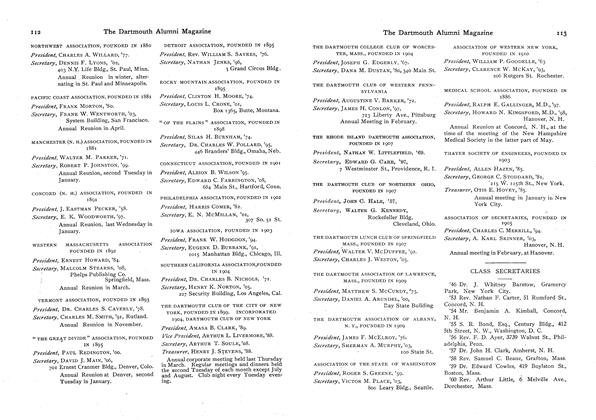
LOCAL ASSOCIATIONS
January 1911 -
Article
OTHER! TRUSTEE ACTION
January 1911 -
 Class Notes
CLASS SECRETARIES
January 1911