CLASS OF 1862
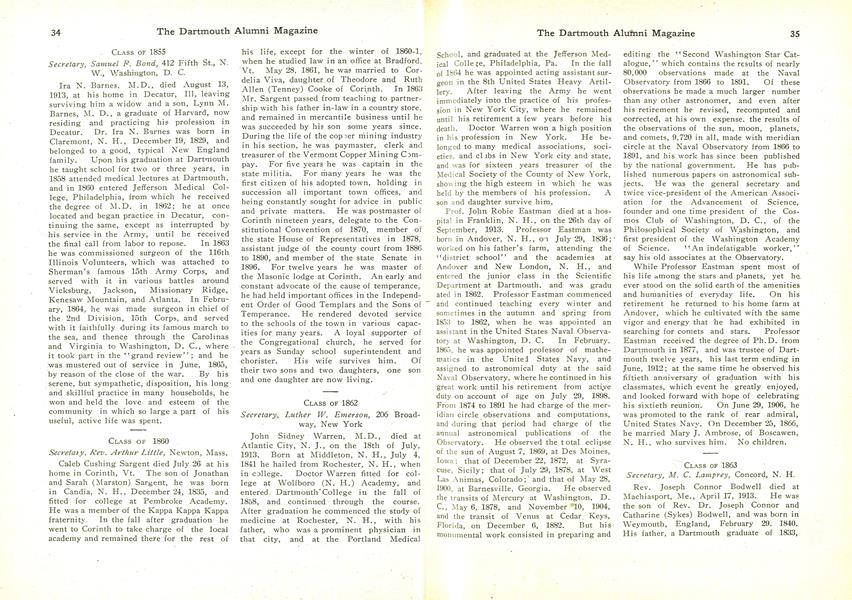
John Sidney Warren, M.D., died at Atlantic City, N. J., on the 18th of July, 1913. Born at Middleton, N. H., July 4, 1841 he hailed from Rochester, N. H., when in college. Doctor Warren fitted for college at Wolfboro (N. H.) Academy, and entered Dartmouth' College in the fall of 1858, and continued through the course. After graduation he commenced the study of medicine at Rochester, N. H., with his father, who was a prominent physician in that city, and at the Portland Medical School, and graduated at the Jefferson Medical College, Philadelphia, Pa. In the fall of 1864 he was appointed acting assistant surgeon in the 8th United States Heavy Artillery. After leaving the Army he went immediately into the practice of his profession in New York City, where he remained until his retirement a few years before his death. Doctor Warren won a high position in his profession in New York. He belonged to many medical associations, societies, and cl lbs in New York city and state, and was for sixteen years treasurer of the Medical Society of the County of New York, showing the high esteem in which he was held by the members of his profession. A son and daughter survive him.
Prof. John Robie Eastman died at a hospital in Franklin, N. H., on the 26th day of September, 1913-. Professor Eastman was born in Andover, N. H., on July 29, 1836; worked on his father's farm, attending the "district school" and the academies at Andover and New London, N. H., and entered the junior class in the Scientific Department at Dartmouth, and was graduated in 1862, Professor Eastman commenced and continued teaching every winter and sometimes in the autumn and spring from 1853 to 1862, when he was appointed an assistant in the United States Naval Observatory at Washington, D. C. In February, 1865, he was appointed professor of mathematics in the United States Navy, and assigned to astronomical duty at the said Naval Observatory, where he continued in his great work until his retirement from active duty on account of age on July 29, 1898. From 1874 to 1891 he had charge of the meridian circle observations and computations, and during that period had charge of the annual astronomical publications of the Observatory. He observed the total eclipse of the sun of August 7, 1869, at Des Moines, Iowa; that of December 22, 1872, at Syracuse, Sicily; that of July 29, 1878, at West Las Animas, Colorado;" and that of May 28, 1900, at Barnesville, Georgia. He observed the transits of Mercury at Washington, D. C., May 6, 1878, and November 10, 1904, and the transit of Venus at Cedar Keys, Florida, on December 6, 1882. But his monumental work consisted in preparing and editing the "Second Washington Star Catalogue," which contains the results of nearly 80,000 observations made at the Naval Observatory from 1866 to 1891. Of these observations he made a much larger number than any other astronomer, and even after his retirement he revised, recomputed and corrected, at his own expense, the results of the observations of the sun, moon, planets, and comets, 9,720 in all, made with meridian circle at the Naval Observatory from 1866 to 1891, and his work has since been published by the national government. He has published numerous papers on astronomical subjects. He was the general secretary and twice vice-president of the American Association for the Advancement of Science, founder and one time president of the Cosmos Club of Washington, D. C., of. the Philosophical Society of Washington, and first president of the Washington Academy of Science. "An indefatigable worker," say his old associates at the Observatory.
While Professor Eastman spent most of his life among the stars and planets, yet ha ever stood on the solid earth of the amenities and humanities of everyday life. On his retirement he returned to his home farm at Andover, which he cultivated with the same vigor and energy that he had exhibited in searching for comets and stars. Professor Eastman received the degree of Ph.D. from Dartmouth in 1877, and was trustee of Dartmouth twelve years, his last term ending in June, 1912; at the same time he observed his fiftieth anniversary of graduation with his classmates, which event he greatly enjoyed, and looked forward with hope of celebrating his sixtieth reunion. On June 29, 1906, he was promoted to the rank of rear admiral, United States Navy. On December 25, 1866, he married Mary J. Ambrose, of Boscawen, N. H., who survives him. No children.
Secretary, Luther W. Emerson, 206 Broadway, New York
More From This Issue
-
 Article
A LOSS TO THE COLLEGE
November 1913 -
 Article
THE CHEMICAL LABORATORY
November 1913 -
 Article
ADDRESS TO THE STUDENTS AT THE OPENING OF COLLEGE SEPTEMBER 18, 1913
November 1913 -
 Class Notes
LOCAL ASSOCIATIONS
November 1913 -
 Article
This number of THE MAGAZINE has
November 1913 -
 Article
MR. JOHNSON'S GIFTS TO THE OUTING CLUB
November 1913