CLASS OF 1875
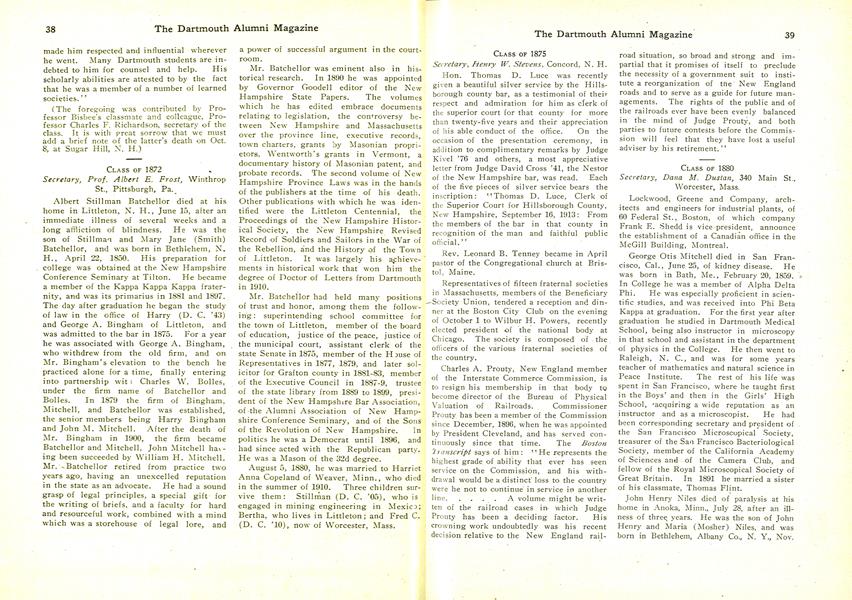
Hon. Thomas D. Luce was recently given a beautiful silver service by the Hills borough county bar, as a testimonial of their respect and admiration for him as clerk of the superior court for that county for more than twenty-five years and their appreciation of his able conduct of the office. On the occasion of the presentation ceremony, in addition to complimentary remarks by Judge Kivel 76 and others, a most appreciative letter from Judge David Cross '41, the Nestor of the New Hampshire bar, was read. Each of the five pieces of silver service bears the inscription: "Thomas D. Luce, Clerk of the Superior Court for Hillsborough County, New Hampshire, September 16, 1913: From the members of the bar in that county in recognition of the man and faithful public official."
Rev. Leonard B. Tenney became in April pastor of the Congregational church at Bristol, Maine.
Representatives of fifteen fraternal societies in Massachusetts, members of the Beneficiary Society Union, tendered a reception and dinner at the Boston City Club on the evening of October 1 to Wilbur H. Powers, recently elected president of the national body at Chicago. The society is composed of . the officers of the various fraternal societies of the country.
Charles A. Prouty, New England member of the Interstate Commerce Commission, is to resign his membership in that body to become director of the Bureau of Physical Valuation of Railroads. Commissioner Prouty has been a member of the Commission since December, 1896, when he was appointed by President Cleveland, and has served continuously since that time. The BostonIfanscript says of him: "He represents the highest grade of ability that ever has seen service on the Commission, and his withdrawal would be a distinct" loss to the country were he not to continue in service in another ne .... A volume might be written of the railroad cases in which Judge Prouty has been a deciding factor. His crowning work undoubtedly was his recent decision relative to the New England railroad situation, so broad and strong and impartial that it promises of itself to preclude the necessity of a government suit to institute a reorganization of the' New England roads and to serve as a guide for future managements. The rights of the public and of the railroads ever have been evenly balanced in the mind of Judge Prouty, and both parties to future contests before the Commission will feel that they have lost a useful adviser by his retirement."
Secretary, Henry IV. Stevens, Concord, N. H
More From This Issue
-
 Article
A LOSS TO THE COLLEGE
November 1913 -
 Article
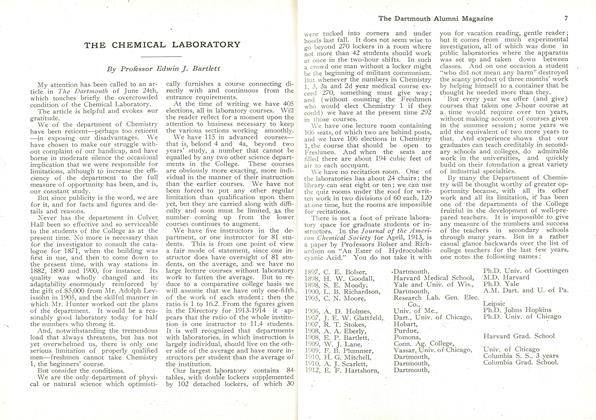
THE CHEMICAL LABORATORY
November 1913 -
 Article
ADDRESS TO THE STUDENTS AT THE OPENING OF COLLEGE SEPTEMBER 18, 1913
November 1913 -
 Class Notes
LOCAL ASSOCIATIONS
November 1913 -
 Article
This number of THE MAGAZINE has
November 1913 -
 Article
MR. JOHNSON'S GIFTS TO THE OUTING CLUB
November 1913