CLASS OF 1910
Dr. Thomas A. Foster is lieutenant in the British Army Medical Corps, General Hospital 27, B. E. F., France. Mail should be sent care War Office, White-Hall, London.
Miss Leona, daughter of Mr. and Mrs. H. K. Bartlett of Manchester, N. H., has recently announced her engagement to William B. Grant of that city.
The engagement of Miss Lillian Staniford Blood, daughter of C. O. Blood, 173 Ocean St., Lynn, to Laurence Hardy Bankart has been announced. Miss Blood is one of the promising young society women of Lynn and Swampscott, and is a graduate of the Lynn Classical High School. Bankart's success as football player and coach is well known to Dartmouth men. Last reports have it that in the face of a large salary he had decided not to coach again at Colgate next fall.
Grover S. Hoyt is with the Western Electric Company, 680 Folsom St.,-San Francisco, Ca. He resides at 57 Alexander Ave., Sausalito, Cal.
George E. Chamberlin is with Stone and Webster at Youngstown, Ohio.
On January 1, William E. Tucker was admitted to memberships in the firm of Tyler, Covneau, and Eames, a prominent law firm in Boston.
Ben A. Williams has .resigned from the Boston American, and is now engaged in writing fiction for the .magazines. He is living at 35 Bowen St., Newton Center, Mass.
Herbert S. Woods is department manager with P. and F. Corbin, manufacturers of builders' hardware, New Britain, Conn., and lives at 204 Hart St. For several years he has been secretary of the Connecticut Alumni Association.
Richard H. Boerker is examiner in the United States Forest Service, now at the Fremont Experiment Station, Manitou, Colo., at the foot of Pike's Peak. A recent letter descriptive of his work is so highly interesting that we quote at length: — "We aim to study and investigate the factors which affect the life and growth of trees and forests. By means of meteorological instruments we try to determine just how much soil temperature, soil moisture, air temperature, rainfall, humidity, etc., each species of tree requires for its best development. We are determining the climate of similar forest types at various altitudes to see if we can discover why some trees grow at some altitudes and some at higher or lower elevations. We have a meteorological station at timber line on Pike's Peak, elevation 11,500 feet, which is one of the highest if not the highest station of its kind in the world. Certainly this station records the most rigorous climatic conditions in the United States, and its main object is to study this climate where tree growth stops, to try to discover what factors make it impossible for trees to live there. So far records seem, to indicate that neither temperature nor heavy snowfall determines the highest limit of tree growth, but, curious as it may seem to the layman, wind is the important factor. Besides these meteorological studies, we experiment upon the best and cheapest methods of planting young trees; we test tree seeds as to their germinability; we study the best methods of cutting the forests to secure their reproduction; we study the effect of cutting the forests upon the climate within the forests, and we aim to attempt to solve many of the important problems which confront the government upon their 200,000,000 acres of national forest domain. The solution of these problems means advances and improvements in forest management, and this in its ultimate analysis means a greater revenue to Uncle Sam. I think I am pretty safe in saying that I am the only Dartmouth man engaged in this kind of work. In fact, there are only about a dozen men in this country engaged in silvical investigations, and I know there is not a Dartmouth man among them except myself,"
Secretary, Sturgis Pishon, 100 Summer St., Boston
More From This Issue
-
 Article
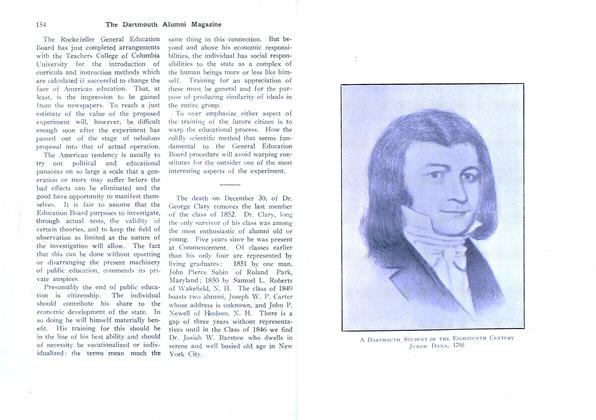
THE SCHOOL AND COLLEGE LIFE OF JUDAH DANA OF THE CLASS OF 1795
February 1917 -
 Books
BooksThe New Reservation of Time
February 1917 -
 Class Notes
CLASS OF 1916
February 1917 -
 Article
TRUSTEE EDWARD K. HALL TO LEAVE NEW ENGLAND
February 1917 -
 Article
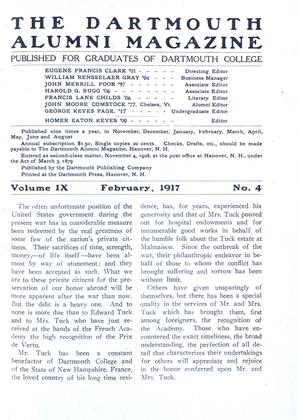
The often unfortunate position of the United States government
February 1917 -
 Class Notes
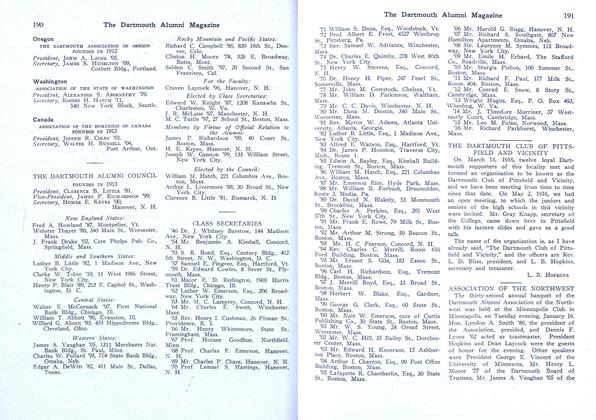
CHICAGO ASSOCIATION
February 1917