MY GENERATION
It is matter for profound gratitude and congratulation that Dr. Tucker has found strength to give to us and to those who shall come after us this masterly interpretation of the great movements of which he has been a part. It is like him to minimize his own influence, and to dwell upon the broad intellectual and social currents on which the men of his generation have been borne along; both his modesty and his characteristic tendency to look always for the governing principle behind the immediate and particular event have contributed to make this book the record of a generation of moral and intellectual progress, more than the • story of his own leadership. That is a fine defect in the record, and one which history will correct. In the final estimate of American religious and educational progress during the last third of the nineteenth century, no name is more sure of lasting position than that of Dr. Tucker. In this splendid volume we read between the lines to see him moving steadily, fearlessly and joyously in the front rank of those who met the challenge of the new age which opened with the close of the Civil War; and no soldier of that war ever risked life more deliberately than did Dr. Tucker in the final campaigns of his presidency, when the rapid growth of the College under his leadership brought upon him labors which must, for the sake of the College, be carried right forward, yet were plainly beyond the power of any man long to endure. This life-history is the story of a brave man.
In the introductory chapter of the book we have Dr. Tucker's rare analytic power at its best. This chapter is the key to the volume: impersonal, analytic, comprehensive, it lays before us the conditions which confronted the young preacher as he entered the Christian ministry in 1867, the professor of Homiletics as, thirteen years later, he took a position of responsibility in the adjustment of an old New England theological seminary to the demands of a new age, and, after another period of thirteen years, the college president, as he began the transformation of the Old Dartmouth into the New. Through this introductory chapter the reader is enabled to relate the varied activities of Dr. Tucker's long career to certain well defined and compelling movements of the time; and we see with what discernment and intellectual and moral courage he threw himself into the work of his generation at just the point where, at each period, his work was especially needed. And one sees what entire unity and consistency underlay all the efforts of a career which to a superficial observer might seem to have involved abrupt changes of interest and activity.
Among the determining influences of his generation Dr. Tucker distinguishes only one as being a distinct inheritance from the past; this was the moral heritage which came down from the antislavery struggle, "the bequest of the Puritan conscience at the stage of its greatest activity" This quickened conscience found itself, at the close of the Civil War, confronted with new problems in the North, arising from the rapid development of industrialism. The growth of the factory and its crowded towns brought problems which were hardly less difficult of solution than those of slavery. The conscience of the nation, aroused for the rescue of the slave, turned now to the condition of the laborer under the modern industrial system. "Christianity had begun to concern itself with economic conditions. Poverty, if the result of unemployment, called for more than charity. The relief lay in social justice, a term which came into service to express the obligation of society to the unemployed or to the underpaid . . . The church became as conspicuously the agency for 'social service' as it had been the 'means of grace' in the work of individual salvation". And the new industrialism had effects which were wider than these. The new order involved "the change from the individualistic to the socialistic conception of society .... Capital rapidly passed from the hands of the individual into the control of the corporation, and thence into the control of the trust. Labor passed in like manner and with equal step from the control of the individual to that of the union, and on to that of the federation. Capitalist and workman alike placed themselves under self-imposed limitations. They allowed themselves to disappear as individuals to reappear as members of organizations".
But more important than the changes due to industrialism was the change of the whole point of view of life which came as the result of the publication of Darwin's Origin of Species in 1859, and his Descent of Man in 1871. Dr. Tucker quotes Mr. Balfour's words, "Our whole point of view has altered. The mental framework in which we arrange the separate facts in the world of men and things is quite a new framework. The spectacle of the universe presents itself now in a wholly changed perspective. We do not see more, but we see differently". This new point of view involved to a large degree the intellectual detachment of this generation from the past. It was the beginning of a new intellectual order. In the field of religion, the challenge came more immediately to the teachings of the Bible as to the origin of man, but the discussion did not stop here; it soon raised the question of the authority of the Bible in the whole field of its teaching, and opened the way for modern Biblical criticism. "The wave of agnosticism which spread over the country necessitated various changes in the presentation of religious truth. . . Gradually there was an appropriation of the new truths disclosed by science in the interest of ethics and. of faith". Dr. Tucker believes that "the loss to religion of certain dogmatic but divisive beliefs found in due time its compensation in the insistence placed upon the function of conscience in the interpretation, as well as in the enforcement, of religion".
In the field of education the effect of the new scientific movement was twofold : "It brought in a vast amount of new subject-matter, and it changed altogether the method of the higher education .... The scientific method may be said to have created some subjects in the curriculum of the colleges, to have recreated others, and to have changed the relative position of certain other subjects, as in the case of the ancient and modern languages. Within the range of college and university teaching, the greatest contribution of the scientific method was the graduate school."
As one reads this analysis of the spirit of the new age in which the young man found himself as he left college, he sees how completely the man threw himself into the center of all these movements, first the distinctively religious, then the social, from the standpoint of religion, then the educational: "It was from first to last", he says, "a period of incentive and challenge. One felt all the while that he was living in the region of undiscovered truth. He was constantly made aware of the presence of some unsatisfied opportunity".
In the chapter called "The Personal Background" Dr. Tucker gives a most welcome glimpse of his boyhood and college days. By an interesting coincidence his earliest boyhood fell in the region in eastern Connecticut from which Wheelock set out to found the college in the New Hampshire wilderness, while his later boyhood brought him to Plymouth, New Hampshire, just across the mountains from the College, the county seat of the college region. So entirely predestined was William Jewett Tucker to be the Dartmouth Man.
The death of his mother when he was only seven years of age had led to the virtual adoption of the little boy by his mother's sister, the wife of the Rev. William R. Jewett of Plymouth, so that his boyhood became that of the typical New Hampshire boy of a refined home in a village of the best sort. Plymouth was equally distinguished for its place in political and social life, and for its superb location at the southern gateway of the White Mountains. Dr. Tucker pays warm tribute to the educational influences of home and village and hills, evidently estimating them as more decisive than the training of the village Academy, where most of his formal preparation for college was obtained. Those who know and love the man can see how qualities inherited by the boy from a fine ancestry were fostered and developed in the Plymouth parsonage, and among the hills and along the troutbrooks of New Hampshire. Of this home life he says, "The family training of that time did not stand primarily for repression. I should say that the prevailing note was freedom. The stage of over-training had so far passed by, that there was little sense of unnecessary restriction. The restrictions' put upon a boy were for the most part such as were shared by his elders, like certain observances of Sunday. They belonged to the customs and conventions of social and religious life. The forms of religion were a part of the family routine, but its realities were no less a pervasive influence . . . The home life of the time as I saw it had found the normal balance between authority and indulgence". Of the life out of doors he says, "Every boy took his lessons at first hand, and without partiality, in the school of Nature. He learned the true meaning of its democracy. It was easy to fling the saddle on his horse, and take a morning or evening ride to 'Prospect' for the view from Winnipesaukee to the mountains; easy to follow the streams with his rod, easy to take all winter sports, though at their price. I have never believed that the city boy, developed into the summer resident who takes Nature in her gentler moods, ever quite knows the meaning of what I have called the democracy of nature—the rule of those great and masterful equalities which far surpass any democracy of society".
After a period of final preparatory training at Kimball Union Academy, then the most popular fitting school for Dartmouth, the future President found himself a Freshman at Hanover in 1857. His sketch of the college training of that day is interesting and suggestive. He comments on the strange absence from the curriculum of modern history and modern literature, but shows how, under the influence of the "Society Libraries", then largely maintained and administered by the students themselves, this defect was, at any rate in his own case, largely remedied by extensive and systematic private reading, especially during the long vacations in winter. Of the effect of the college upon the incoming student he says, "In the college curriculum of the first two years there was little change from the studies of the preparatory school. The change was altogether in the surroundings, in outward conditions, in atmosphere, in the tone and spirit of the common life. It was a change into a world of freedom, of individual responsibility, of constant stimulus. . . . The new freedom wrought its own transformation. It effected with surprising rapidity a change of disposition and temper, and thus gave to the various objects of college pursuit their chance according to their value. I found that the suddenly acquired sense of responsibility produced a new and unexpected zest for the essential business of the college, and gradually opened a true perspective into the essential business of the after life. Without hesitation I date the beginning of any really responsible purpose or ambition from my entrance upon college, and ascribe the change to the complete readjustment of desires and purposes which then took place." Of the uniform curriculum of that day he says,_ "The college acted constantly through its totality. Whatever it had to offer intellectually or morally, it brought to bear in its unity upon every student. . . There was little questioning of the value of individual parts of the earlier curriculum. The whole curriculum was accepted in its entirety, and because of its entirety. It was the whole that counted as a whole, not as the sum of individual parts, the end in view being mental enlargement more than mental furnishing. . . . The modern curriculum is constructed with a view to the largest possible development of each separate subject, a purpose made practicable through the elective system. The effect of this set of the instructor and of the curriculum toward intensiveness, is to carry the individual student whom it reaches, farther on his way to a specific goal. But under this dominating influence the modern college parts company more easily with the average student. Scholarship below the line of advanced work is on the whole more desultory and less cumulative."
In his review of the events and the currents of thought which marked the period of the Civil War, Dr. Tucker expresses his life-long regret that a severe illness prevented his taking an active part in the struggle until near its close, when he served in the field under the Christian Commission. One effect of the war and the problems which developed with it, was to change the life plans of Dr. Tucker; he had expected to enter the law; in college his special interest had been in the courses which looked in that direction. But of the change in his personal outlook he says, "This period now became a season of reappraisals and revaluations in the light of newly awakened ambitions, or of more decisive appeals of duty. ... A man could not make himself most effective or most serviceable without constant regard to the direction of the forces which determined the movement of his time. . . . To me it seemed upon reflection, that the ministry stood for the time being in closet relation to what may be termed the personal element in professional service. Nor do I hesitate to add that the field of opportunity which it then offered seemed to be wider when given its full range. The moral necessities of the situation made their own appeal to the imagination, and taken in connection with the new stirrings of thought, carried the appeal over into the region of intellectual adventure. ... It was not the conventional call of the church. But it took account of certain moral and spiritual values which were not then emphasized in the creeds, and which had little .recognition within the sphere of organized religion. It was a call, though imperfectly apprehended, to that larger ministry which was soon to find its place within the scope of modern Christianity."
Of Andover Theological Seminary, as he found it in the sixties, Dr. Tucker says, "It represented an advanced theology, keen intellectual life, and the spirit of devotion for service at home or abroad. What was lacking, and the lack was serious, was some fresh, more direct, and penetrating approach to the heart of Christianity. . . . The 'New England Theology', like every great religious holding of the truth, was vitalized at times by spiritual quickenings, but the continuous struggle after truth, the tremendous earnestness of search rather than of inquiry, the conflict with doubt, the baffled but determined demand for personal assurance and personal possession, were not conspicuously in evidence. The theological atmosphere was not highly charged with intellectual or moral passion." It is to a source outside the group of seminary professors and their teaching that Dr. Tucker attributes, the really formative influence of the period of his theological studies. This was the influence of the writings of Frederick W. Robertson of England. "The conception of Christianity, as the power of God working on the basis of human sonship, had never been laid hold of with such clearness of apprehension, or interpreted with so deep and inclusive a meaning, as in the utterances of Robertson when he returned to the pulpit. It was the ground of his intense hatred of sin, and of his tender, almost reverent, regard for sinning men and women. And certainly never was the doctrine of Christ enforced with a more passionate devotion to his person. . . . There was that about his experience of Christian truth and about his teaching of it, which struck the note of reality. For the impression then made upon my mind of the supreme importance of this quality, in the holding and teaching of the Christian faith, I am profoundly grateful to the influence of the spirit and teachings of Robertson. His fundamental conception of Christianity as revealing the fact of human sonship, every man by nature a son of God, has been the conception which has most influenced me in my work in the pulpit and among men. It has given me a steady working faith in human nature. I have not been afraid of what may have seemed to others to be an overestimation of men." Dartmouth men scattered the world over will read those words with tender appreciation, and a new insight into the sources of that marvelous power which discovered for them possibilities of manhood in which they could at first hardly believe, but which are being realized in their lives today.
Of Dr. Tucker's thirteen years in the pastorate, eight years were spent in the Franklin Street (Congregational) church of Manchester, N. H., and five in the Madison Square (Presbyterian) Church of New York City. The Manchester pastorate brought him into the center of a rapidly growing mill town, the largest in the State, and into close personal contact with the problems of labor, at a time when employer and employee were not as far apart as now in nationality, social interest, and sympathy. The parlors of the church became social club-rooms for young women from the mills; the educational work of the church was extended on lines which the most advanced churches of the present day have hardly reached; and above all, the great meetinghouse became from Sunday to Sunday the gathering place of a democratic body of people, drawn by the message which had called the young pastor into the Christian ministry. Here it was that he developed that command of speech, with its direct and simple power, which was the outgrowth of the most rigorous study and unsparing- preparation.
The New York pastorate brought him into a position of yet greater influence. Some of his New England friends may be not a little shocked to read his remark that "the New York of that day was less theological, but more religious than Boston." In the Madison Square church the pastor was in a position to inspire men of the greatest influence in city and nation. Among them were Cyrus W. Field, at that time in the midst of his long and discouraging struggle to realize the object of his persistent faith, an Atlantic cable, and Samuel J. Tilden, yielding, with the loyalty of a patriot and the grace of a Christian, the high office to which he believed the people of the country had elected him. Judge Porter, a member of the church, is quoted as saying, "Judged by the test of the responsibilities public and private of those who attended the church, there was no pulpit in the city which had more direct access to the sources of public welfare." It is interesting, particularly in times of social stress like our own, to read Dr. Tucker's statement of the way in which he endeavored to use this position of influence: "It was the consciousness of the fact to which Judge Porter referred that led me to give to my preaching, so far as possible, the tone of moral invigoration and spiritual quickening. I recognized the fact, of course, and acted at times upon it, that the discussion of public questions had a legitimate place in the pulpit, but the essential thing, as it seemed to me, was to increase the moral sensitiveness and to stimulate the moral purpose, of those who had most to do with the intricacies and liabilities of affairs. And it was at this point that I found, as I have said, a ready response."
In the fifth year of the New York pastorate, Dr. Tucker was invited to take the chair of homiletics in Andover Theological Seminary. Of the motive which led him to accept this position, he says, "It was evident that a process of reconstruction was going on in which, if one was to take part at all, he must have a place nearer the sources. And the necessity for the closer range of thought was equally apparent, whether one considered the critical or the social questions which were fast becoming the problems of modern Christianity. It was under this conviction of the need of a nearer approach to the distinctive issues of the time, arid in the hope of accomplishing the larger service for the ministry through those who were entering, or who might be led to enter it, that I decided to exchange the pastorate for the professorship to which I was called. In the view which I took of the religious situation the step from the church to the Seminary was a forward step—my response to the demand for religious progress." Of the progressive movement then under way in the churches, Dr. Tucker says, "The progressive movement covered three distinct though related forms of investigation and research - the technically theological, having to do with the method of the Divine working in and through nature; the critical, employed upon the Scriptures and the early Christian literature; the humanistic, concerned with the problems of human environment and human destiny. It was this last subject of investigation and inquiry upon which my own personal and professional interest centered." It is interesting to Dartmouth men to recall that while Dr. Tucker with the Andover group was taking the lead in this humanizing movement in religion, another young Dartmouth graduate, Francis Brown of Union Theological Seminary, was taking a like part in the field of Biblical criticism, in which that seminary was to become preeminent.
When Dr. Tucker came to Andover in 1880, the movement later known as Progressive Orthodoxy was already under way in the Congregational churches, under the lead of men like Newman Smyth, Theodore T. Munger, and Washington Gladden, but it had hardly reached the class-rooms on Andover Hill. The center of the theological course was then, as it had long been, the teaching of Edwards Park in dogmatic theology. Dr. Park, brilliant, incisive, a leader of progressive thought himself in his younger days, was then in his last year of teaching, still fighting the old battles, resurrecting dead issues for the pleasure of annihilating them again with the old weapons, unaware of the real issues which were to confront the young men who were going out to meet the philosophic and social questions of their own time. It is true that in the class-room of James Thayer in New Testament Greek, principles of Biblical interpretation were being taught which would in the end bring his pupils out into the new world of critical thought, but Profess. Thayer was more interested in investigation than in teaching, and few of his pupils realized then the significance of his teaching and method, or saw that it was undermining the foundations of the traditional theological teaching of the School. There was certainly a place for Dr. Tucker with his complete devotion to the new movements in theology and social Christianity; from the day of his coming the Seminary took on new life and vigor. Those who, like the writer of this review, heard Dr. Tucker's sermons in the Academy-Seminary pulpit in that first year of his, will never forget the impression of sincerity, reality, and spiritual power which they received. It was the coming of a new life to the institution.
Soon circumstances which he had not foreseen brought the new professor into a wider opportunity than he had expected, giving him as an audience not merely the group of young men on Andover Hill, but the churches of the denomination at large. For Andover became the center of a theological controversy which reached all the churches, and involved the readjustment of the whole denomination to the new movements in religious thought.
The resignation of Professor Park, incapacitated by age for further public service, brought to the trustees of the Seminary the question of their attitude toward the progressive movement. By request of the Seminary faculty the vacant chair was offered to one of the men most definitely committed to this movement, Newman Smyth, whose book, "Old Faiths in New Light," published shortly before, had been recognized as marking a new period in religious thought.
Discussion of Dr. Smyth's book had been concentrated largely upon a single position which he had taken, not in a dogmatic way, but as a reasonable hypothesis, to remove a glaring inconsistency in the current theology; the church was laying the utmost stress on the redemptive work of Christ as the only means of the salvation of the individual, and yet it held that the only opportunity for the acceptance of this means of salvation was in this life, that death ended 'probation'. Manifestly this doctrine excluded from the work of redemption the great mass of the human race of past and even of present times, the uncounted millions who go down to death without the knowledge, or the possibility of knowledge, of Christ. A generation of Christians who were feeling the new movement of enthusiasm for humanity could not tolerate such a theological anomaly. Dr. Smyth's hypothesis offered them a possible relief.
At the same time the machinery of the denomination was as anomalous as its theology. One of the most democratic of all the churches, with no central' creed which could demand the assent of the individual church or minister, with ordination in the hands of local councils of ministers and laymen, and with an unbroken record of theological progress, it nevertheless found its leading denominational paper, the Congregationalist, a purely private enterprise, in the hands of a man who was an expert in the theology of the seventeenth and eighteenth centuries in New England, but out of touch with the movements of the new time; its foreign missionary board, a self-perpetuating corporation, with a creed of its own, prepared by one of its own officials, to which the assent of every missionary candidate was required—without regard to the fact that he might already be a minister in full standing by ordination; and the leading theological seminary of the denomination required by its constitution to demand that every five years each professor reaffirm his assent to the private ancient creed of the Seminary, and all the acts of the faculty and trustees subject to final review by a self-perpetuating board of three 'Visitors'.
With the denominational paper, the foreign missionary board, and the theological seminary so constituted, it was high time that the issue be raised between the most democratic of churches and the most oligarchical of instruments. The appointment of Dr. Smyth to the Andover professorship raised the issue. A small but influential group of men in and around Boston, supported by the editor of the Congregationalist and the governing powers in the Foreign Board, made formal appeal to the visitors to annul the action of the trustees and declare the appointment of Dr. Smyth void, on the ground that his published teachings were inconsistent with the creed of the Seminary. After considerable delay the prayer of the petitioners was granted, but the Visitors evaded the real issue, by basing their action, not on the theological views of Dr. Smyth, but on their opinion that his habit of mind was such as to lead him to "conceive of truth sentimentally and poetically, rather than speculatively and philosophically."
The vacant chair was soon filled by the appointment of a man not publicly committed to the new views, but frankly in sympathy with them. The election of several other able men to chairs vacant or newly established brought together a group of professors who were, with those already in service, unanimous in their support of the progressive movement, and convinced that the time had come to carry it definitely to the churches. For this work they established the Andover,Review, a theological monthly magazine, edited by five of the professors, among whom Dr. Tucker and Professor Smyth, a brother of the Dr. Smyth whose election had been annulled, took an active part. The Review was announced late in 1883 ; for the next three years controversy against its positions went on vigorously in the denominational press and on the platform of the Foreign Board. Soon the conservatives began to press the attack upon other than theological grounds; they declared that men holding these views could not honestly subscribe to the creed of the Seminary, and that it was a breach of trust on their part to retain their professorships, and on the part of the trustees of the Seminary to employ them. The issue now turned upon the question whether the creed of the Seminary was to be taken as a final and exhaustive statement of truth, or whether sufficient freedom of interpretation of it was to be allowed to enable the Seminary to contribute in the future, as it had done in the past, to religious progress. Dr. Tucker and the men elected after him had given only a qualified assent to the creed; was such qualified assent to be allowed ? The issue at stake was too great to admit of compromise. The professors were subjected to misrepresentation and abuse, but they stood firmly for the right of the Seminary to investigate and teach the truth; if it could not continue to do that, there would indeed be somewhere a "breach of trust".
In the third year of the Review the issue was joined by a formal appeal to the Board of Visitors, presented by a small group of alumni of the Seminary, calling upon them to declare vacant the chairs of the five editors of the Review. Protracted hearings were held in Boston, both sides being represented by able counsel. The charges against the five professors were identical, based on editorials in the Review, for which all assumed equal and entire responsibility. After five months of deliberation, the Visitors—or more exactly two of them—rendered the astonishing verdict that the charges were sustained against one of the professors, Dr. Smyth, and dismissed as concerned the other four. By the constitution of the Seminary, appeal could be made from the verdict of the Vistors to the Judges of the Superior Court of Massachusetts, sitting as a board of last resort. This appeal was taken by Profess sor Smyth, and joined by the trustees, on the ground that they had been wrongfully excluded from the proceedings of the Visitors. For nearly three years the case was before the Superior Court; when at last their verdict was given, it annulled the action of the Visitors and left Professor Smyth in his chair at Andover, but the verdict was based entirely on the technical error in procedure of the Visitors, the exclusion of the trustees from their hearing.
It was possible now to reinstitute proceedings before the Visitors, and this was done against Professor Smyth by two of the original complainants. But by this time the Board of Visitors had changed in personnel, and the inconsistency of the prosecution of Professor Smyth apart from the other four was so glaring, that the new board of Visitors promptly dismissed the case, and the long protracted legal struggle was over. But meanwhile, futile as all the legal steps had been as reaching the real issue of religious liberty at Andover, the Review had been steadily carrying on its educative work among the churches. The editors had refused to be diverted by the undue emphasis placed by their opponents on a single, subsidiary point of theology, and had covered a wide range of essential topics. This influence was widely supplemented by Dr. Tucker's preaching in the leading pulpits of New England. The spiritual and constructive nature of the new movement was brought home to these churches, and prejudice changed into cordial assent on the part of a great body of laymen.
Meanwhile Dr. Tucker was steadily carrying on his professional work of training the seminary students for their work in the pulpit. By tradition his professorship had confined itself essentially to the preparation of the sermon, and the pastoral duties of the minister. But Dr. Tucker saw a wider field which he believed the Seminary should enter, and which fell fairly within the scope of his own work, the opening field of social service. Of the demand for the cultivation of this field, new to the seminaries of that day, Dr. Tucker says, "The fundamental idea [of the churches] was still that of charity, and the .whole trend of events was showing the insufficiency of the idea for social reform and advance. The greatest social grievance came from those who, if in need of charity, did not want it—the vast army of unskilled labor. Their grievance, as it became understood, changed the whole problem from that of charity to that of economic justice. In like manner a change was going on in the whole theory of treating the defective and otherwise dependent classes—not the more abundant relief of the deficient and dependent, but the prevention so far as possible of deficiency and dependency. It seemed imperative that the incoming ministry should be apprised of these changes, and as few had been so apprised in their academic training, that the seminary course should be open to the necessary instruction, even if mainly corrective and directive. . . . The introduction of 'Social Economics' into the seminary curriculum apprised the churches of the times upon which they had fallen." Not only was the new department developed in the seminary curriculum, but through the Andover Review extension courses were outlined and widely used.
An immediate outgrowth of the work at Andover in Social Economics was the establishment of a laboratory of social service in Boston. "Andover House," now known as the "South End House," modeled on Toynbee Hall in England, was ojDened under the leadership of Robert A. Woods, an Andover graduate student. It gave to the theological students the most practical training in the new type of city work, and brought them into immediate touch with the problems of labor and of poverty, and it has become one of the powerful agencies of the Christian life of the city.
With the Andover trial over, the progressive movement carrying everything before it in the churches, and the new work in the field of Christian sociology prospering and enlarging at Andover and in Boston, Dr. Tucker had every promise of a long period of untrammeled and productive work in the Seminary and among the churches of its constituency. But at just this point a call came to a new work, a most difficult task, in a field where his experience had been only that of an adviser. The trustees of Dartmouth College had twice before asked Dr. Tucker, already a member of their board, to return to the College as its President. The call was now repeated under circumstances which made it impossible for him to decline.
Years of internal dissension at Dartmouth and slow progress toward cooperation between trustees and alumni had at last ended in agreement and confidence. The spirit and machinery for cooperation and progress were ready. All depended now upon finding the right man for leadership. There was one man and only one among the alumni who could command the enthusiastic support of the whole constituency of the College. Dr. Tucker, with his unfailing insight, could not deny the logic of the situation. Reluctant as he was to leave the Andover home and the growing work there, he knew that the essential victory was already won and that a new struggle demanded his leadership. The record of the years which followed his decision is written in the hearts of a generation of Dartmouth men, and in the New Dartmouth, which arose as if by magic under his hands. Of the meaning of the apparent change in his life-work involved in the acceptance of the presidency, Dr. Tucker writes, "I began to realize the fact that the more specialized purposes which I had sought to attain through training for the ministry, might have a broader application in the training of college men. It was becoming more and more evident that the fundamental duties involved in the readjustments of society must be assumed by all the professions, and by men of affairs, some of whom might be expected, under the right incentives, to render a larger and more practical service than the ministry, could the colleges be made to furnish the sufficient motive to the study of the principles of economic justice."
As introductory to his sketch of the "Dartmouth Period" of his life, Dr. Tucker gives the reader a section on "The Corporate Consciousness of the College." It is one of those chapters of the book which reach far beyond the personal interest, great as that is, and significant as showing Dr. Tucker's insight as he approached his new work. Referring to words of Dr. Kirsopp Lake he says, "It is the distinction of the college that it creates a 'corporate consciousness,' which in turn is capable of creating in the college man 'a lively sense that he has been called with a great vocation'. . . . . The college stands for more than finds expression in any technical or cultural output. It represents also in high degree the play of those deeper human forces which have such freedom and scope in the whole range of human life." Answering the criticism that the institutional spirit of the college is institutional at the expense of the educational, he says, "It is not the supreme office of education at the period covered by the college to develop the individuality of the student, but rather his humanity, using this term in its strict educational sense. In this sense it is more desirable that a college student shall be thoroughly humanized than that he shall be prematurely individualized. The humanizing process consists in the introduction of mind to mind under mutually stimulating conditions, in the give and take of the physical and intellectual life, in the stimulus of competition, in the sense of comradeship in the intellectual adventure into life." He recognizes the fact that there are some students, very few in comparison, who can profit at once by the individualizing process, and that for them abundant provision must be made in the college; but he says, "The concern for individuality usually expresses itself in some undue concession to a partial or prematurely specialized talent, with the result to the individuals so treated that they are .intellectually stranded in later life; they fail to make connection with men and with events. They are not for the most part those who best meet the tests of the professional schools, or even of the specialized graduate school. Experience has shown beyond dispute that the higher education at the college stage is best mediated through institutions; and the institutional process is not set directly to the task of individualizing the student mind." One of the most suggestive remarks in this connection is the expression of the conviction that in the institutional spirit and appeal there are possible incentives to scholarship which have hitherto been neglected. The power of such appeal to institutional loyalty is felt overwhelmingly in athletics; the individual will make any effort and any personal sacrifice for the team and the College. Dr. Tucker believes that something of this institutional ambition and loyalty can and ought to be brought into the field of scholarship. "There are very many men in the colleges who are capable of reaching the results which can be gained only through scholarship, and who may be expected to reach these results, provided it can be made clear to them that scholarship is one of those indisputable things which a college expects a man to contribute as his part in the discharge of the common obligation. The spur of competition is purely individualistic. The sense of accountability is part of the social sense. It may be incorporated into the spirit of the college and applied where the stimulus is most needed. Today the men who most need this special stimulus are the strong and capable men who are in danger of making a miscalculation in regard to college values. From the strictly individualistic point of view, the investment of power in scholarship may not seem to them to be the most profitable investment. Let the question be changed. Is there any other investment of power, open to a college student, so profitable to his college, so profitable to his country ? . . . The really significant task of the college "is to make the strong and capable men under its training realize in time the social value of scholarship. . . . The rescue of a strong man from the misuse, or from the underuse of his power, is the most satisfying arid usually the most rewarding of all college endeavor." These words of Dr. Tucker are a challenge to the college of today and tomorrow. In them lies the possibility of intellectual vigor and power such as no college in the land has ever known. Can his vision be made a reality?
Of his fundamental purpose as he assumed the new office, Dr. Tucker says: "This office was nothing less than to attempt to give to the college its possible institutional development—to develop it to its full institutional capacity. The colleges with which Dartmouth had been associated in its early history—Harvard, Yale, and Princeton—had gradually drawn away in the pursuit of their own educational ideals. Harvard and Yale had already defined themselves as universities, and Princeton was taking steps to reach the same end. What further development should Dartmouth attempt, consistent with its traditions, and possible of realization? . . . The purpose was legitimate and practicable, and the opportunity was present, for Dartmouth to expand and to seek to fill to the full the college ideal. This was the purpose entertained, altogether distinct from the ambition to realize the university ideal, but in itself honorable and satisfying."
Of the means for carrying out this purpose, Dr. Tucker says that in his mind the emphasis rested at three points. "First, Dartmouth was in a peculiar sense an historic college. Its history was its great asset, both moral and material. It was necessary that its history should be capitalized at its full value. . . Dartmouth had no advantage in the transmission of culture. Her advantage, and it was very great, was in the wellnigh unrivaled possession of an originating spirit at once creative, adventurous, and charged with spiritual power. . . . Second, the creation of a high college sentiment, not mere college spirit, was essential to the full institutional development of the College. I have placed much stress upon the educational value of the human element during the college stage. It is of special value in creating the institutional spirit in constructive periods. The mind of the college' can be lifted at such times above the ordinary causes of enthusiasm and set upon the growths and advancements of the college itself. Such periods produce a fine community of feeling among members of the faculty, students, and alumni. . . . The third point upon which emphasis was placed was that any plan of reconstruction and expansion must be commensurate with the existing- opportunity. . . . The contrast is often drawn between teaching and equipment to the disparagement of the latter. There may be reason for this disparaging contrast, but it was entirely out of place in that period of educational reconstruction which followed the introduction of the sciences and of the scientific method. Teaching became in large degree a question of equipment. Colleges had to be rebuilt."
The next chapter, on the traditions of Dartmouth, serves at the same time as an admirable survey of the great crises in the history of the College, and as evidence of the grasp which Dr. Tucker had from the first of the significance of its early struggles and the spirit which surmounted difficulties. The New Dartmouth finder Dr. Tucker's care had its roots deep in the soil of the old.
Returning to the treatment of his own administration, Dr. Tucker sketches the problems which confronted the new movement; the enlargement of financial resources, the rebuilding and modernizing of the college plant, and the enlargement of the curriculum and increase of the faculty. As to the financial problem he says, "The historic colleges are all possessed of an intangible wealth which can be made productive. They have at lege; second, the free, though it may —first, the earning capacity of the college; second, the free, though it may properly be the organized, tribute of those who have profited by its advantages ; third, the goodwill, if not obligation, of a large constituency associated with it through its history or through its activities. The essential thing in the financial development of an historic college is the order in which it shall draw upon its resources. This I believe should be in the order just named."
There follows a sketch of the financial development of the College. Considerable funds became available as just this time by means of which it was possible to enlarge the faculty and increase the college plant. The State of New Hampshire began that policy of regular appropriations for the help of the College which has been of such constant value and served to bring the College so near to the community at large. The great Fayerweather bequest, unrestricted as to use, became the indispensable reservoir from which deficits were met in those early years of rapid expansion. The material growth is sketched in detail, and is a wonderful record of achievement. Of the educational development, Dr. Tucker says, "The educational expansion of the College necessarily adjusted itself to existing conditions. It meant in part the introduction of entirely new subjects, like biology and sociology into the curriculum, in part the organization of unorganized or detached subjects, like history and economics, into departments, in part the disproportionate increase of the teaching force in some departments, as especially in the modern languages, and generally an enlargement of the Faculty."
Especially interesting is the sketch, of the life of Edward Tuck, whose benefactions during Dr. Tucker's administration and the years which have followed have amounted to over a million and a half dollars. A college friend and for a time a room-mate of Dr. Tucker's, he early became interested, without solicitation of any sort, in seconding the work of the President, and his gifts made possible much, of the enlargement of the College. Of the reasons which led to the foundation of the Tuck School Dr. Tucker says, "The colleges representing a liberal education were failing to make a responsible connection, through the lack of a proper intervening training, with the world of affairs. The interests of that newer world were quite comparable with those involved in professional life—banking, corporate administration, and all the problems incident to the economic development of the country. It was a confession of the inutility or narrowness of a liberal education, for the colleges to leave their graduates in a helpless attitude before their new responsibilities, or to commit them altogether to the fortune of their personal initiative. ... It was in the attempt to offer some satisfactory solution of the problem confronting the colleges that the Amos Tuck School of Administration and Finance had its origin."
The chapter on the "New Morale" comes close to the heart of Dr. Tucker's administration, and enables the reader to appreciate some of the sources of his personal power and the invigoration which he brought to the whole College, faculty, students, and alumni. "From the first", he says, "I believed in the incorporation of the students, individually and collectively, into the movement for reconstruction and expansion. I believed that it was entirely possible, as it was certainly in every way desirable, that they should be made to share in the 'corporate consciousness of the college'. To the degree in which they understood and felt this larger consciousness, they would be qualified to take a leading part in remoulding college sentiment as a means of reaching and applying higher standards." An early case of impending discipline, involving a large number of students, was made the means of bringing the whole student body to a decidedly higher level of sentiment, so that the discipline itself became needless, replaced by student opinion. The dormitory system was so organized as to secure the democratic spirit, while providing the best of modern appliances. Of the strong support which he gave to intercollegiate athletics, Dr. Tucker says, "I have never been able to see the moral equivalent of organized athletics. The alternative is recreation; but recreation is no substitute for athletics, because athletics is in no sense a recreation. Athletics is a game, a contest, and means all that is implied in these terms—adequate training, stimulating antagonism, and a considerable degree of publicity. .... I regarded athletics as a legitimate school for training in leadership. Leadership grows out of the combination of personality and attainment. . . . When the scholar fails to attain leadership, as is so often the case, having presumably attainment, the lack is somewhere in those personal qualities which make up effective personalityauthority, virility, sincerity, sympathy, manners. Without doubt the personality of many athletes enters to a considerable degree into their influence over their fellows, but their chief claim to leadership lies in the field of attainment. This fact must not be overlooked in estimating the value of academic athletics." He emphasizes too the democracy of athletics, and the influence of the moral issues which inevitably arise in the conduct of intercollegiate contests, issues which in the end must be settled by student opinion.
The work of the new studies of the curriculum and the extension of the elective system is traced, as affecting the morale of the College. Thinking tended to become more intensive and responsible. "The effect was wider and deeper than could be measured by the ordinary standards of scholarship. It was difficult to rate it in the terms of the marking system. . . What is often apparent is a certain cumulative effect of a subject upon the student himself. The test really comes within the category of morale".
But the topic which will most of all command the interest of every Dartmouth man as he reads this book, will be the chapel service, as interpreted by the man who made it the center of the College, and the inspiration of the whole life of the institution. "It seemed to me", Dr. Tucker says, "to be necessary as a complement to the work of the classroom, that there should be some direct and authorized endeavor to stir up the mind of the College to the understanding of the meaning of its own personality, individual and collective; to keep its mind open and sensitive to that human world of which it was a part, though for a while detached, that in due time it might enter more fully into its life; and also to give the mind of the College some vision of that larger environment whose boundaries are discernible and accessible to faith. In other words, there was need of some agency in and of the College which should pursue, in all fitting variety of form, the one object, to interpret and quicken the sense of the personal, the sense of the human as felt in the life of the world, and the religious sense." These are golden words, already in effect inscribed on the hearts of a generation of Dartmouth men.
Graduates of the College will read with great interest the sketch of the activities of the President outside of the specific work of the College—his Lowell Lectures, and other lecture courses, numerous occasional addresses, his visits among the schools of the country at large, a notable service in protecting New Hampshire from the threatened disgrace of being sold out to an organization of New York gamblers, and that beautiful address on the occasion of the return of the battle flags taken by New Hampshire troops from Alabama regiments in the Civil War—"The restoration of these flags is not a charity, it is not even a courtesy. These flags go back to you, men of Alabama, by the logic of the situation, and with them go our hearts".
The final chapter, "The New Reservation of Time", is equally interesting for the picture of Dr. Tucker's quiet and happy life in his home on Occom Ridge, and his enjoyment of the Hanover hills, and for the sketch of the work which he has been enabled to do, in spite of physical limitations, by the timely word sent forth again and again in times of national anxiety or peril. These later years have seen no abatement of the moral purpose or the intellectual zest with which the young minister set out upon his life work—rather a strengthening and deepening of the spirit and a broadening of outlook which have made his voice even from his retirement one of the moral forces of his time.
My Generation is more , and less than an autobiography. It is far more, in that it is an interpretation of the great movements of the time in personal terms; it is something less, in that the purely personal finds less place than in the ordinary life story. Yet there are very delightful glimpses of home and family —the boyhood in Connecticut and among the New Hampshire hills, the home group of children and grandchildren, and, exquisite as a cameo, the picture of the home on Andover Hill, "the meeting place of sacred memories and of restored hopes".
The book comes to Dartmouth men as a record of the past, but still more as a challenge for the future. No man should venture to fill a chair in the College without this book very near his desk, yes, nearer than that; no alumnus can interpret his own life in his own generation better than by learning how "abundant" life can be, with insight and sympathy ' for men; and no undergraduate will find in all the studies of his curriculum a more sure and powerful revelation of the truth that will make a man wise.
A Review of Doctor Tucker's AutobiographyProfessor Charles Darwin Adams
More From This Issue
-
 Article
There has never been question as to the need of erecting a memorial to the Dartmouth
January 1920 -
 Article
DARTMOUTH MEN ACTIVE IN WEST
January 1920 -
 Class Notes
CLASS OF 1919
January 1920 -
Class Notes
CLASS OF 1919
January 1920 -
 Class Notes
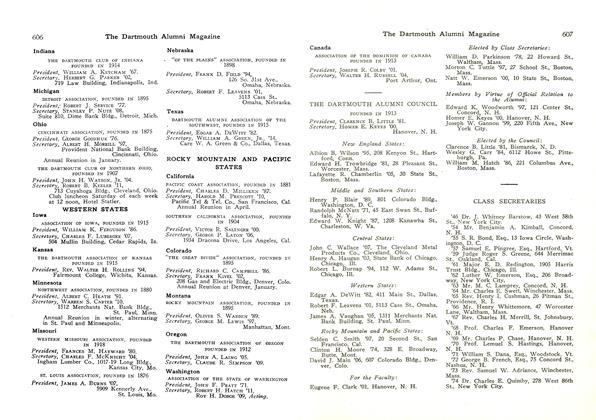
CLASS SECRETARIES
January 1920 -
 Article
PLANS FOR MEMORIAL FIELD ANNOUNCED AT FOOTBALL DINNER
January 1920