Class of 1873
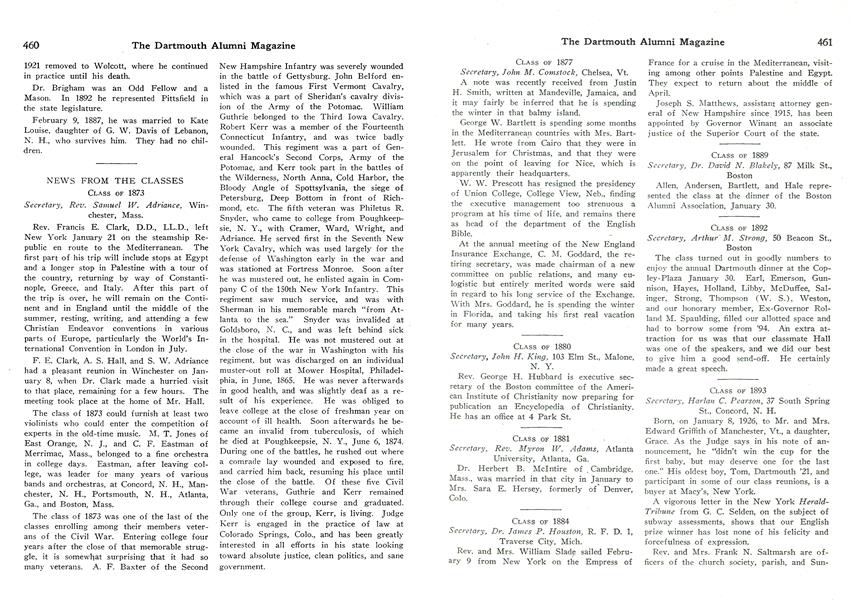
Rev. Francis E. Clark, D.D., LL.D., left New York January 21 on the steamship Republic en route to the Mediterranean. The first part of his trip will include stops at Egypt and a longer stop in Palestine with a tour of the country, returning by way of Constantinople, Greece, and Italy. After this part of the trip is over, he will remain on the Continent and in England until the middle of the summer, resting, writing, and attending a few Christian Endeavor conventions in various parts of Europe, particularly the World's International Convention in London in July.
F. E. Clark, A. S. Hall, and S. W. Adriance had a pleasant reunion in Winchester on January 8, when Dr. Clark made a hurried visit to that place, remaining for a few hours. The meeting took place at the home of Mr. Hall.
The class of 1873 could furnish at least two violinists who could enter the competition of experts in the old-time music. M. T. Jones of East Orange, N. J., and C. F. Eastman of Merrimac, Mass., belonged to a fine orchestra in college days. Eastman, after leaving college, was leader for many years of various bands and orchestras, at Concord, N. H., Manchester, N. H., Portsmouth, N. H., Atlanta, Ga., and Boston, Mass.
The class of 1873 was one of the last of the classes enrolling among their members veterans of the Civil War. Entering college four years after the close of that memorable struggle, it is somewhat surprising that it had so many veterans. A. F. Baxter of the Second New Hampshire Infantry was severely wounded in the battle of Gettysburg. John Bel ford enlisted in the famous First Vermont Cavalry, which was a part of Sheridan's cavalry division of the Army of the Potomac. William Guthrie belonged to the Third lowa Cavalry. Robert Kerr was a member of the Fourteenth Connecticut Infantry, and was twice badly wounded. This regiment was a part of General Hancock's Second Corps, Army of the Potomac, and Kerr took part in the battles of the Wilderness, North Anna, Cold Harbor, the Bloody Angle of Spottsylvania, the siege of Petersburg, Deep Bottom in front of Richmond, etc. The fifth veteran was Philetus R. Snyder, who came to college from Poughkeepsie, N. Y, with Cramer, Ward, Wright, and Adriance. He served first in the Seventh New York Cavalry, which was used largely' for the defense of Washington early in the war and was stationed at Fortress Monroe. Soon after he was mustered out, he enlisted again in Company Cof the 150 th New York Infantry. This regiment saw much service, and was with Sherman in his memorable march "from Atlanta to the sea." Snyder was invalided at Goldsboro, N. C., and was left behind sick in the hospital. He was not mustered out at the close of the war in Washington with his regiment, but was discharged on an individual muster-out roll at Mower Hospital, Philadelphia, in June, 1865. He was never afterwards in good health, and was slightly deaf as a result of his experience. He was obliged to leave college at the close of freshman year on account of ill health. Soon afterwards he became an invalid from tuberculosis, of which he died at Poughkeepsie, N. Y., June 6, 1874. During one of the battles, he rushed out where a comrade lay wounded and exposed to fire, and carried him back, resuming his place until the close of the battle. Of these five Civil War veterans, Guthrie and Kerr remained through their college course and graduated. Only one of the group, Kerr, is living. Judge Kerr is engaged in the practice of law at Colorado Springs, Colo., and has been greatly interested in all efforts in his state looking toward absolute justice, clean politics, and sane government.
Secretary, Win- chester, Mass.