Nineteen Eleven's Twin Tenth
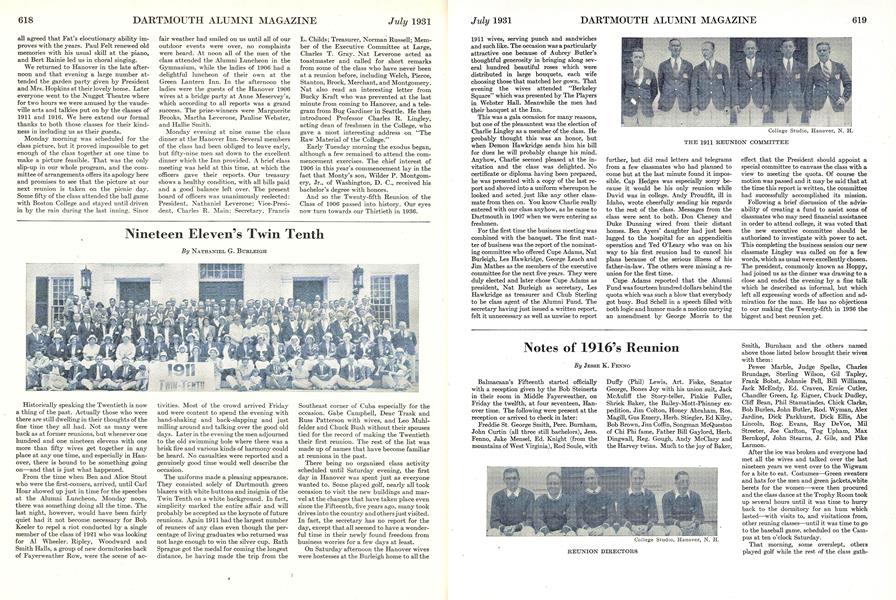
Historically speaking the Twentieth is now a thing of the past. Actually those who were there are still dwelling in their thoughts of the fine time they all had. Not as many were back as at former reunions, but whenever one hundred and one nineteen elevens with one more than fifty wives get together in any place at any one time, and especially in Hanover, there is bound to be something going on—and that is just what happened.
From the time when Ben and Alice Stout who were the first-comers, arrived, until Carl Hoar showed up just in time for the speeches at the Alumni Luncheon, Monday noon, there was something doing all the time. The last night, however, would have been fairly quiet had it not become necessary for Bob Keeler to repel a riot conducted by a single member of the class of 1921 who was looking for A 1 Wheeler. Ripley, Woodward and Smith Halls, a group of new dormitories back of Fayerweather Row, were the scene of activities. Most of the crowd arrived Friday and were content to spend the evening with hand-shaking and back-slapping and just milling around and talking over the good old days. Later in the evening the men adjourned to the old swimming hole where there was a brisk fire and various kinds of harmony could be heard. No casualties were reported and a genuinely good time would well describe the occasion.
The uniforms made a pleasing appearance. They consisted solely of Dartmouth green blazers with white buttons and insignia of the Twin Tenth on a white background. In fact, simplicity marked the entire affair and will probably be accepted as the keynote of future reunions. Again 1911 had the largest number of reuners of any class even though the percentage of living graduates who returned was not large enough to win the silver cup. Rath Sprague got the medal for coming the longest distance, he having made the trip from the Southeast corner of Cuba especially for the occasion. Gabe Campbell, Deac Trask and Russ Patterson with wives, and Leo Muhlfelder and Chuck Bush without their spouses tied for the record of making the Twentieth their first reunion. The rest of the list was made up of names that have become familiar at reunions in the past.
There being no organized class activity-scheduled until Saturday evening, the first day in Hanover was spent just as everyone wanted to. Some played golf, nearly all took occasion to visit the new buildings and marvel at the changes that have taken place even since the Fifteenth, five years ago, many took drives into the country and others just visited. In fact, the secretary has no report for the day, except that all seemed to have a wonderful time in their newly found freedom from business worries for a few days at least.
On Saturday afternoon the Hanover wives were hostesses at the Burleigh home to all the 1911 wives, serving punch and sandwiches and such like. The occasion was a particularly attractive one because of Aubrey Butler's thoughtful generosity in bringing along several hundred beautiful roses which were distributed in large bouquets, each wife choosing those that matched her gown. That evening the wives attended "Berkeley Square" which was presented by The Players in Webster Hall. Meanwhile the men had their banquet at the Inn.
This was a gala occasion for many reasons, but one of the pleasantest was the election of Charlie Lingley as a member of the class. He probably thought this was an honor, but when Demon Hawkridge sends him his bill for dues he will probably change his mind. Anyhow, Charlie seemed pleased at the invitation and the class was delighted. No certificate or diploma having been prepared, he was presented with a copy of the last report and shoved into a uniform whereupon he looked and acted, just like any other classmate from then on. You know Charlie really entered with our class anyhow, as he came to Dartmouth in 1907 when we were entering as freshmen.
For the first time the business meeting was combined with the banquet. The first matter of business was the report of the nominating committee who offered Cupe Adams, Nat Burleigh, Les Hawkridge, George Leach and Jim Mathes as the members of the executive committee for the next five years. They were duly elected and later chose Cupe Adams as president, Nat Burleigh as secretary, Les Hawkridge as treasurer and Chub Sterling to be class agent of the Alumni Fund. The secretary having just issued a written report, felt it unnecessary as well as unwise to report further, but did read letters and telegrams from a few classmates who had planned to come but at the last minute found it impossible. Cap Hedges was especially sorry because it would be his only reunion while David was in college. Andy Proudfit, ill in Idaho, wrote cheerfully sending his regards to the rest of the class. Messages from the class were sent to both. Don Cheney and Duke Dunning wired from their distant homes. Ben Ayers' daughter had just been lugged to the hospital for an appendicitis operation and Ted O'Leary who was on his way to his first reunion had to cancel his plans because of the serious illness of his father-in-law. The others were missing a reunion for the first time.
Cupe Adams reported that the Alumni Fund was fourteen hundred dollars behind the quota which was such a blow that everybody got busy. Bud Schell in a speech filled with both logic and humor made a motion carrying an amendment by George Morris to the effect that the President should appoint a special committee to canvass the class with a view to meeting the quota. Of course the motion was passed and it may be said that at the time this report is written, the committee had successfully accomplished its mission.
Following a brief discussion of the advisability of creating a fund to assist sons of classmates who may need financial assistance in order to attend college, it was voted that the new executive committee should be authorized to investigate with power to act. This completing the business session our new classmate Lingley was called on for a few words, which as usual were excellently chosen. The president, commonly known as Hoppy, had joined us as the dinner was drawing to a close and ended the evening by a fine talk which he described as informal, but which left all expressing words of affection and admiration for the man. He has no objections to our making the Twenty-fifth in 1936 the biggest and best reunion yet.
THE 1911 REUNION COMMITTEE
More From This Issue
-
 Article
Attributes of Vision: The Baccalaureate Address
July 1931 -
 Article
LOCAL ASSOCIATIONS
July 1931 -
 Class Notes
1926 in the Hills: The Glorious Fifth
July 1931 -
 Class Notes
1921 Tenth Reunion
July 1931 -
 Article
Characterizations of Honorary Degree Recipients
July 1931 -
 Class Notes
Reunion of the Class of '76
July 1931