Class of 1900
The last issue contained a brief account of the career and sudden death of Jasper Gibson. His life was one of varied experiences, and Fortune was not kind to him during the past few years. We shall always remember him as the father of the 1900 out-door round-ups. He started them by inviting us all to his camp near Clinton, Mass., while his father was still living. We had such a wonderful time that it was voted to hold another, until it became an established custom. Gib was a wonderful host, and throughout his life enjoyed the round-ups more than any other 1900 gathering. Now he has had his last, as the song goes.
Harry Marshall sends us the record of a very busy fall and winter in Burma, with the usual ups and downs of missionary work. Dr. Shailer Matthews of the Chicago University Divinity School has been his guest, while delivering a series of lectures at the Karen Theological Seminary. On March la Harry sails for England on the S. S. Pegu. He will arrive in the United States the latter part of May, and will surely be glad to see all his old friends and especially his children. Vacations must be wonderful for those who have to stay so long in foreign lands.
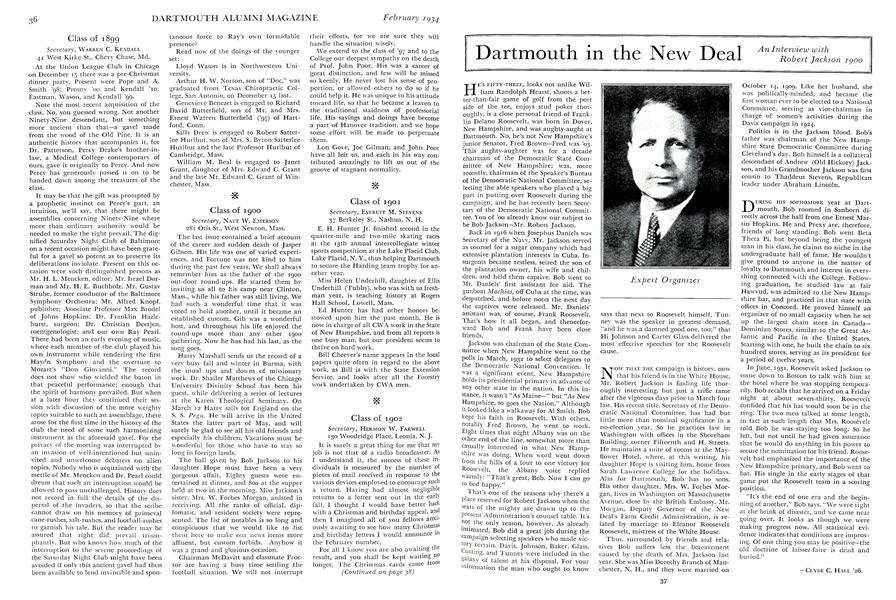
The ball given by Bob Jackson to his daughter Hope must have been a very gorgeous affair. Eighty guests were entertained at dinner, and 800 at the supper held at two in the morning. Miss Jackson's sister, Mrs. W. Forbes Morgan, assisted in receiving. All the ranks of official, diplomatic, and resident society were represented. The list of notables is so long and conspicuous that we would like to list them here to make our news items more affluent, but custom forbids. Anyhow it was a grand and glorious occasion.
Chairman McDavitt and classmate Proctor are having a busy time settling the football situation. We will not interrupt their efforts, for we are sure they will handle the situation wisely.
We extend to the class of '97 and to the College our deepest sympathy on the death of Prof. John Poor. His was a career of great distinction, and few will be missed so keenly. He never lost his sense of proportion, or allowed others to do so if he could help it. He was unique in his attitude toward life, so that he became a leaven to the traditional staidness of professorial life. His sayings and doings have become a part of Hanover tradition, and we hope some effort will be made to perpetuate them.
Lon Gove, Joe Gilman, and John Poor have all left us, and each in his way contributed amazingly to lift us out of the groove of stagnant normality.
Secretary, 281 Otis St., West Newton, Mass.