Class of 1899
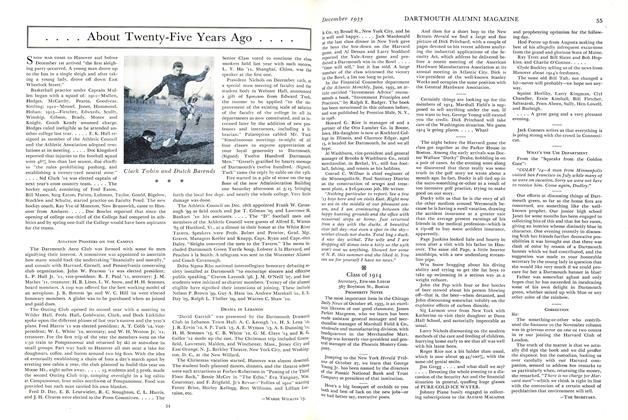
Summer vacation news continues to come in, brightening the workaday hours of the fall. Joe and Elsie Hobbs made their chief diversion a trip to the Gaspe Peninsula. Herb Rogers' daughter Virginia left her secretarial work at Macmillan's in Boston long enough to make a five-week trip to Europe, while Herb and Laura themselves made the circuit of New England. And in Plymouth, N. H., Ned and Mrs. Warren and K. Asakawa kept up the social atmosphere of Clarkland while George "was peacefully sailing down the Volga river in a good-sized packet of the vintage of 1860, imagining himself living in the age of Mark Twain and his friends on the Mississippi." Also for an hour on a Sunday afternoon there was a get-together at Fred Walker's cottage on Boone Lake of Fred and his wife Irene, Gus and Muriel Heywood, and K and May Beal, together with Roy Ward '97 and Roy's wife, Mary Downing Ward, who was in K's class at K. U. A. Fred has developed a miniature community at the Lake, owning and letting several cottages besides the one occupied by his own family.
Meanwhile the new young couples of the '99 family make as interesting news as their elders. Genevieve Benezet Butterfield and her husband Richard are now located in Litchfield, Conn., where Richard works for a well-known architect, Ernest Sibley. Warren and Helen Kendall's son William Hersey was married on October 31 in Bristol, Va., to Lucile Woodson Hayworth, daughter of Mr. and Mrs. Thomas Lee Hayworth, and in Stamford, Conn., Carl and Mary Elizabeth Miller's daughter Mary Louise was married to Kenneth M. Spang, son of Mr. and Mrs. William Spang of Cleveland, Ohio. There was a real Dartmouth flavor to this event, for the bridegroom—who is now studying in the Graduate School of Columbia University—is a Dartmouth 1933 man, and the bride's brother Edward, who gave her away, is now a freshman at Dartmouth, living in Middle Mass., that reunion stronghold of NinetyNine.
In the New York Times Book Review of September 29, Ray Pearl discusses at length the recent book "Man, the Unknown," written by the famous French biologist, Dr. Alexis Carrel. Aside from one's keen interest in Ray's analysis of Dr. Carrel's semi-mystical views of the nature of man, there is interest in the comparison that the reviewer draws between this recent publication and the "Sartor Resartus" of the Scotch philosopher, Thomas Carlyle. This last book takes men of '99 back to Clothespin Richardson's classroom and to the inspiring personality of one who was to many of us the first true reviewer of books that we had known.
John Ash of Oregon and his wife, parents and grandparents par excellence of the class of '99, are never far away in spirit from classmates and friends and scenes in the East. As would be expected, John has been intensely interested in the new bridge across the Connecticut. Their daughter Alice now has a secretarial position with the secretary of the Board of Higher Education of Oregon, and will be located at Eugene, about forty miles from Corvallis. John Jr. spent the summer working in the Forest Service in the Sinclair National Forest, sixty miles from home. But Ruth and her husband are not so near; they have gone to Alaska, where they may possibly remain for a few years. Meanwhile John Sr. combines business and pleasure by taking his son Homer's oldest boy (now seven) to the hospital to have his tonsils and adenoids removed so that he may be in first class condition for later fishing trips. The fish, John adds, will look with scorn and disdain upon Warren Kendall or other would-be Ninety-Nine fishermen who don't keep their hand in by fishing frequently on John's private preserves. So westward, ho! you fellows, to the mountain brooks of Oregon!
Secretary, 31 Parker St., Gardner, Mass.