Not So Long Ago
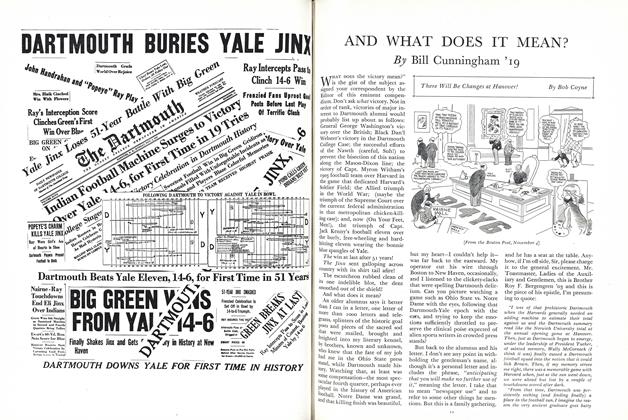
ONLY YESTERDAY Dartmouth tossed the jinx clean out of the Yale Bowl. A team in green jerseys, made up of boys whose names were just newspaper copy to most of us old timers, played as so many fine Dartmouth teams have played before. It will be something to read about with pleasant recollection in a "Not So Long Ago" column fifteen or twenty years hence.
"What difference does it really make?" people often ask. Very little to many of us, as for winning or losing, laying ghosts, or piling up topheavy scores. But a nameless quality, a spirit that animates Green teams, a myth to the other fellow, a reality to us, has been always present and always important. The thing defies analysis, disappears under a microscope; but countless evidences of it come back to mind. Since undergraduate days these eyes have seen Harvard snatch away a victory in the Stadium, Columbia submerged after dancing a triumphant snake-dance at half-time, and Yale seemingly guarded year after year by unrelenting Fate. Five games in particular still stand out, not counting the unforgettable affair at the Bowl this fall which should rank forever with the best of them.
Three of those on our personal honor roll were played between Dartmouth and Cornell in the early 'Twenties. There was the one when Jim Robertson was still on hand, throwing and kicking a football farther than anybody else in the United States. A field goal of Jim's, a long one, decided that game; but the goal he didn't kick furnished the big thrill of the day. He stood close to his own forty-yard line, with the goal-posts sixty or more yards away; and the crowd roared at the sight of a drop-kick, not a punt, from that impossible position. Yet the ball sailed on and on, never high but apparently never dropping, until it crossed the line, between the posts but barely under the cross-bar.
Another year brought another story. Cornell had the great George Pfann, and for sixty minutes a game Dartmouth eleven clutched despairingly but vainly for his elusive legs. The Green was outclassed, but it commanded and won respect. The score mounted to proportions which must have rankled at the time. Then Jess Hawley hauled Oberlander out of the line, put Myles Lane beside him for a running-mate, and set the stage for the re- turn engagement at Hanover.
Winter was setting in, snow was in the air, that day in 1925 when the slate was wiped clean of past humiliations. Dartmouth's team of destiny could do nothing wrong, against a Cornell eleven which was formidable in itself. That Cornell team, if you remember, covered the ground when it had possession of the ball. It scored two touchdowns in the first half on determined down-thefield marches. But Dartmouth, once gaining its poise, demon- strated to perfection a new type of football strategy: never let the other team have the ball. Forward passes shuttled back and forth between Oberlander and Lane, and to the bare-legged ends, Tully and Sage. And in between times slants off tackle netted tremendous gains. After each touchdown Dartmouth received the kickoff and started all over again.
The score of that one is as hard to remember as the score of a later game out in sunny California was hard to believe. Stanford, elated over a terrific shellacking administered to California the week before, looked fully four touchdowns stronger than the pigmy eleven from New Hampshire, sweltering in unaccustomed heat. Yet a single touchdown was the margin of the Green's defeat. Invincible morale, the quality of greatness, carried into the crowd in the stands and brought glory to Dartmouth three thousand miles from home.
The whole thing sums up to perfection when you think of the 33-33 engagement at New Haven. Columns, pages, tomes of manuscript have been written about it. No man's retained impressions of it will be quite the same as his neighbor's. But, by and large, it was for all of us the triumph of an unquenchable spirit, asking no quarter, conceding nothing, despairing never.