The New Social Science Program
DESCRIPTION OF BACKGROUND AND MAJOR FACTORS IN THESIGNIFICANT CURRICULUM REVISION OF THIS YEAR
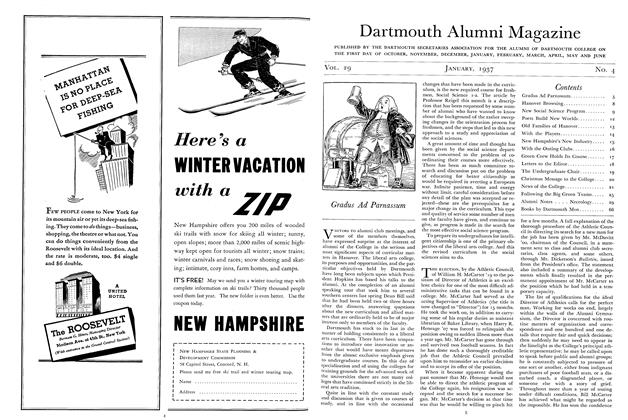
THE NEW social science program at Dartmouth is an effort to give the future graduate an opportunity to acquire a better understanding of the world of human social relationships political, economic and sociological. The attainment of this aim is one of the most useful contributions possible for the liberal college to both its students and indirectly to the outside world. Any rearrangement of formal courses and requirements is only a means to that end.
Prior to the present changes each student was required to take Industrial Society (Citizenship), a one semester survey course, plus any two year courses from a list of six subjects labeled as social sciences. This arrangement has never been justified except as a practical working compromise. If the idea of surveying the entire field without consideration of departmental boundaries was good, then Industrial Society had too short a time to do a satisfactory job; if the idea was bad, it should have been abandoned. Furthermore, it was hard to believe that any two courses, picked for any one of a hundred reasons, and with no relation to each other, would give a satisfactory view of the entire field of the social sciences.
One of the most obvious developments of the past generation in college education has been the increase of the importance and isolation of each department of knowledge. As knowledge has increased it has become more and more specialized, and each department has tended to make itself a close and self-sufficient group of scholars. Each department has tended to believe, quite honestly, in the paramount value of its own subject material, has tried to attain the maximum of power and prestige, and has demanded an ever larger budget for an expanding personnel. This tendency was particularly marked during the prosperous '20s. Certain advantages accrue from specialization and departmentalization, but accompanying disadvantages also become apparent, especially for the undergraduate in search of a general and non-technical training. Advanced courses are closed except for those having taken specified prerequisites—often contracting unduly the number of courses available to the average student. Repetition becomes evident, for every department must teach factors of general importance, such as the Industrial Revolution. Duplication appears with such topics as International relations, in which every department gives one or more courses. Jurisdictional disputes are not unknown; for example, is economic history economics or history? These and other difficulties do not necessarily lead to the conclusion that specialized departments are entirely bad, but rather to the realization that even specialization must have its limits, particularly when applied to undergraduates in a liberal college.
The general problems confronting the social sciences may be stated as (1) how to give the student a more comprehensive and inter-related view of the entire field; and (a) how to break down departmental boundaries sufficiently to allow the student a wider range of subjects and of courses. Upon these objectives practically the entire teaching staff of the college will agree. The only real problem is to find the best solution. Our new plan has such an answer. The cooperating departments are History, Political Science, Economics and Sociology.
DEVELOPMENT OF THE PLAN
Any important change is preceded by a vast amount of private conversation and discussion. In the present case this discussion tended to be crystallized into effective channels quite early because of the wise leadership of President Hopkins, who has long advocated a more useful arrangement of the social sciences. The first formal presentation of ideas for change came to the Social Science Division in a series of papers presented in the fall of 1933. After considerable discussion a committee, headed by Professor L. B. Richardson, was appointed to make specific recommendations for changes in the work of the first two years. The result of its labors was a report made in the spring of 1934 favoring a two year general course to be required of all students. After a long debate the Division accepted the report, but with strong opposition manifested. Most of this opposition fell under two general heads (1) that the two year plan would not allow proper training in the basic concepts of each discipline, particularly for the student later majoring in one of the social sciences; (a) that drastic changes in the work of the first two years should not be made until the later work was reexamined carefully and the entire social science curriculum made more logical. The Committee on Educational Policy approved the two year project and recommended its adoption to the faculty. The faculty considered the entire matter carefully from the viewpoint of general educational policy. The concensus of opinion seemed to be that no matter how meritorious the project, its success would be jeopardized seriously by the lack of unanimity in the Division. Consequently the faculty referred the entire matter back to the Division for further study.
A new social science committee, headed by Professor A. H. Meneely, was formed in the fall of 1934, with greatly increased powers. Not only was it empowered to deal with the first two years, but also it was given to make recommendations concerning the major, and in fact on any phase of the social science curriculum. The committee worked diligently for the remainder of the school year of 1934-35, gathering information and weighing possibilities. It finally recommended a new plan the one now in operation which was accepted in the fall of 1935 by the Division with a practically unanimous vote, and which was then accepted by the Committee on Educational Policy and by the general faculty.
REQUIRED OF ALL FRESHMEN
The new plan insists that the first step in obtaining an understanding of the field of the social sciences is to appreciate the sources and general lines of development of modern institutions. Consequently every freshman is now required to take Social Science 1-3, which presents such background material in both the European and American fields. All later social science work is built on this base, and consequently the student is prohibited from taking other social science courses until after freshman year. During sophomore year those men expecting to major in the social sciences are treated differently from the remainder of the college, being required to take the basic courses in Sociology, Economics and Political Science, each a one semester course dealing with the fundamentals of the subject. They may be taken in any order. Each student in his last two years must take the work necessary to fulfil the requirements of his major. As part of this work he takes in senior year a coordinating course (labeled 101-2) designed to tie together the courses of the major and to indicate relations between this work and that of the other social sciences. The plan for the social science major is then this the basic Social Science 1-2 (integrated), a brief survey of the several social sciences, work in a field of concentration, and finally a unifying senior course.
One additional innovation has been made for the social science major the introduction of the "topical" major. This development gives expression to the growing sentiment that the curriculum of 1925 encouraged too rigid departmentalization. The opposite pole seems to have been reached by the prediction of President Hutchins of the University of Chicago that "the departmental system, which has done so much to obstruct the advancement of education and the advancement of knowledge, will vanish." Without accepting this statement completely, it is still evident that each social science has material of great value to students of every other social science. For example, the political science major who studies the decisions of the Supreme Court is better equipped for the task if he has studied American history, and also if he has studied railroads, money, corporations, and labor policies in the department of economics. Particular topics, such as international relations, obviously cut across departmental lines. While a few students have been able to follow the ramifications of particular interests, such has not usually been the case, particularly because of the ordinary prerequisites for advanced work. Under the new plan every social science major will have the prerequisites needed for taking almost every advanced course in all four fields. Consequently it has been possible to develop topical majors in which the topics cut across departmental boundaries and in which the student can follow a major interest no matter where it leads. Naturally the number of available topics must at first be limited for practical considerations, but others can later be added.
The man who does not expect to major in the social sciences has two options after freshman year. He can complete his social science requirements by taking any two of the three basic courses mentioned earlier. This option is not entirely defensible logically, but has considerable psychological justification. The other possibility is that he take Social Science 3-4, a new course which is designed to continue the integrated work of the first year by a description and analysis of some contemporary situations without reference to departmental lines. The expectation is that the student will obtain a birds-eye view of the social sciences by the consideration of some of the more important problems that affect all of them. If the student later takes no other social science course he will at least have a minimum view of the entire field. If he takes advanced courses he will have a frame of reference into which to fit his later more specialized knowledge. Advanced courses are to be opened very freely to students who have completed So cial Science 3-4. Special provision is made for those students who take Social Science 3-4 and then decide to major in the social sciences. All told, the social science requirement for graduation has been reduced from fifteen to twelve hours.
The main new developments of the present plan are Social Science 1-2, Social Science 3-4, and the topical majors. Upon them the success of the plan depends. A brief description of each follows. Social Science 1-2 is headed by Professor J. G. Gazley. Only about four months were available for the planning of the course, and the staff was composed of eighteen men from five departments, thus presenting a fairly formidable job of social planning. Baker Library was the scene of intensive mental and conversational activity as the men got to know each other better and to work out an acceptable basis of common action. Those of us who participated in this labor will always look back with appreciation on the intelligence and fairness of the members of the staff, as well as on their willingness to devote unending time to the job. The work was finished on time and the new course is now being given. It starts with a preliminary period of three weeks devoted to stating a few of the more pressing complexities of the modern world. This opening period has been useful not only in showing the strains on institutions to be studied in more detail later, but also in allowing the student and instructor to become acquainted rapidly and pleasantly, and in breaking down the formality of the first part of the student's college career. The major part of the course is devoted to tracing the development of human institutions, both European and American, from the middle of the eighteenth century to date. Social and economic factors are stressed, and the entire second semester is devoted to the period after 1870. Reports of progress are satisfactory. The students have been ab- sorbing large quantities of material with earnestness and interest. As to the second semester reactions and long time results no one can speak with authority, but our combined judgment is at present optimistic.
OUTLINE OF SECOND YEAR COURSE
Social Science 3-4, with Professor R. E. Riegel, chairman, will not be given until 1937-38. At the time of the present writing the course has been outlined and the assignments picked subject to possible later changes. The staff is composed of eight men, two from each of the four cooperating departments. Three of these men have had long experience with Industrial Society, and a fourth has taught in that course, so that it has been possible to utilize many years of experience in the giving of an integrated social science course. The entire group has shown a remarkable interest, enthusiasm, and judgment. Its ability to reach satisfactory conclusions in a highly controversial field has been a source of pleasure. No one who has not planned this type of basic course can realize the tremendous amount of time and effort necessary before the first class is taught. Social Science 3-4 is to deal entirely with the American scene. It will start with a description of some basic and significant American concepts such as democracy, free initiative in business, and civil liberty. On the basis of these general ideas it will consider specific institutions such as agriculture, business (including its relation to government), money and banking, government and its functions, propaganda, foreign relations, crime and punishment, the family and the church. Any topic to be included must be important, must be the subject of stresses and strains in modern life, and must have implications for more than one social science department. Each topic is to be treated descriptively and analytically. Differences of opinion will be given proper statement, but we will be more interested in facts than in fury. Such subject material is worthy of the best possible discussion and of participation in that discussion by every student. Consequently we will hold discussional groups of about fifteen men each, rather than the usual more formal classes.
The topical majors are being developed by a committee under the chairmanship of Professor W. A. Robinson and will also be available next year. Present plans call for the immediate offering of four topics, as follows (1) "International Relations," which defines itself: (2) "Democratic Institutions," a study of modern democracy and the institutions through which it operates, and in which the student may stress the historical and institutional, the legalistic and juristic, or the social and economic; (3) "National Problems—Social and Economic," a study of the problems of the United States in the field of the social sciences; (4) "Local Institutions and Problems," which does a similar job on a local rather than a national stage. In each of these topics the student will have a range of choice in all four departments, and will also have careful guidance so that his program is unified and fruitful—a task which will be highly important, but onerous, since the College at present can afford no additional personnel. The general requirements concerning such things as the number of courses to be taken will be similar to those of the present departmental majors. While the titles of the topics are perhaps not always accurately descriptive of the courses combined under each head, it is hoped that the special needs and interests of a much larger number of students will be met, and that a basis will be laid for a better understanding of the complex social problems of the present era. If the topical majors are successful they may well exert an important influence on the nature of departmental work, on the present comprehensive examination, and on the coordinating course of senior year.
COOPERATION BY ALL CONCERNED
No statement of the new program can be realistic without a deep and sincere bow of appreciation to both the faculty and the administration. The open-mindedness and encouragement of the entire faculty, but particularly of the social science faculty, is a matter of record, and has left the happiest of memories for those of us who have been privileged to participate in the formulation of the new plan. The help of the administration has been indispensable. President Hopkins has been responsible in very considerable part for the initiation and success of the venture by the force of his directive influence, and by his sympathy and encouragment. His patience and tolerance have been notable, and his willingness to afford every facility for the consideration and introduction of the new plan, as well as his willingness to accept faculty judgment, are a tribute to his genius as an administrator. The intelligent interest and sympathy of the trustees have been an inspiration. Other members of the administration have been uniformly helpful. Particular appreciation should be given Dean Bill, who has smoothed many otherwise rough spots. The aid of the library staff has been vital, and particularly that of Prof. N. L. Goodrich, librarian, of Professor F. M. Anderson, chairman of the faculty committee on the library, of Prof. W. H. McCarter, assistant librarian, and of Miss Ellen F. Adams, assistant librarian. Under such ideal conditions the new plan has every chance of success. Certainly those of us who are given the work can never blame any lack of success on anyone but ourselves. However, we are not now stay, ing awake nights worrying of possible failure. The plan is in satisfactory operation and promises to be a success.
Professor of History and Chairman of Social Science 3-4
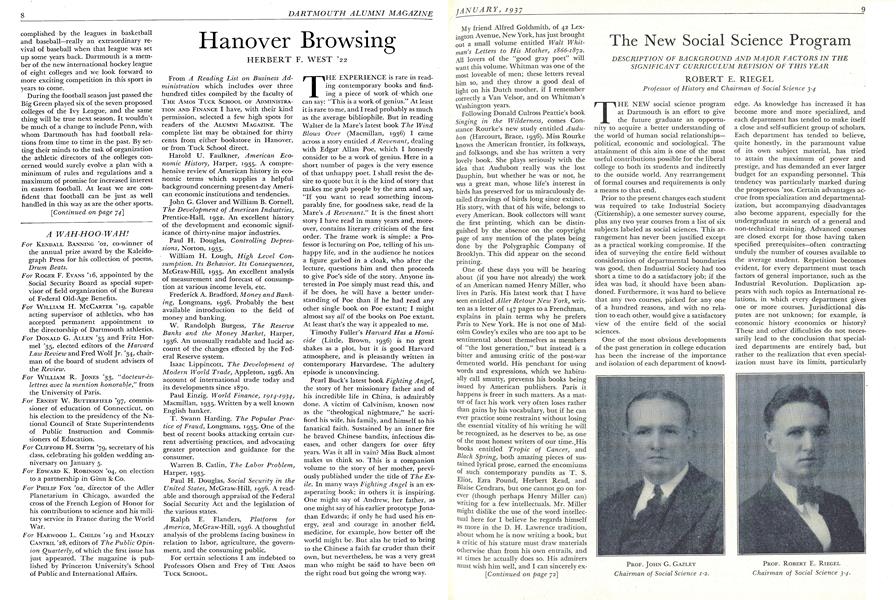
PROF. JOHN G. GAZLEYChairman of Social Science 1-2.
PROF. ROBERT E. RIEGELChairman of Social Science 3-4
(Left) Charles N. Haskins, professor of Mathematics on the Chandler Foundation; (center) George C. Wood, professor of Italian, chair-man of faculty committee on educational policy; (right) John B. Stearns 'l6, professor of Greek and Latin and Junior class officer.
(Left) Charles N. Haskins, professor of Mathematics on the Chandler Foundation; (center) George C. Wood, professor of Italian, chair-man of faculty committee on educational policy; (right) John B. Stearns 'l6, professor of Greek and Latin and Junior class officer.
(Left) Charles N. Haskins, professor of Mathematics on the Chandler Foundation; (center) George C. Wood, professor of Italian, chair-man of faculty committee on educational policy; (right) John B. Stearns 'l6, professor of Greek and Latin and Junior class officer.