Gradus Ad Pamassurn
ECHOES OF THE cause celebre of Harry Gates are still ringing. At its height, when newspapers throughout the land were headlining the case, a few anonymous letters were received by administrative officers in Hanover. One of the epistles that we happened to see decried "this latest in a long series of cheap publicity stunts."
A communication addressed to the President that can be taken more seriously follows:
"If the dean of your 'college' runs ahundred miles for a punch-drunk quarterback, how far would you go for two topnotch halfbacks and a roving center?
"Yours in football, "AMUSED."
For the information of "AMUSED" it could be pointed out (but it would doubtless make slight impression) that in its attitude toward athletes the College operates upon the same basis as it does toward any one else. It is apparently a pretty difficult thing to get any acceptance of belief on the part of the public that the College is equally scrupulous against any form of favoritism being shown to an athlete or any attitude of discrimination taken against him.
President Hopkins has said again and again, in discussing this matter with alumni, that practically all of his convictions in regard to intercollegiate athletics could be boiled down into the formula that eligibility should consist of "a college student incidentally participating in athletics instead of an athlete incidentally attending college."
If "AMUSED" bespeaks any general public sentiment it might be well to point out that the distance the Dean would go to keep a college athlete from mistakenly abandoning his college course is the same distance he would go, and has oftentimes gone, to prevent undergraduates whose names mean nothing to the public from presumably subjecting themselves to longtime regrets over impulsively taken action.
This attitude toward undergraduates, and instances of the kind that have been in this case highly publicized, are distinguishing qualities of a good Dean.
ANOTHER ANONYMOUS communication (but we know who wrote it) has come in, as follows: Dear Sir: Re: Editor's Note in November issue, ALUMNI MAGAZINE.
Any dope can read about shooting apartridge.
We have no defense. Any dope could also write about shooting a partridge. But could any dope shoot one? The guy who wrote that editorial note commending Kenneth Roberts' Trending Into Maine has spent much more time this fall trying to shoot partridges, than he has in reading or writing about it. And with about equal success.
CAN THE President of the College take a leave of absence? Apparently not. To term what little time off President Hopkins has so far taken as a "leave of absence" is a misnomer. Some other designation will have to be found to describe his schedule. Except for a too-brief sojourn at his place in Maine after the opening of College he has been in Hanover and on the job all the time.
If any alumni wondered what might become of the institution during the President's prolonged absence this year they don't need to worry. He has hardly been absent. If anybody has been concerned about his health take a look at the informal picture of him published in this issue, and take the word of his associates that he is just as fit as he looks.
So far as any worry about Prexy goes it should be along the line of whether or not he will actually use the vacation intervals that the trustees have urged him to take during this College year. If a trip on College business is a requirement how about a visit to the Dartmouth Alumni Association of Hawaii? or of South America? or Paris? And we can think of places where there are no alumni associations but which have other attractions.
ALL AMERICAN males are said to have the desire, at one time or another, to own a farm. Dartmouth men would, however, like to own a cabin. They do not yearn so much for livestock as they do for a log camp set in a grove of birches, pines, or spruces with a wide vista in all directions.
The specifications usually posted for a camp-site are: top of a hill (for the view) but with abundant water (for swimming and fishing); open slopes for skiing but thick woods and brush for hunting; a good dirt road to the door but an isolated back-country location; and also a nearby farmhouse for supplies.
The fact is there are a hundred locations for cabins within a few miles of Hanover that answer many, if not all, of the above requirements. One thing that is so far non-existent is a set of architect's plans (and estimate of expense) for the model or ideal cabin. Blueprints of this nature are not available to answer frequent requests that come to the Outing Club.
In collaboration with the D. O. C. the ALUMNI MAGAZINE invites entries in the cabin contest now under way. Alumni and undergraduates are eligible to submit 500-word descriptions and no-matter-howrough sketches of what they think the model cabin should be. The winners will be selected by a committee of distinguished local judges and suitable prizes will be awarded. Meanwhile we will keep on searching for that hilltop site with a never-failing stream flowing by the door.
SO FAR AS league championships, undefeated teams, and so forth go we refer you to the year 1937-38. Athletically Dartmouth had a marvelous record last year. Championships in football, basketball, skiing, hockey, baseball, and lacrosse, and the track team with dual meet victories over Harvard and Holy Cross, set an all-time high record in Big Green athletic history.
Director of Athletics McCarter expressed doubt earlier this year that athletic success would be comparable to last year. There is no longer any suspense about football. Cornell holds the mythical eastern "ivy league" championship by virtue of its good big team beating a good smaller team in a thrilling, hard-fought game. After 22 games without tasting defeat the Big Green met more than its match. The experts have written that in defeat the Dartmouth team appeared at its best. In defeat, Capt. Bob MacLeod and Bob Gibson and their plucky mates gave ground grudgingly to superior Cornell, up to the final whistle.
Coach Earl Blaik and his staff of able assistants can look back on every kind and variety of success during their four seasons of directing Dartmouth football: Yale was beaten for the first time (and not the last); the team was undefeated last season; this fall there have been victories over Harvard, Yale, and Princeton for the first time in one season; players of national fame have been developed. But more to the credit of the coaches than these or other accomplishments is the high standard they have set for themselves and the squad. It is a privilege for a boy to come within the scope of their important work in the College.
THE ORDINARY seating capacity for the so-called large theater in the proposed new theater and auditorium plant is about 900. By pulling back heavy curtains the floor and gallery seats can be increased to a total capacity of 2700—a large auditorium, large enough to take care of a Commencement audience or the opening of College exercises, or any other great gathering of students, faculty, and friends.
The Players gave two performances of "Brother Rat" at the house-party show early last month. Webster Hall was well filled on both nights. In spite of all the handicaps, discomforts, and inadequate equipment as a theater, both" the audience and members of the Players cooperated to make the performances successful, and one more mark of high credit for dramatics in the College. When the curtains are drawn across the rear half of the auditorium in the proposed new Webster Hall there will be about 900 comfortable seats available for an audience to watch performances presented on a stage equipped to the last word with modern facilities of the theater. It is apparent that at least this number of persons, if not more, will support the first rate efforts of the Players.
When one adds to the fine work of the Players the many other activities that will be centered in the huge structure, its usefulness and significance is better appreciated. There will be life there—concerts, lectures, movies, mass meetings, local talent nights, recitals, musical and dramatic rehearsals, language club plays, fraternity plays, Experimental Theater shows, community gatherings, and the academic occasions at the beginning and ending of the College year for which no adequate space exists.
If it becomes possible to go ahead with construction there will be a place where the entire college can gather at one time, where the unity and wholeness of the student body can be seen and felt.
None of us have to be convinced of the need for the building.
IF AND WHEN financing of the theater and auditorium plant can be solved, another and different and very promising use of the building is in prospect. The Dramatists' Guild, as announced in these pages some weeks ago, will plan and operate a Summer Drama Festival of national importance. Here is a use for the proposed new plant that adds one more, and an impressive, item to the list of requirements that will be met when it is available.
Nothing short of a revival and a revitalization of the American drama is visualized as the result of the type and scope of Drama Festival being planned by the Guild. The leading playrights of the country, headed by Robert E. Sherwood, president of the Guild, are proving themselves to be practical in the theater this season. They not only write the best plays but they produce, direct, and manage them. They are the keystone in the American theater. When they talk about a Summer Drama Festival in Hanover of unprecedented scope and importance, they mean just that.
Write down another and pressing need for the new Webster Hall.
THERE WILL be no campaign among the alumni to secure the building fund of a million dollars. Basil O'Connor '12, chairman of the special committee charged by the Alumni Council with the responsibility of attempting to secure funds to meet this need of the College, looks to the alumni to help, as individuals may be asked to help, and to volunteer. He has always stood ready to do more than his full share for Dartmouth and in this instance he is undertaking a difficult task of the greatest importance to the College.
TWO OF THE alumni have written in deploring the use of the heading "Publications Control?" in the October issue of the MAGAZINE when the report of the Student Publications Committee was reviewed. A more accurate two-word headline for the article would have been "Publications Responsibility?" For the central issue in the discussions is the question of where shall responsibility for the student publications rest.
The statement on the matter prepared by President Hopkins and presented to the Board of Trustees is published in this issue in full. The President focuses attention on the all-important question of where shall responsibility and proprietorship of the publications be located.
He says: "It is, in my belief, desirablethat there be a proprietorship somewhereoutside of any one of these annuallyelected editorial boards to which theboard should report and to which itshould be accountable. Whether, however,this should be in a trustee such as is suggested by the Committee, or in a facultygroup, or in an undergraduate organization, or in the Alumni Council, or in theBoard of Trustees of the College, or possibly in a composite group from part orfrom all of these, neither the membersof the Committee nor I are greatly concerned. It seems to me that the fundamental fact of responsibility cannot beestablished except on the basis of recognition of the proprietorship outside of therapidly changing group of undergraduateeditors who no sooner become accustomedto the demands of their work than theya few months later are called upon to layit down."
Reference of the controversy to a threeman board of arbitration to which Dean Strong and Editor Boldt '39 have already been named is the current status of the matter.
Observation in this corner is that everyone connected with the College—students, faculty, alumni, and friends of the institution—want to give full emphasis to student initiative. But in all undergraduate activities there is an obligation for responsibility, and it is an important obligation in the case of student publications.
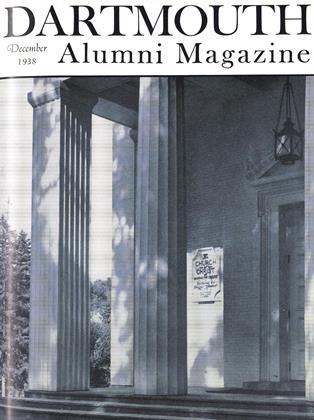
THE COVER illustration this month is from a photograph by Ralph Sanborn '17. It shows the portico of the Church of Christ, better known locally as the White Church. The new and handsome building is located on College Street, opposite Steele Hall. The adjoining Parish House is a busy community social center with affairs held there ranging from square dances to meetings of the Hanover Women's Club. It also has something of the academic flavor, being the headquarters of the nursery school and kindergarten.
The handsome name-plate on the church, as shown on the cover, was handcarved by F. E. Austin '95, and is his gift to the church.
A WAH-HOO-WAH!FOR HAROLD K. DAVISON '15 (R), elected to the Governor's Council in New Hampshire. FOR JOSEPH E. TALBOT '22 (R), elected State Treasurer of Connecticut. FOR WHITNEY H. EASTMAN '10 of Milwaukee, chosen vice president of the Archer-Daniels-Midland Co. FOR DR. EDWARD j. O'BRIEN who now has a son in every class in College. FOR DR. M. T. HOERNER '26 of Dayton, Ohio, recently awarded a research prize of $500 and membership in the American College of Surgeons. FOR JAMES M. LANGLEY '18, appointed chairman of the World's Fair Committee for New Hampshire. FOR FORREST BROWN '92 whose 45th year as high school headmaster was celebrated in Amesbury, Mass., on his 70th birthday, Nov. 7. FOR OWEN A. HOBAN '99 (R), reelected District Attorney of Worcester (Mass.) County.