1920

Once the proud claimant of three college presidents in its ranks, 1920 now has only Sam Stratton of Middlebury to carry the torch of administrative prestige all by himself. But the class, from the bottom of its heart, wishes Honorary Member Ernest Martin Hopkins many years of well-earned rest and happiness in retirement.
As happier days dawn for the world in general, we are especially anxious to keep the record straight on the '20 men in uniform, now mostly somewhere along the route of return to civil life. Mel Merritt, for example, is back in Boston with F. S. Moseley & Cos. Retiring July 9 with rank of full Commander, he had been serving as commanding officer of the Naval Auxiliary Air Training Command at Mayport, Fla. Fighter pilots were trained there for operations both from land and from carriers. Mel jtsed to see something of Commander Jake Gorton, CO of the Banana River Station; on occasion they bent an elbow together.
The rapid rise of Bob Dow is one of the best possible indications that his military branch is aptly named Army Air Intelligence. Bob is now a Major, has been since February last. "Nothing ends more rapidly," he writes, "than actual war. Instantly the doldrums set in, welcome of course. But this fiddling about, picking up the pieces, writing history, etc., is not too palatable, especially for those who have long been over." There is implication in his letter of a possible 1945 return home, because he says, "There's an outside chance I might get to read It (the 25th Report) before an- other snowfall." But sometime later Bob was reported en route through New York (by his own wish) to an assignment in the Far East.
Meanwhile, Laddie Myers, like Charlie Crathern and Hib Richter, is already back in our midst. Writing in July from an air force assembly point in Sioux Falls, S. D., Laddie was about to move on to Texas, with early return to his Chicago business connection a likely prospect. Russ Jones, newest 1920 member of the Dartmouth Club of New York, stopped being a major and came back in February to civil life, where he got a big-sigh-of relief welcome from his old advertising firm of Newell-Emmett.
Peg Johnson, whom Frank's friends will all remember, has turned out to be the best possible source of information on San Palo. Giving us the dope, which was not available for the 25th Report but properly belongs therein, she wrote: "I think I can tell you the following without disclosing any military secrets or giving aid and comfort to the enemy. In the early summer of 1943 we saw quite a lot of the Palos and San had just then returned from Ireland where he was training Paratroopers. For the past six months (as of May 24) he has been studying Japanese and has been able to master the language. Charlotte is back here in Buffalo and San is awaiting orders at an undisclosed point for an undisclosed destination."
Captain Hal Clark of the Navy sounded contented enough, writing not long ago from South Carolina. We have his word for it that he has been favored with perfect duty. "Here at the air base I can fish for bass 30 yards from my porch, play golf in to minutes, or get some Blended in two minutes fiat when 1 have leisure time, which is not too infrequent." But the most interesting part of Hal's letter is his reference to his wife Catherine, whose existence was unknown to some of his most intimate friends at the time the 25th Report went to press.
Through Major Tom Ainsworth we have a new address (350 Grand St., Newburgh, N. Y.), which is presumably the one he hopes to come home to. There is no indication that Tom is not still stationed at the General Hospital in Hawaii. He left for the South Pacific sometime last December was aboard ship on Christmas Day, 1944, in fact and put in some time at an Officers' Replacement Pool in New Caledonia. Thence in due course to his present spot. Believe it or not, they get out about twenty-five men for a dinner in "The Islands," the first Saturday of each month, and at one of these Tom and Pike Emory held an exclusive little 25th Reunion all their own.
Late in July Lieutenant Colonel Hib Richter was attending Judge Advocate's School at the University of Michigan and was still in the dark as to what might be coming next. Major Spence Snedecor made it known that mail would reach him at 207 South Valley Road, Colonial Heights, Petersburg, Va., which, it stands to reason, must be somewhere on the outskirts of Camp Lee.
There are two sad items of current news: Port Durkee, always remembered and respected as one of the quiet and substantial members of the class, passed away at his California home in July, after a long illness. Ray Moody's boy, Bill, was lost on Iwo Jima. Ray wrote thankfully and courageously about the letters of praise and appreciation received from his son's buddies and officers. Ray himself had some internal repairs made a while back; resumed work for the American Express Cos. last spring, but settled then in Albany (35 Chestnut St.) instead of returning to Port Henry. His daughter-in-law Nancy entered the Waves after her husband's death.
Sal Andretta's appointment as administrative assistant to the Attorney General of the United States was announced in early June. Queried on this promotion, Sal sent the good word: "I have been executive assistant to the Attorney General for the past six months and now I am the new Attorney General's Administrative Assistant, a position which I have always wanted. It is the same as an Assistant Attorney General's job except I have to handle all the business and financial operation of the Department, which is a sizeable task in an outfit of 30,000 persons scattered all over the country."
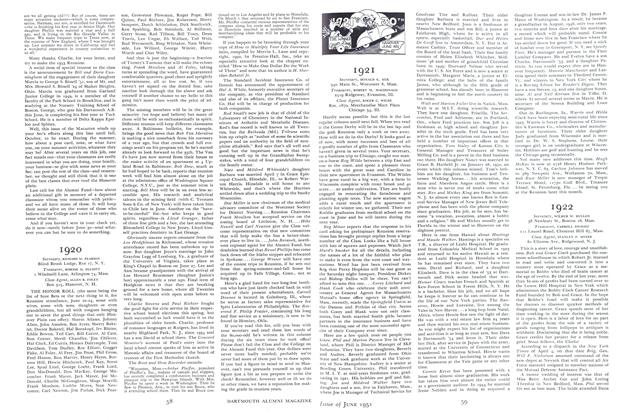
REUNION PICTURE OF 1920 finds some of the class with their families gathered on the lawn of the Hanover Inn. They met at the Inn in June for what in normal times would have been a gala 25th Reunion.
Secretary, Blind Brook Lodge, Rye, N. Y.
Treasurer, i Windmill Lane, Arlington, Mass.