1926
The gentleman from Buffalo to be presented herewith needs no introduction; so, by- passing the customary few thousand well chosen words, I give you the Chairman of the 20th Reunion Committee—Paul Venneman, who herewith makes his first report to the class on plans for an important event to be staged in Hanover next year:—"The Class Secretary and the Reunion Chairman attended a meeting at the Dartmouth Club together with representatives of the other classes on October 31 to discuss plans for class reunions in 1946. Don Cameron, who is acting as coordinator of the complex arrangements the College must make in order to permit of reunions for all classes who are due this year, as well as all classes who have missed reunions in the past three years, announced that '26's 20th Reunion is tentatively scheduled for July 25-28, 1946. Mark your calendar right now and lay plans for the biggest and best reunion the class has had to date. The first of a regular series of 20th Reunion notices will soon reach you and the chairman will appreciate some indication from all of you, as to whether you are planning to attend and whether you would be interested in coming back for a whole week, rather than just a week-end All suggestions that anyone may have will be welcomed by the committee."
It is said that pleasurable contemplation is good for the soul. What more potent soul medicine could we ask for than to contemplate the prospects of seeing old friends once again, and in the perfect setting of Hanover in the summer time? So lay your plans and be ready for the trek. One delegation already is 100% strong. Frank Poor writes, "You can count in the entire Erie '26 contingent for the 20th— namely Zaeder and Poor. Have convinced Ben he should attend one more reunion before he puts on the shrouds."
The annual fall 1926 dinner tor the New York brethren, held at the Dartmouth Club on October 26th, was attended by 26 men,, oddly enough. It was a good party, particularly so because o£ the presence of several guys who haven't been seen in these parts for many a moon. The roster comprised Lloyd Sanford, Jim Jenkins, Andy O'Connor, Fred Hurd, Snipe Esquerre, Charlie Bishop, Brant Wallace, Larry Kennison (on his way to Washington for release from the Navy), Tony Gleason, Harold Van Duyn, Art Wilcox, Bill Barclay (who stayed over in New York two extra days in order to attend and claimed no connection with cranberry bogs), Hank Merry, Charlie Singleton, Gordon Chipman, Bleeck Williams, Dick Mandel, Bob Cleary, George Scott, Chet Morton (who writes by-lined first page features for the New York Sun), Graham Ford, Ernie Stebbins, Jack Roberts, Carl Allen, Herm Trefethen (over from Philadelphia especially for the dinner), Hap Johnson and Bus Heydt, who was in from the west coast for a short visit and never looked better in his life. Telegraphic greetings and regrets at being unable to be on hand were received from Ed Dooley and Bill Farnsworth.
Another pleasant feature of the evening was the presence of a goodly number of '25ers who likewise were holding a class dinner. Ernie Stebbins gave us an interesting story of the work of the New York City Health Department, with its 3,500 employees and $8,000,000 budget. Ernie plans to leave his post as Commissioner of Health next summer to join the faculty of Johns Hopkins, where he will be professor of public health administration and assistant director of the School of Hygiene and Public Health.
A letter has come in from Holt McAloney which I only wish could be published in full Excerpts, however, are revealing:
After sending me to a flock of schools—Marine at Quantico, Army Air Force at Harrisburg and at Norfolk—I was moved to the West Coast as Air Liaison officer, and attached to the Fourth Marine Division. Our first show was the Roi-Namur landing in the Marshalls. I hit the beach at H plus six minutes which is all too early for a man of my age. The Saipan landing was plenty rugged—only about a third of us got to the O-one line that day. Then we had ten whole days before we left for Tinian, where again my regiment was elected for the assault landing. Fewer than 400 of what had been over 1000 of us sailed from Tinian. The landing on Luzon and the dash for Manila was a fabulous experience- 100 miles in three days, with almost every bridge blown up ahead of us, ambushes along the road, and wildly excited Filipinos shouting and waving flags in towns the Japs had fled from. Seven hundred of us of the First Brigade got in at dusk the first night (February 1) and fought our way to Santo Tomas prison by midnight. We found 3700 hysterical civilian prisoners there (and 80 Japs in one building, with machine guns), and also found that the rest of the Division was cut off from us and twelve miles away. So we rescuers were besieged in Santo Tomas for 24 hours.
Tack Titcomb ('32, later killed in action) and I were proud to say that two of the first three Marine Officers into Manila were Dartmouth men.
These are only the high lights of Holt's experiences. Now he is safely quartered at the Marine Corps School at Quantico.
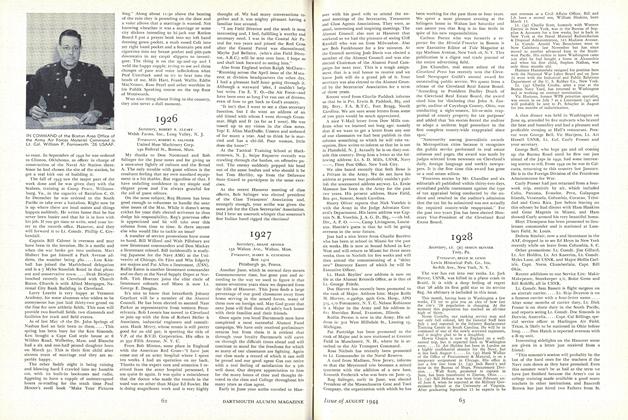
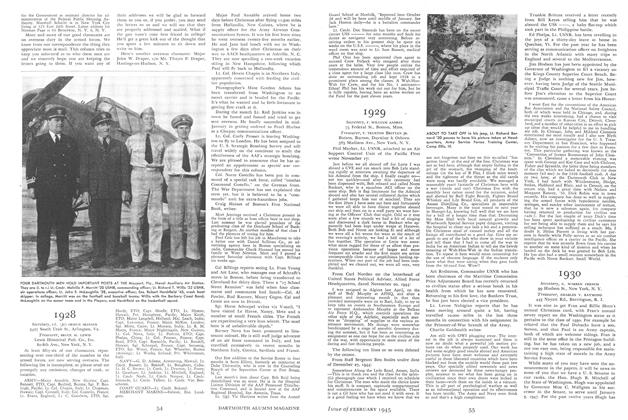
Too late for last month's notes, word came in that Clarence McDavitt has been awarded the Bronze Star Medal for exceptional service while acting as Officer of the Deck on his aircraft carrier. During amphibious operations against Okinawa, an enemy plane exploded on the flight deck. Mac took over the duties of the wounded steersman, brought the ship around in a tight turn, and thereby dumped the blazing plane into the sea. Another, and conspicuous, example of what men have done in their country's service. The picture herewith presents a less nerve-wracking moment for Mac.
And now, gentlemen, here is the report promised last month from Dick Mandel (R.F.D. No. l, Mt. Kisco,' N. Y.):-
"As of October 31st, thirty-three men have given $3,284.01 to the 1926 Memorial Fund, our 25th Reunion Gift to Dartmouth's endowment. Added to this is interest on the Fund amounting to $216.99, making a total of $3,501 deposited to our credit. Thirteen men have donated one or more government bonds to the "Trustees of Dartmouth College, a Corporation, Hanover, N. H." These range in value at maturity from $25 to $500, although cost value is used in the above total. Nine men are making gifts on an annual basis up to 1951, so that their gifts will be substantial and of a size they always wanted to give but could not at one time.
"The Class of 1923 has set a quota of $50,000 to be presented to the College at its 25th Reunion, and we will very likely aim at a similar target. One of the Quiz Kids could figure out that to raise $50,000, four hundred men would have to average $25 each every year .for the next five. We can break the existing record only if each man realizes that his support is essential. We cannot feel that the large gifts will offset the ones that didn't come in—it just doesn't work that way. To date each gift with interest accrued averages $106.09 and this will increase as annual gifts are received.
"Dartmouth is considered the most national college in the country and a beacon among liberal arts schools. The future student body will undoubtedly have a more international flavor than pre-war. The whole trend of DartMouth's educational policy will require more and more scholarships and financial aid to students. At least part of our gift will go toward this worthy cause."
A merry Christmas to you all!
TWO DARTMOUTH MEN MEET IN HAWAII. Lt. Clarence McDavitt Jr. '26 of the Navy and Basil O'Connor '12, Chairman of the American National Red Cross at the Dartmouth Hawaii Club luncheon given in honor of Mr. O'Connor on his inspection tour of the Red Cross facilities in the Pacific. Lt. McDavitt has recently been awarded the Bronze Star Medal for exceptional service described in the '26 Class Notes.
Secretary, Welsh Farms, Inc., Long Valley, N. J.
Treasurer, United Shoe Machinery Corp. 140 Federal St., Boston, Mass