1920
There's never a dull moment in 1920. The years pass, but the boys keep right on making their marks, reaping fame and fortune. Examples for the Month: Hal Bernkopf is the new general manager and executive director of Lamson Hubbard, Inc., of Boston; Jack Mayer, but recently ushered out of the Army, stepped immediately into the vice presidency of Distributors Group, Inc., 63 Wall St., New York; Kel Smith has been honored with the degree of Doctor of Science by the well-known Case School of Applied Science in Cleveland.
Remember when, if it wasn't a Lamson Hubbard, it wasn't a hat? Just that recollection would make Hal Bernkopf's new executive connection impressive. Formerly topshelf branch store manager for Filene's (where, incidentally, he began with men's hats) Hal is now officering two companies at once, because the new job applies also to the Brooklyn establishment run under the name of Balch Price. Hal is president of the board of trustees of Hecht Neighborhood House, vice president of Jewish Centres and a member of the Newton Citizens' Advisory Committee for returned veterans. His picture graced the pages of both the Post and Herald in Boston on March 23, when the news was released.
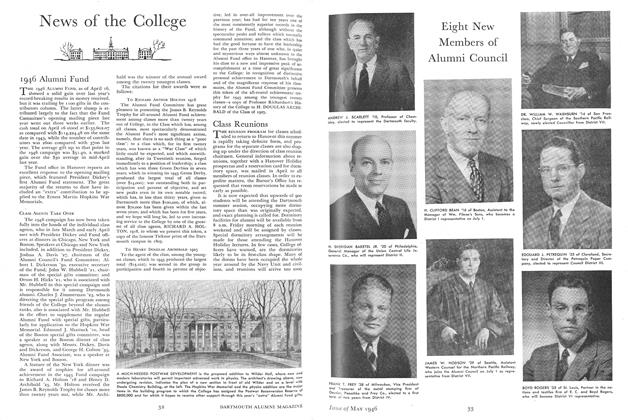
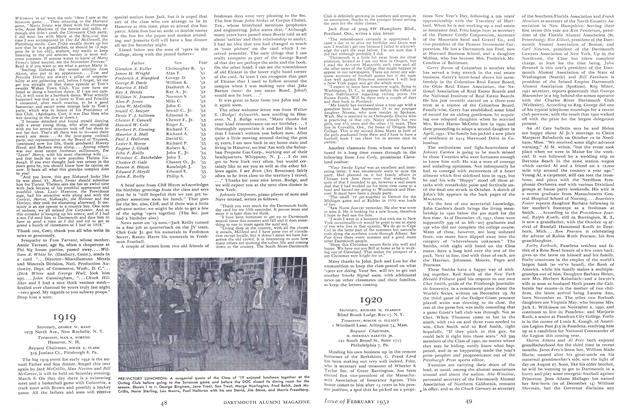
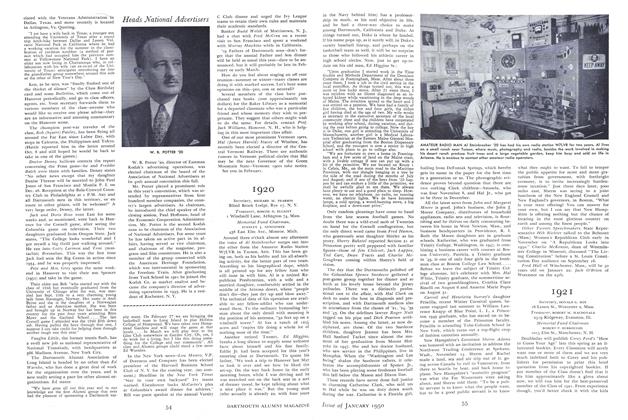
Jack Mayer left the Army a colonel, having commanded the 133 rd Anti-Aircraft Gun Battalion for 17 months in the European Theater. That stretch covered active campaigning in Northern France, .the Rhineland and Central Europe. Announcement of his return to Distributors Group and his election as vice president took place on March 6, accompanied by a gratifying dither on the financial pages of the New York papers. A neophyte—or a plain ignoramus—in the investment field would be hard put to explain exactly how Distributors Group operates. But Jack makes it perfectly clear that their management of Group Securities, Inc., extends to investors, large or small, the kind of diversified holdings that we have always associated with investment trusts. At the same time, under their guidance, you can specialize in automobiles, food, chemicals or almost anything.
The citation for Kel Smith's honorary degree, dated February 24, tells much that we have been wanting to know about his last 25 years. He took the B.S. degree in Chemical Engineering at Case in 1922; then went to work for Dow Chemical in Midland, Mich., where he immediately started applying himself ingeniously to running down new processes and developing them. Returning after a few years to his home town of Cleveland, Kel helped to organize the Lubrizol Corp., for the manufacture of special lubricants. From the beginning he has been vice president in charge of research, and under his leadership the Corporation has achieved top rank in the field of heavy duty lubricants. During the war a major portion of the heavy duty additives used for military purposes by the Allied Nations came from Lubrizol. To quote from the statement made as Kel was presented for his degree, "Many of the premium grade motor oils you will use in your cars in the next few years will owe their efficiency to him." President Wickenden of Case said, as he conferred the honor, "Albert Kelvin Smithson of a revered father and well-loved mother, you have added to this goodly heritage high attainment as a scientist, rare vision as a
research executive, and creative genius as an organizer of industry." Kel's father, Albert William Smith, was for many years head of the Department of Chemical Engineering at Case.
Conflicting reports about Clayt Wallace's recent movements have been conveyed to us by our Twenty paper. However, the Indianapolis News for February 22 straightens everything out, complete with portrait of a businesslike-looking individual whom it identifieas Clayton M. Wallace, "a member of the New Hampshire legislature, arriving March 1 to become superintendent of the Indiana AntiSaloon League." Clayton was the central figure at a reception held March 12, whereat initial strategy was mapped out for formation of the United Dry Committee, striving for enactment of a local option law. Back in his former home town of Wolfeboro, N. H., Clayt had been president of the School Board and president of the Rotary Club. He is secretary and member of the executive committee of the Anti-Saloon League of America.
Nobody eats more Dartmouth luncheons than Paul Richter. He gets around with tremendous energy, meets the boys, digs out the facts, and makes the secretary's life that much easier. Several weeks ago Paul reported on a meeting with Sam Stratton, who was said to be bearing up under the considerable strain of steering a college through the most critical of all times. Sam's modesty lets him add little to that, but he does announce with pardonable pride that he has joined the ranks of the class grandfathers. He adds that Al Stillman s daughter Nancy is one of his Middlebury College students, and so the Stillmans and Strattons see something of each other every so often.
It was likewise Paul Richter who formed the welcome-home committee to greet Major John Stickney, now returned to New York practice as a cardiac specialist in a new office at 155 East 73d St. John's promotion to major had not been heretofore noted. He spent his last year of Army life at Camp Shanks, Orangeburg, N. Y., where he was chief of the cardiovascular service. According to Paul he is heavier but otherwise much the same; appreciates the civilian blessings of life with his wife and eight-year-old son in Queens.
Charlie Mills, still in the Army and still in Europe, has moved up a couple of rungs on the military ladder and is now a lieutenant colonel. He sends a lovely postcard view of the Swiss landscape at St. Moritz: "On vacation, I attended the Rotary Club of Zurich as guest of Dr. Ludvig Farrer, former president of Switzerland, and am now up here in St. Moritz skiing and enjoying the winter sports. Will be returning to my duty as chief of the Rail Transportation Section of Berlin, Germany, district, A.P.O. 755, c/o Postmaster, N. Y. C." Another service promotion that calls for congratulation is that of Dick Hayes. "I'll be a civilian May 21," he writes. "The Army is letting me out a full colonel, but it's a hollow honor with no one but my wife to bark at."
Financial Report: On March 8, by word of Treasurer Elliott, the class was finally sunning itself in solvency, basking in a bank balance of $132.79. Something short of prosperity, this nevertheless represents an appreciated start toward a better credit rating than we've had for several years.
New Addresses: Ken Hardy, 11 Great Plain Ave., Wellesley 81, Mass Stan Munroe, 257 Wilcox, Joliet, 111.
Musts of the Moment: The Alumni Fund and the Hopkins War Memorials. Just leave enough in the till to get yourself and the family to Hanover, June 28-30.
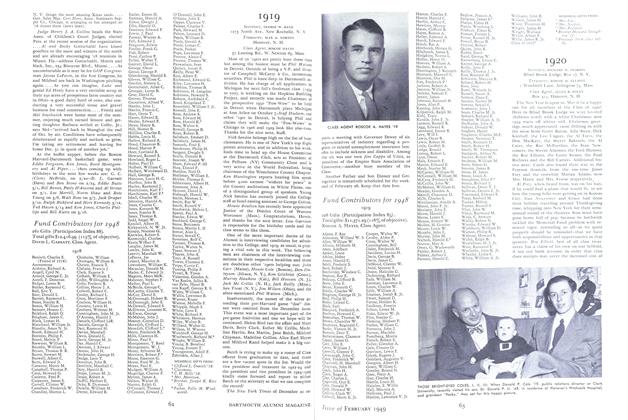
RECENTLY A COLONEL in the Army, John S. Mayer '20 has taken up his new work as vice president of Distributors Group, Inc., in New York.
TWO NINETEENERS at their 20th Reunion: Treasurer Max Norton (left) and President Jim Davis at Garden-Side, Lake Morey, in June 1939.
Secretary, Blind Brook Lodge, Rye, N. Y. Treasurer, 1 Windmill Lane, Arlington, Mass