The 1949 Valedictory
WE are Dartmouth's 180 th graduating class. Few classes from this college have included such a variety of ages and experience. Most of us had our education interrupted by service in the war; so that although we are indeed one class today, there are actually many classes among us. Like previous Dartmouth classes, we are not the products of one section of this country; we have come from every part of the United States, and indeed from many parts of the world. Our backgrounds and traditions are as diverse as the places from which we came, yet in a very real sense we are truly one group. For here at Dartmouth there have emerged from the interaction of our diversities certain unities of thought and purpose which will sustain us long after we leave.
Our common experience began on that day when each of us walked rather uncertainly into a dormitory and realized for the first time that we were part of this college. The realization of what it meant to be a part of Dartmouth was not to come so soon. But, as the autumns and winters and springs fled by, a sense of what Dartmouth is came imperceptibly upon us. Whether we have yet fully realized the meaning of Dartmouth we cannot say. But this we do know: that we have lived here in a relationship of man to man that few of us will ever experience again; and that relationship has grown and thrived because of the way Dartmouth has nurtured it. On that foundation a loyalty has grown to the College and to each other which did not exist four years ago. And forty years from now that loyalty will still be ours.
Yet Dartmouth exists for a larger purpose than the creation of loyalty to herself and among her sons. It is an institution of learning and its first task is the education of men. The loyalty of the sons of a college is sound only as it springs from respect and an awareness of how the college has fulfilled that purpose.
Today we receive a degree, which is symbolic of the education which Dartmouth has given us. In one sense what we do with that education is a personal matter. We know that for the choices we make and the individual purposes we follow we must answer to ourselves. But we have seen that there is another choice which we really do not have, and that is the choice between making use of our education and ignoring it. We have been educated as rational men, and it is not our choice but our duty to be rational men. I think that I can say that we as a class sense that duty more than many classes that have gone before us.
I think we also sense more clearly the areas in which it is vitally important that our trained powers of reason be exercised. We have come to realize that progress is not inevitable and that this thing called the American Dream is not a necessary outcome of an historical process. It can be achieved not by faith alone, but by works. Furthermore, we cannot escape the fact that in the realization of our democratic ideal lies much of the hope for the rest of the world. We must accept our responsibility toward the fulfillment of that hope.
This is the way Dartmouth has pointed out to us. We pray that we may follow it, and in so doing bring credit to our College and new strength to the cause of all men of good will.
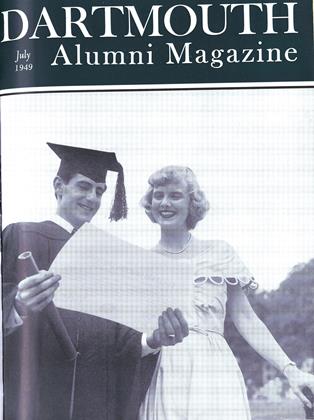
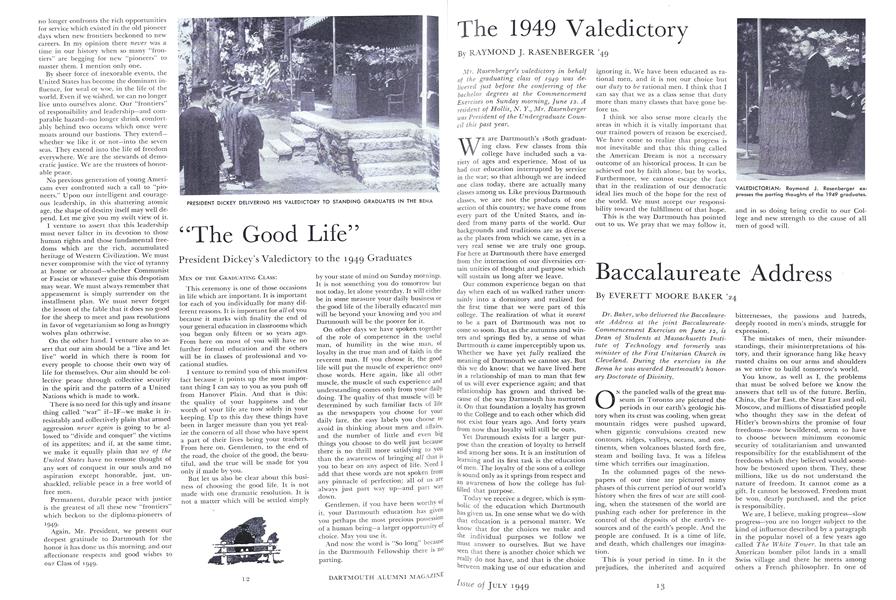
VALEDICTORIAN: Raymond J. Rasenberger expresses the parting thoughts of the 1949 graduates.
Mr. Rasenberger's valedictory in behalfof the graduating class of 1949 was delivered just before the conferring of thebachelor degrees at the CommencementExercises on Sunday morning, June 12. Aresident of Hollis N. YMr. Rasenbergerwas President of the Undergraduate Council this past year.