"To Promote Interest and Education in Art"
THE STORY OF ART at Dartmouth has not yet been written. Few Dartmouth men know much of the College art collection, largely, perhaps, because the collection is so new, but also, in part, because it is so old, and so taken for granted.
The purpose of this article is to shed some light, to spotlight the beginnings, to indicate some of the historical growth, and to floodlight the present scene. In describing the evolution of our art collection, it is necessary to speak of the history of the College, of some of its viewpoints and of some of its constructions. The Library, the Museum, and the Art Department are, of course, interwoven with the collection.
Our collection begins with the magnificent silver punch bowl delivered to Eleazar Wheelock in March 1773. This gift, the first object of artistic value to be received by the infant college, is a truly princely one, expressing the geniality and the generosity of his Royal Majesty's Colonial Governor, the Honorable John Wentworth, Trustee, friend and godfather to the young institution. The bowl is of the "monteith" type with a scalloped rim which will hold the glasses while they are chilled with ice-water prior to the mixing of the punch. It was made in Boston by Daniel Henchman and engraved by Nathaniel Hurd, two Yankee mastercraftsmen who were friends and competitors of Paul Revere. The American metal smith of the eighteenth century was a rare combination of artist, technician, and entrepreneur, who was laying a foundation, with his drawing and designing, his fabricating and processing, for the lusty young industries of the postwar days.
Returning to our bowl, Hurd's beautifully engraved inscription reads: His Excellency John Wentworth Esq. Governorof the Province of New Hampshire andthose Friends who accompanied him toDartmouth College the first Commencement in Testimony of their Gratitude and Good Wishes present this to theRev. Eleazar Wheelock D.D. Presidentand to his Successors in that Office. This silver monteith, the symbol of the Whee-lock Succession, and the witness of old world favor and new world skill, is one of the greatest treasures of our institution. In that same year, 1773, on August 25, the Trustees "voted that the thanks of this Board be given to the Honorable George Jaffrey Esquire for his generous donation of a Seal and Press to the Trustees of this College agreeable to their devise and inscription." Mr. Jaffrey, himself a Trustee, was footing the bill for the official College Seal which had been planned by President Wheelock and Governor Wentworth and executed on a steel die by the same Nathaniel Hurd who engraved our punch bowl.
In the next decade, a very interesting and valuable object was sent to our second President, John Wheelock, by a London business man, John Flude, friend and well-wisher to the College. This object is a ceremonial badge or jewel of gold and silver, four and three-quarter inches long by three inches wide, to be worn by the President on occasions of state. On its face, a group of figures illustrate the legend "Unanimity is the strength of society" and on the reverse there is the inscription: The Gift of John Flude, Broker,Gracechurch Street, London, 5th April,1785, to the President of Dartmouth College, for the time being at Hanover in theState of New Hampshire. Unfortunately, we do not know the designer or the maker of this finely wrought product of English eighteenth century craft. However, the badge remains to this day a bright and glittering part of the official paraphernalia of college ceremony.
Our collection of paintings has its origin in a vote of the Trustees on August 28, 1793, commissioning Joseph Steward, a Dartmouth alumnus of the Class of 1780, "to tSke a whole length portraiture of the honorable John Phillips LL.D. to be deposited in one of the public chambers of this University at the expense of this board; said Steward having agreed to do it at the price of twelve guineas including his expenses of travelling to and from Exeter for the purpose." John Phillips had just resigned after a long term of service as a Trustee of the College and so his fellow Trustees promptly voted "that the President be requested to transmit to the honorable John Phillips LL.D. a letter of thanks of this board for his attention to the welfare of this institution as a member of the board, and also for his munificence in contributing to its support and towards a foundation for support of a Professor of Divinity at this College," and that he "be requested to permit his portraiture to be taken at whole length for the purpose of being deposited in one of the public chambers of this University, that this board, the officers, students and others in future time may have opportunity to view the traits of the person who far beyond all others hath extended his liberality to this institution."
Today, this portrait hangs over the fireplace in the Periodical Room of Baker Library, where its forthright strength and dignity is indeed viewed and admired by "officers, students and others." In 1949 this picture was loaned to the Art Institute of Chicago lor their big exhibition, "From Colony to Nation." Mr. Frederick A. Sweet, Associate Curator of Painting and Sculpture, wrote, "We are delighted to have this painting for our exhibition and on examining it closely feel that it is even more distinguished a painting than we had remembered it." It attracted a great deal of favorable attention and Mr. Hans Huth, writing about Steward in Antiques Magazine for May 1949, said, "It seems now that John Phillips is Steward's magnum opus. In its unpretentious straight forwardness this is not only a remarkable likeness but a most ingratiating work." It is in truth a worthy memorial to Dr. Phillips whose generous labors in behalf of the education of youth (at And over and Exeter as well as at Dartmouth) are well summarized in his epitaph: "Without natural issue he made posterity his heir."
Along with the portrait of John Phillips, the Trustees also commissioned from Joseph Steward a full-length figure of Eleazar Wheelock, then deceased some 14 years. Steward had studied under Whee-lock and, remembering him with great admiration, agreed to paint the portrait at half his usual fee. Tradition says that he used a now lost miniature of Eleazai to aid his visual memory of the man, and there is an amusing early 19th century statement by Professor I. L Kingsley of Yale that "I saw that painted at Hampton, Connecticut, when I was fitting for college with Parson Ludovicus Weld who sat for the lower half of the picture.
Both the Phillips and the Wheelock portraits were delivered in Hanover at the Commencement of 1796 where they formed the nucleus, and probably for many years the sole examples, of the College collection of paintings. Both survive today in excellent condition and are priceless relics of our early history, as well as being quite creditable works of art.
As a painter, Steward is not of the same high rank as Copley, Stuart, Earl or Trumbull, but he is a better than average exponent of the new American realism in art. His pictures are somewhat stiff and naive, but these traits are compensated for by sincerity, honesty, and directness. He is our first alumnus artist and a most interesting all-around person.
He trained first for the ministry, and throughout his life he did much preaching, particularly in Hampton, Connecticut, where he long substituted for his ailing father-in-law, the Rev. Samuel Moseley, and also in Hartford at the First Church, where he frequently took the pulpit for Dr. Nathan Strong. His main vocation, however, was painting and this mostly in Hartford. His "painting rooms" were on the upper floor of Bulfinch's fine old State House where he advertised "to give entire satisfaction to those Gentlemen and Ladies who favour him with their patronage."
In the 18th and early 19th centuries, art and science were not separated in men's minds as they seem to be today. The spirit of inquiry, the careful observation and the creative manipulation essential to both were widely accepted and encouraged. Artists' studios accommodated so many specimens of natural history and such varied artifacts of archaeology that they became museums. Charles Willson Peale's studio in Philadelphia was the father of all American museums, both of art and of science. Joseph Steward's painting rooms in the Connecticut State House contained portraits of such celebrities as John Adams, Thomas Jefferson, Benjamin Franklin, and Buonaparte, first Consul of the French Republic, "a large elegant Historic Painting containing fourteen figures," wax-work statues, "several articles of dress and ornament from China," "a number of beautiful Birds and Animals from the Island of Japan," natural curiosities from the South Seas, an armadillo, a pelican, a penguin and a seal, spears, war clubs and airguns, several articles from the inland part of Africa, pieces of meteor, marine shells, and exact renderings of 180 American birds.
In Hanover, by the end of the eigh-teenth century, Dartmouth had acquired the creditable beginnings of a library (about 3,000 volumes), some scientific apparatus, such as an air pump, orrery, telescope, thermometer and barometer, two large globes, a set of twelve maps of New Hampshire, a collection of lava, many fossils, curiosities from India and from the South Seas, brought by Captain Cook (presented to the College by William Forsyth, keeper of Kensington Palace), a stuffed zebra and something vaguely known as "the great bird." All these items, with the meager portrait collection, were housed in Dartmouth Hall in either the library room, second floor center, or the museum room, third floor center. This latter room cut off the student living quarters in the north end from those in the south end and thus all visiting back and forth required arduous stair-climbing. Student irritation resulting from this impediment of art and science to social intercourse culminated in 1811 in an act of violence. An old French six-pounder cannon was carried to the third floor and the museum walls blown down, thereby nearly wrecking the whole building.
The Dartmouth College Case, successfully mencement of that year a happy one. Daniel Webster was present and received the grateful praise of the whole college community. In addition, the Trustees voted that all four of the College counsel, Mason, Smith, Hopkinson, and Webster, be requested to sit for their portraits and that the Treasurer was to pay the bill and to provide suitable frames. However, it was a very difficult time for the College financially, and nothing would have come of this vote if Dr. George C. Shattuck, 1803, one of the Trustees, had not taken it upon himself 15 years later to arrange for and finance the painting of the four portraits. Francis Alexander painted Webster and Smith, Chester Harding painted Mason, and Thomas Sully painted Hopkinson. They are all first-class portraits by leading artists of the day, similar in size, well framed, an excellent memorial to the men who saved the College from political bondage, and a tremendous addition to the then meager Dartmouth art collection. Alexander's Webster in particular, the famous "Black Dan" portrait, is a fresh and dashing presentation of our hero by an able follower of Gilbert Stuart.
In gratefully accepting these pictures from Dr. Shattuck, the Trustees at their annual meeting of 1836 voted that "whereas it is desirable to obtain correct likenesses of all the distinguished benefactors of the Institution wherefore Resolved that Dr. Shattuck be requested to sit for his own likeness to be taken by such artist as he may select at the expense of the board that the same may be kept in the Gallery of Paintings of this Institution."
This Dartmouth Gallery of Paintings was in Thornton Hall, the new brick building that had been erected directly south of overcrowded Dartmouth in the late 1820's. Art was now extricated from the natural history exhibits and the scientific apparatus and, although still in the orbit of the Muse of Literature, was achieving a measure of independence.
An especially interesting acquisition at this time was the gift by the fourth Earl of Dartmouth of a portrait of his grandfather, William Legge, the second Earl. This was a good copy by Samuel William Reynolds of the famous portrait by Sir Joshua Reynolds in the Foundling Hospital in London. The New York Mercury on July 8, 1829, carried the following item: "The Ship Cambria from London has brought out a full length portrait of William 11, Earl of Dartmouth, the founder of Dartmouth College at Hanover, N. H. This splendid painting has been presented to that institution by a grandson of the noble Earl, and at the request of the Corporation (of New York City) graced their banqueting room on the 4th, as the representative of one who was an early friend to our country, and is worthy to be remembered on its proudest anniversary. We understand that the cost
The portrait was exhibited publicly in New York and Hartford and one commentator said, "The merits of the execution, independent of all other considerations, drew golden opinions the veterans in paint, especially Col. Trumbull, say it's without a fault."
In the 1830's the second of our alumni artists appears, Albert Gallatin Hoit, of the Class of 1829. He must have set up as a painter almost immediately after graduation, because in 1831, he presented to the College his portrait of John Quincy Adams, sixth President of the United States. It is a very competent painting, remarkable for a 22-year-old artist, and one of the first portraits in our collection, the subject of which was not one of the College family. This portrait today is a bold but dignified adornment of Dean Neidlinger's office in Parkhurst Hall.
Mr. Hoit, during the 1830's, painted in Bangor, Belfast, and Portland, Maine, and in Halifax and St. John's, Canada. Later, he settled permanently in Boston, except for a two-year trip to Europe, 1842-44. After returning from Europe, he gave the College two Renaissance pictures, a 17th century Cavalier and his Lady, which he had purchased at the auction of the collection of Cardinal Fesch in Florence. He also painted portraits of three Dartmouth professors, two of which were gifts of graduating classes (starting in the 1820's and lasting into the 60's, there were many portraits of teachers given by student groups). In recognition of Mr. Hoit's achievement in art and his interest in the College collection, Dartmouth gave him a Master of Arts degree in 1845.
Of the professors of this time, it is interesting to note in passing that Benjamin Hale, Professor of Chemistry from 1827 to 1835, gave lectures for many years on "Civil and Ecclesiastical Architecture," and that of Daniel Oliver, Professor of Medicine from 1815 to 1837, it was written, "In the arts of painting and sculpture his information was liberal and his taste said to be excellent The beautiful in nature, in life, or in art or literature few men have so exquisitely enjoyed or so justly appreciated."
In 1839, Reed Hall was built and provided a spacious room on the northeast corner of the first floor for the art gallery; and here, for 45 years, the collection grew, overflowing into the nearby library rooms and even into other buildings. In 1869, when the College was 100 years old, some 70 portraits had been acquired, plus various other pictures, a few interesting daguerreotypes and early photographs, six sculptured slabs from Nineveh, and a number of marble and plaster busts (the best ones being of Daniel Webster, Rufus Choate, and Nathan Lord, all three by Thomas Ball of Boston).
In Mr. Ball's autobiography there is the following passage: "One honor that was paid me ... I must mention, as I have always been very proud of it. . . . Having been called upon ... to make a bust of President Lord of Dartmouth College, the work when finished in marble giving universal satisfaction to the students who paid for it, as well as to the College Faculty, and considering my successful statue and bust of two of their most eminent alumni, Rufus Choate and Daniel Webster, the honorable degree of Master of Arts was conferred upon me (1864)."
The Nineveh Slabs, which reached Hanover in December 1856, were a most unusual but highly valuable addition to the Reed Hall Art Gallery, and the story of how Dartmouth happened to get them is an interesting one. Oliver Payson Hubbard, Professor of Chemistry and College Librarian, stimulated by reports of the archaeological excavations near Nineveh, wrote to his long-standing friend, Rev. Austin H. Wright of the Class of 1830, who was a missionary in Persia, asking if anything might be obtained for Dartmouth. Mr. Wright, in turn, was a good friend of Sir Henry Rawlinson, British Resident at Bagdad and director of the excavations, and had no trouble in obtaining the gift of six very fine slabs subject only to the condition that Dartmouth pay the expenses of packing and transportation. This cost was assumed by the Trustees and the great slabs were cut into sections each of which was wrapped in heavy woolen felt, boxed, and then bound in another covering of felt. They were then transported 500 miles on camel back from Mosul to Iskanderoom on the Mediterranean and by sailing vessel via Beirut to New York. The Trustees, in recognition of Sir Henry's generosity, awarded him an honorary degree of Doctor of Laws.
The slabs depict the Assyrian King, Assur-nasir-apal, flanked by supernatural winged figures, and they formed part of a stone wainscoating eight feet high which ran around a large ceremonial hall in the King's palace at Kalah-Nimrud. They were carved in the 9th century B.C., in low relief and originally were touched with bright color. A special feature of the figure of the King is the delicately incised border of his robe depicting scenes of hunting and fighting. Today, three of the slabs are installed in the center gallery in Carpenter Hall and three are in Wilson Museum.
The place of art in the thought and life of Dartmouth in the middle years of the 19th century is an important corollary of the meaning of the growing art collection. This was the time (1852) when the modern, as distinguished from the ecclesiastical or classic, curriculum was first introduced. In the words of Mr. Abiel Chandler s will, "I give and devise the sum of fifty thousand dollars for the establishment and support of a permanent department or school of instruction in the college, in the practical and useful arts of life, comprised chiefly in the branches of Mechanics and Civil Engineering, the Invention and Manufacture of Machinery, Carpentry, Masonry, Architecture and Drawing, the Investigation of the properties and uses of the materials employed in the Arts, the Modern Languages and English Literature, together with Bookkeeping, and such other branches of knowledge as may best qualify young persons for the duties and employments of active life."
At the Centennial Celebration at Dartmouth (1869), this same note of the practicality of science and art was struck by the Hon. James W. Patterson, LL.D., in his address on the Relations of the College to Science and the Arts when he said, "The ancient masters of thought dwelt upon the subjective and aesthetic, and stigmatized the utilizing of knowledge, but the modern deal with the objective and practical and stimulate improvement by the application of science. A marble of Phidias refined and gratified the taste of Athens, but a steam engine revolutionizes the industry of the world, and with it the intellectual condition of man. Invention .... has bestowed upon the individual a power of accomplishment beyond the capacity of Herculean strength, and furnished the homes of the poor with the means of material comfort and intellectual enjoyment superior to the appointments of patrician palaces in the luxurious periods of ancient power."
The emphasis, as it should be, was on the socially useful, the ethical, the faith that art with science might make a better world for all. Also between the lines, masked somewhat by Yankee bluntness and fear of excessive aestheticism, there was an awareness of individual enrichment, through the arts, of intellectual and emotional enjoyment as a part of the educational experience to "best qualify young persons for the duties and employments of active life." At this time an editorial in The Dartmouth asked for instruction illart.
On June 25, 1884, there was the ceremonious laying of the cornerstones of Rollins Chapel and the new library, Wilson Hall. They were to be granite and sandstone structures, "useful and tasteful.... a bold and free rendering of the romanesque."
Rev. Henry Fairbanks, secretary of the building committee, said, "The beautiful structures commenced to-day and others that will follow them, the Art building and galleries that must soon come (they eventually came 45 years later), the increasing opportunity for the study of English Literature and Belles Lettres, and for training in English composition and elocution, soon to be provided, will furnish means for securing refined taste, elegance of scholarship, and facility of expression."
Rev. Alonzo H. Quint, speaking for the Trustees, added, "The upper floor (of Wilson Hall) will be given at present to the fine collection of portraits and other paintings rapidly accumulating, for which so much is due to our graduate and Trustee, Benjamin F. Prescott, late Governor of the State. But we doubt not that, before long, someone will affix his name to an Art Gallery totally distinct, and placed somewhere in our picturesque grounds, perhaps near our beautiful College Park."
The cornerstone of Wilson Hall was actually ence I now' place in position the cornerstone of Wilson Hall, which when completed, will be an ornament to this village, and will supply a want long felt by this institution as a place of safety to its works of art and its large and valuable library."
The upper floor art gallery was a large sky-lighted room below the (at that time romantically modern) exposed steel roof trusses. Here were assembled the pictures and statuary from Reed and other buildings and also some fifty new portraits gathered through the zeal and enthusiasm of Mr. Prescott. Among the best of these were John Wentworth, Class of 1836, and Edward F. Noyes, Class of 1857, both by G. P. A. Healy, and Ex-President James A. Garfield, by F. B. Carpenter.
At this same time, Edward Spalding, Class of 1833, of Nashua, N. M., gave the College a set of 59 large photographs of "the most artistic and remarkable painti ngs in the galleries of Florence, Italy." This is probably the beginning of our now large and very valuable collection of photographic and print material indispensable to art education.
Formal lecture courses on art appear in the nineties, classical art taught by George Dana Lord and Frank Gardner Moore, and modern art by Arthur Sherburne Hardy, a West Pointer, mathematician and Professor of Engineering at the Thayer School, another witness to the interaction of art and science. And at this time, landscape paintings were added to the collection, "Kefene Valley in the Adirondacks," given by the artist, Roswell Shurtleff, Class of 1857; and "Dartmouth Harbor, England, an early and significant work of Frederick Waugh, the very popular marine painter, given by Rev. John E. Johnson 66.
Two events in the early 19th century were of great importance to art at Dartmouth. laying the foundation for a much broader art collection and giving new life to the small and feeble art department.
The first of these happenings was the receipt in 1904 of the "Guernsey Center Moore Fund for Collections of Art.... to purchase objects of artistic merit and value, to be kept, exhibited and used by said Trustees of Dartmouth College to encourage and promote the interest and education in art of the students in said College. "It was not a large fund but nevertheless it was, and still is, of very great worth, for it provided for the first time an annual income with which the College could gradually build up the teaching equipment of objects of artistic value without which education in art is almost meaningless.
The Moore Fund was the gift of Henry Lynn Moore '77, Minneapolis banker, and a Dartmouth Trustee, in memory of his only son, Guernsey Center Moore, who died in Hanover in his sophomore year.
The second event of importance was the appointment of Homer Eaton Keyes '00 in 1905 as Assistant Professor of Modern (as opposed to Classical) Art. He was a sensitive, creative, genial, and very practical man and he moved with dispatch to build a strong foundation for instruction in art at Dartmouth. His point of view was a broad humanistic one, seeing art as a natural part of a full life, as a useful aid to discrimination, vision, wit and human understanding. He established courses in Medieval and Renaissance Italian Painting, in Renaissance Painting in the Netherlands and Germany, in French 19th century Painting, in the Principles of Art Criticism, and in the History of Architecture. He purchased two thousand photographs illustrating art history, added materially to the lantern slide collection, and started the art library. He arranged that all the activities of the art department should be centralized in new quarters on the top floor of the newly rebuilt Dartmouth Hall (following the fire of 1904). He also encouraged studio work in drawing and painting.
An unusual addition to our collection during this era was the gift of various artifacts and objects of ancient art from the Mediterranean Island of Cyprus, by Mrs. Emily Howe Hitchcock, widow of Hiram Hitchcock, Trustee from 1878 to 1891. Mr. Hitchcock had received this Cypriote art from his friend, General Luigi Palma di Cesnola, an Italian soldier of fortune, who had fought in ojur Civil War and, later, been appointed Consul in Cyprus. The gift included four very interesting limestone heads illustrating first Assyrian and then Greek and Roman influence on the art of Cyprus.
About the same time, Judge Horace Russell '65 gave the College a fine large painting by Frederick Remington, one of his characteristic hard-boiled Western subjects, "Shot-Gun Hospitality." This picture of good romantic realism has always been popular with undergraduates and now hangs in Thayer Hall.
Mr. Keyes was a graduate of the Class of 1900, and an instructor in English from 1900 to 1903. However, before coming to Dartmouth, he had studied art at Pratt Institute and, from 1903 to 1905, studied art in Europe where he also travelled widely. In J 913, when younger men had come into the art department, Mr. Keyes became Business Director of the College. He also served as Assistant Editor and then Editor of the ALUMNI MAGAZINE until in 1921 he left Dartmouth to found and edit the scholarly and highly successful magazine Antiques, at which post he remained until his death in 1938.
Under Mr. Keyes' successor in the Art Department, Prof. George Breed Zug, courses were added in American Painting, Photography, and the Graphic Arts, the Art of the Book, and City Planning. The Department moved to much larger quarters in old Culver Hall, the print collection and art library were expanded, and Miss Mildred Morse came from Brown University to be the first Curator and Art Librarian. Exhibitions of paintings and sculpture were planned on a more ambitious scale than heretofore, and from some of these, works of art were purchased for the College collection.
One such outstanding exhibition was that of original works by artists of the colony at Cornish, N. H., which was held in the Little Theater of Robinson Hall, in January 1916. The works of twelve sculptors, nine painters, two landscape architects, and various illustrators were shown, including pieces by such well-known artists as Augustus Saint-Gaudens, Daniel Chester French, James Earle Fraser, Frederick MacMonnies, Herbert Adams, Charles A. Piatt, Everett Shinn, Frederick Remington, and Maxfield Parrish.
In the years after the first world war many great strides were made by Dartmouth under the able leadership of President Hopkins. Baker Library and all that it stands for in the life of the College was one of these giant steps, and Carpenter and Sanborn were the accompanying armswings in the forward surge.
The Art Department, under the guidance of the older men, Arthur Fairbanks, George D. Lord, George Breed Zug, and the cooperative efforts of the present generation, John Barker Stearns '16, Artemas Packard, Hugh Sinclair Morrison '26, and myself, was enabled to build surely and swiftly in the twenties and thirties, because of a golden succession of benefactors.
First came the munificent gift of $50,000 from the Carnegie Corporation to secure a first class library of books and pictures on all the visual arts, both fine and applied. Then came the generous offer of Mr. Frank P. Carpenter of Manchester, N. H., of the funds to erect a building for the enhancement of the cultural aims of the College and specifically for the use of the Art Department. So in 1929 with the completion of Carpenter Hall, we had a home for the new Art Library, the extensive collection of teaching material, ample gallery space for exhibitions, lecture hall, classroom, and studio space in short, the long awaited art center of which Dartmouth had been dreaming for a half century.
A prominent artistic adornment of the new building was the Renaissance Mantelpiece from the Chateau of Chenonceau in France, given to the College by Robert Jackson 'oo of Concord, N. H. This handsomely carved oak mantel of the 16th century bears the initials and the salamander symbol of Francis the First and his Queen Claude and is a superb example of the decorative sculpture of the period.
The opening exhibition in the new Carpenter Galleries was a gala one with a group of Old Masters, loaned by Mr. Jackson, and "The Thames Series" of Whistler etchings, loaned by Mrs. John D. Rockefeller Jr. A feature of the new building was the studio space for practical work. To encourage the use of this on the part of the students, the Department arranged for a succession of visiting artists who came to Hanover for periods varying from a few days to many months. Among such artists were Mahonri Young, Thomas Benton, Julius B. Katzieff, Charles H. Woodbury, and Lauren Harris.
Among the gifts of this time were four portraits of prominent Dartmouth teachers, Charles Darwin Adams, Charles Franklin E merson, Craven Laycock, and Charles Francis Richardson, all four the gift of the Class of 1902, in 1929. The Adams and the Laycock are by Sidney E. Dickinson, and the Emerson and Richardson by Blanche Ames. Thomas C. Colt Jr. '26 gave, in memory of Professor Herbert Darling F oster, a fine painting, "Barns and Silos," by the American artist, Charles Rosen. Mr. Colt later became the Director of the Virginia Museum of Fine Arts in Richmond. Mrs. Maribel Pratt, wife of Elon Graham Pratt 'O6, gave 55 Egyptian amulets, magical talismans worn by ancient and fearful citizens of the Nile valley.
Miss Emily Sargent and Mrs. Francis Ormand, daughters of the American painter, John Singer Sargent, gave the College, in 1930, ten large drawings by their illustrious f ather. Just recently these were part of a fairly large and important exhibition of Sargent's work in the Carpenter Galleries.
Fresco painting on large walls is one of the great traditional techniques of visual presentation practiced all through the Middle Ages and Renaissance and culminating in the great Sistine Chapel paintings of Michelangelo. Most American students, however, have no direct experience with this way of painting, even though it has been vigorously revived in modem times in Mexico. Therefore, the Art Department was most happy to assist in bring- ing Jose Clemente Orozco to Hanover in 1932 for the start of his great mural project in the fresco technique in Baker Library. The Trustees gave Senor Orozco a faculty appointment, and for two years his fresco painting, publicly executed, constituted a sort of visual lecture-demonstration series in one phase of contemporary art. Whatever o ne's personal opinions or taste may be in relation to this project, it was a most stimulating one for the Dartmouth generation which saw it in process, and it has brought considerable renown to the College in the outside world. Visitors come from distant places in surprising numbers to see it. Articles have been written about it in practically every language of the globe, and the Dartmouth Publications booklet about it has gone through three editions. Certainly the frescoes are a major exhibit in the College art collection.
In 1935, the largest single gift of works of art ever to come to the College was presented by Mrs. John D. Rockefeller Jr. One hundred and nineteen items, mostly contemporary American paintings, but including some 18th and 19th century folk art, some twenty paintings by American Indians, a 19th century American masterpiece, the "Portrait of an Architect" by Thomas Eakins, and two fine pieces of European sculpture by Charles Despiau and Georg Kolbe. Among the modern Americans were representative examples by the following artists: George Ault, Peggy Bacon, Gif Ford Beal, Alexander Brook, Stuart Davis, Charles Demuth, Emil Ganso, George ("Pop") Hart, Bernard Karfiol, Luigi Lucioni, Joseph Pollet, Max Weber, and Marguerite Zorach. Outstanding in this group were "Donita Ferguson" by Brook, "Nude" by Karfiol, and "Cubist Portrait" by Weber. This collection, rich and varied, and, reflecting as it did the tolerant, perceptive and invariably sure taste of its donor, was exactly right for the needs of the Art Department. This was above all a teaching collection, works to be examined closely in the classroom or studio, or enjoyed at leisure in the gallery. These objects of art have had greater use than any other group in the College collection.
Also, in 1935, a Graphic Arts Print Shop was set up in the basement of Baker Library, and here under the genial leadership of Ray Nash, a true amateur of prints and printing, many a Dartmouth student has found pleasurable and profitable experience in the problems and processes of this important field of art.
In 1938 our studio activity in drawing and painting was aided tremendously by the appointment of one of America's leading artists, Paul Sample '20, as Artist-in Residence. Mr. Sample conducts classes in sketching and life drawing and is available to all students for guidance and criticism in their creative work. Each year an exhibition of the work of Mr. Sample's classes is held in the Carpenter Galleries and they are very popular and worthwhile shows. Mr. Sample has given to the College in memory of his brother, Donald M. Sample '21, two of his very fine oils, "Beaver Meadow, Vermont," and a portrait of his Vermont neighbor, "Will Bond." He also gives all his preliminary drawings, sketches and color studies to the College for preseration in Baker Library.
An example of how good fortune snowballs took place in 1938. Mr. William Preston Harrison, of Chicago and Los Angeles, former editor and publisher of the ChicagoTimes and an art collector of considerable standing, happened to drive through Hanover Pleased with what he saw, he later wrote from California offering us some pictures by French and American moderns. A most happy relationship started between Mr. Harrison and the Art Department which continued until his death in 1940, and during that time he gave to the College 32 pictures in various media, oil, watercolor, drawing, lithography, etc. Among the French artists represented in the group were Andr6 Derain, Jean Lurcat, Kees Van Dongen, Andre L'Hote, Paul Signac, and Jules Pascin; among the Americans, Kenneth Hayes Miller, John E. Costigan, George Bellows, Maurice Prendergast, Mary Cassatt, Walt Kuhn and Yasuo Kuniyoshi. This fine gift of Mr. and Mrs. Harrison has been an excellent supplement to the Rockefeller nucleus.
In 1940 a still further addition came to the College collection from A. Conger Goodyear of New York, a distinguished patron of art and President of the Museum of Modern Art from 1929 to 1939 This gift comprised eight French and two American drawings, some with color, and was offered because Mr. Goodyear felt that Dartmouth "has done very fine work in interesting students in the arts" and because
"one of my objects would be to interest others in giving to institutions that might be glad to have such works." Especially fine in the Goodyear group are "The Boardwalk" by George Bellows, "Man with a Wheelbarrow" by Marcel Gromaire, "Bar by Andr£ de Segonzac, and "Mme. Modigliani" by Amadeo Modigliani.
A major event in this same year, 1940, was the receipt of a bequest from Julia L. Whittier of South West Harbor, Maine, of a fund, the income of which was to be expended "for the purchase of works of art for the department of Fine Arts in Dartmouth College." This was the first help of this sort since the Moore Fund gift of 1904, and was most welcome as it more than doubled our purchase resources.
In the decade in which the Whittier Fund has been available, some very fine additions have been made to our collection, most important of which, perhaps, is a group of three oils, one drawing, and three etchings by John Sloan, the dean of living American painters.
In the field of prints we have been especially fortunate in the current decade, for in addition to such prints as came along with the gifts, primarily of drawing and painting, already mentioned, there have been also notable gifts entirely, or almost entirely, in the field of fine prints. In 1940, Mr. Phillip Hofer, Curator of Graphic Arts at Harvard, gave us two Goya etchings. In 1942, Mr. Robert Burnap '94 gave us seven English sporting prints. Also in 1942, Mr. Hamilton S. Foster of Reading, Mass., father of Alan S. Foster '45, gave a print by Thomas W. Nason, and in 1943, a "Crucifixion" by Diirer. In 1945, from the estate of Harry E. Burton, Professor of Latin at Dartmouth for half a century, came a large group of 17th and 18th century Italian prints, mostly of classical subjects and including some good Piranesis. In 1948 and 1949, Dr. F. H. Hirschland of New York, the father of two Dartmouth sons, Richard S. '35 and Herbert E. '39, gave the College approximately 100 prints, excellent examples of every century and almost every school of printmakers: woodcuts, engravings, etchings, and lithographs from the 15th to the 20th centuries.
In this year, 1950, an exceptionally fine group of 50 prints has been given to the College by Helena W. Wade of New Canaan, Conn., in memory of her husband, Alfred Byers Wade. This collection includes eight Diirers, two Schongauers, eight Rembrandts and nine Whistlers. The accumulation of these prints has added greatly to the effectiveness of study in both Art History and Graphic Arts courses. Furthermore, the frequent exhibition of such material brings visual knowledge and enjoyment to the whole Hanover community.
Among other quite recent gifts to our collection should be mentioned the large oil painting, "Harlem Loge" by Miss Ilse Bischoff of New York and Hartland, Vt. In addition to her own work, Miss Bischoff has given another oil, "Street Fight" by Jared French and a group of drawings and etchings by Paul Cadmus. Mr. Sanford Ross of Rumson, N. J., and Pomfret, Vt., has given a fine drawing by Gaston Lachaise and an etching by Segonzac. The Boston Society of Independent Artists has given an oil, "Cinderella's Coach" by Eleanor Treacy, and a large colored lithograph, "Bellingham Place" by Richard C. Bartlett. The American Academy of Arts and Letters has given a gouache by William Brice entitled "Dead Roses."
It is an aim of the Art Department to acquire representative examples of the work of alumni artists and a fair start has been made in that direction. We have two fine oils by Russell Cowles '09, two oils and one watercolor by Paul Sample '20, a watercolor by Herbert Faulkner West '22, a watercolor by Stuart Eldredge '24, three drawings by Abner Dean '3l, an oil by Dantan Sawyer '33, a watercolor by Robert Hodgell, V-12, 1943, and twro oils by Peter Michael Gish '49. Further gifts in this group will be much appreciated.
Among recent purchases by the College a few pictures that are of special interest are Eastman Johnson's portrait of "George Fisher Baker," Abraham Rattner's "Village Landscape," Preston Dickinson's "River Scene" and Sanford Ross' "Into Pittsburgh."
The present Art Library in Carpenter Hall, under the able jurisdiction of Miss Maude French, contains 17,000 books and pamphlets and, without doubt, is one of the best undergraduate art libraries in any American college. Across the hall in our Print Room, Miss Mildred Morse is Curator of a large collection of teaching material. There are 25,000 lantern slides and 15,000 photographs and color reproductions. Also in the Print Room, of course, are many sub-groupings of the varied graphic arts collection. There is a very complete collection of the woodcut magazine and book illustrations by Winslow Homer, and an interesting collection of Early American Advertising Art, such as posters, trade-cards, booklets and catalogues. Both of these collections, and also one of Lithographic Music Covers, have been built up with the aid of the Jesse Appleton Fund, a library fund given in 1939 especially for the graphic and applied arts.
In summary, our collection, after small but good beginnings, has grown slowly and sporadically to the present varied and fairly impressive state. We have a priceless piece of Colonial silver, some fine portraits of the first decades of the Republic, and a representative group of Modern American paintings. We are woefully weak in European art and we have no examples of many great periods of art history. Such works, of course, are very expensive and perhaps should be only in large urban museums, although it is true that some of our sister institutions do have them. We should build, probably, to our strength, which is American art, at least in the main, and with due consideration to our quite limited funds.
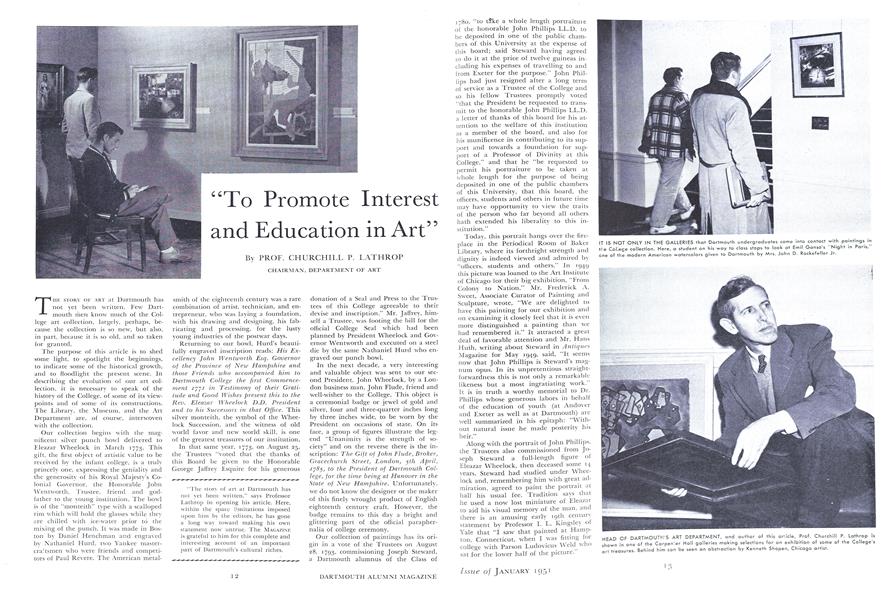
IT IS NOT ONLY IN THE GALLERIES that Dartmouth undergraduates come into contact with paintings in the College collection. Here, a student on his way to class stops to look at Emil Ganso s Night in Paris, one of the modern American watercolors given to Dartmouth by Mrs. John D. Rockefeller Jr.
HEAD OF DARTMOUTH'S ART DEPARTMENT, and author of this ariicle, Prof. Churchill P. Lathrop is shown in one of the Carpen!er Hall galleries making selections for an exhibition of some of the College's art treasures. Behind him can be seen an abstraction by Kenneth Shopen, Chicago artist.
THE NINEVEH SLABS, acquired in 1856, are from the palace of the Assyrian King, Assur-nasir-apal, and were carved in the 9th Century B.C.
THE FORMER ART GALLERY on the top floor of Wilson Hall shows the extent to which oil portraits mode up the College collection 60 years ago. Francis Alexander's famous "Black Dan" portrait of Dame Webster can be seen seventh from the left in the middle row of paintings hanging on the wall.
MCDcRN OIL: "Dcnita Ferguson" by Alexander Brook is in the College's Rockefeller Collection.
"WHITE SAILS" by Edmund Lewandowski is a con- temporary American watercolor now in Carpenter.
ALSO GIVEN BY MRS. ROCKEFELLER was the oil painting "Roofs" by the American, George Ault.
MAX WEBER, well-known American modern, is rep- resented in the collection by "Cubist Portrait."
: :€2LSctIL & A\ int COLOKI-UL OIL, "VILLAGE LANDSCAPE," IS BY ABRAHAM RATTNER
JOHN SLOAN'S "A ROOF IN CHELSEA" WAS PURCHASED THROUGH THE WHITTIER FUND
"COMPANY HOUSES" BY STEVAN DOHANOS, ALSO A WHITTIER FUND PURCHASE
PAUL SAMPLE '2O IS REPRESENTED BY "WHITE RIVER, TURN TABLE"
"The story of art at Dartmouth has not yet been written," says Professor Lathrop in opening his article. Here, within the space limitations imposed upon him by the editors, he has gone a long way toward making his own statement now untrue. The MAGAZINE is grateful to him for this complete and interesting account of an important part of Dartmouth's cultural riches.
CHAIRMAN, DEPARTMENT OF ART