1897
This month has rolled around with pretty much of a ding-dong bell kind of a race in my business with 773 homes transferred to new owners all in one day, February 16.
For 37 years I have been working to build up an institutional kind of approach to the problem of housing for working people, trying to prove that it is possible to have the force of domesticity reach the heart of workers and satisfy the pocket of the investors at the same time. February 16th this year gave me the answer which I wanted to have. I started on December 1, 1916, and the answer to this proposition is that the heart and purse are bound together by domesticity.
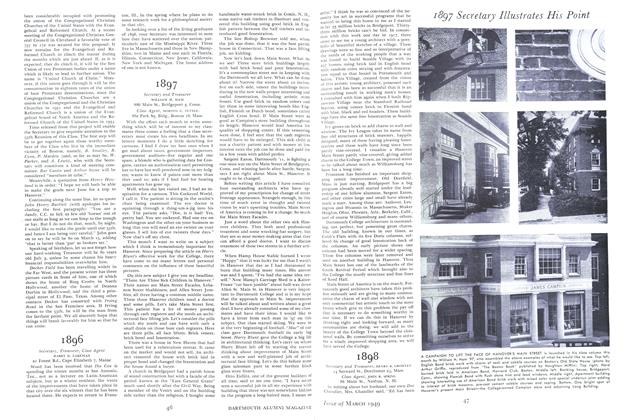
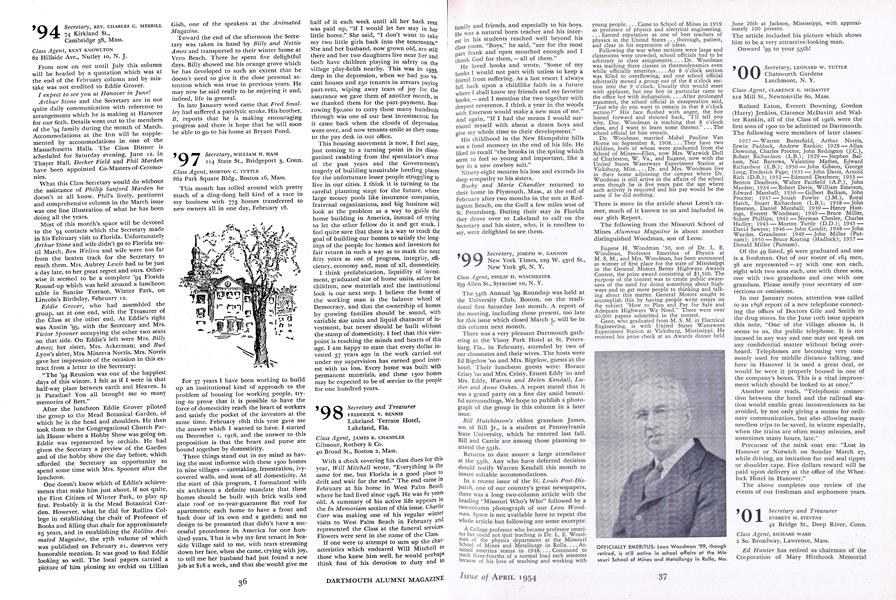
Three things stand out in my mind as having the most influence with these 1300 homes in nine villages - caretaking, fenestration, ivy-covered walls, and most of all domesticity. At the start of this program, I formulated with six architects a definite mandate that these homes should be built with brick walls and slate roof or 20-year-guarantee flat roof for apartments; each home to have a front and back door of its own and a garden; and no design to be presented that didn't have a successful precedence in America for one hundred years. That is why my first tenant in Seaside Village said to me, with tears streaming down her face, when she came, crying with joy, to tell me her husband had just found a new job at $18 a week, and that she would give me half of it each week until all her back rent was paid up, "if I would let her stay in her little home." She said, "I don't want to take my two little girls back into the tenements." She and her husband, now grown old, are still there and her two daughters live near her and both have children playing in safety on the village play-fields nearby. This was in 1933, deep in the depression, when we had 300 vacant houses and 250 tenants in arrears paying part-rent, wiping away tears of joy for the assurance we gave them of another month, as we thanked them for the part-payment. Borrowing $30,000 to carry these many hundreds through was one of our best investments; for it came back when the clouds of depression were over, and now tenants smile as they come to the pay desk in our office.
This housing movement is now, I feel sure, just coming to a turning point in its disorganized rambling from the speculator's error of the past years and the Government's tragedy of building unsuitable herding places for the unfortunate lesser people struggling to live in our cities. I think it is turning to the careful planning stage for the future, where large money pools like insurance companies, fraternal organizations, and big business will look at the problem as a way to guide the home building in America, instead of trying to let the other fellow do it and get stuck. I feel quite sure that there is a way to reach the goal of building our homes to satisfy the long- ings of the people for homes and investors for fair return in such a way as to mark the next fifty years as one of progress, integrity, efficiency, economy and, most of all, domesticity.
I think prefabrication, liquidity of investment, graduated size o£ home units, safety for children, new materials and the institutional look is our next step. I believe the home of the working man is the balance wheel of Democracy, and that the ownership of homes by growing families should be sound, with variable size units and liquid character of investment, but never should be built without the stamp of domesticity. I feel that this view-point is reaching the minds and hearts of this age. I am happy to state that every dollar in vested 37 years ago in the work carried out under my supervision has earned good interest with no loss. Every home was built with permanent materials, and these 1300 homes may be expected to be of service to the people for one hundred years.
Secretary, 114 State St., Bridgeport 3, Conn.
Class Agent 862 Park Square Bldg., Boston 16, Mass.