Deaths
[A listing of deaths of which word has been receivedwithin the past month. Full notices may appear m thisissue or may appear in a later number.]
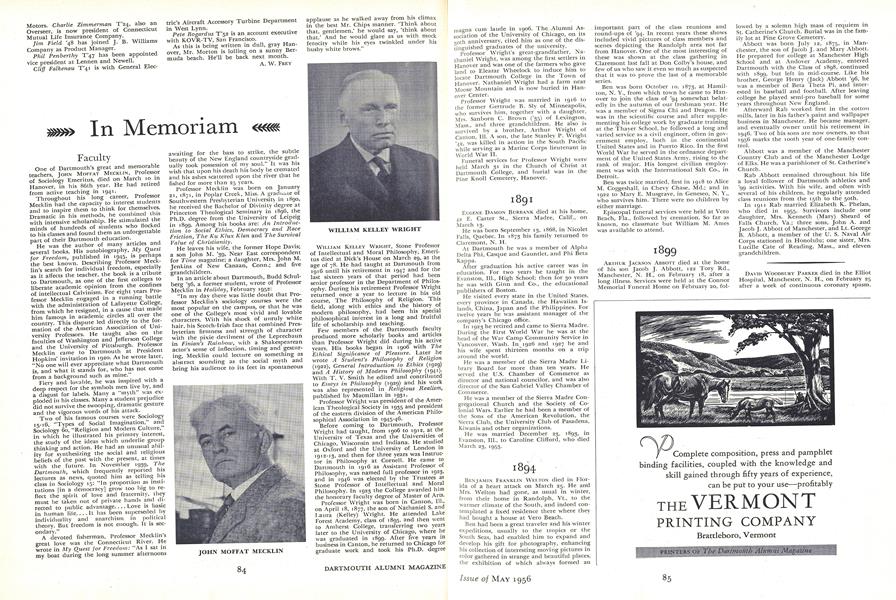
Burbank, Eugene D. '91, Mar. 13 Welton, Benjamin F. '94, Mar. 25 Gilman, John A. '98, Feb. 26 Irving, Arthur P. '99, Mar. 27 Andrews, John G. '01, Mar. 30 King, Harold D. '03, Mar. 6 Eaton, Max E. '11, Mar. 25 Welsh, Carlton K. '13, Mar. 31 Hawse, Maynard McK. '21, Mar. 9 Marsans, Romulo L. Jr. '26, Apr. 5 Kruming, Paul R. '28, Mar. 23 Keeler, Ford G. '30, July 7, 1953 Drake, Sherwood A. '52, Nov. 10, 1955 Hopkins, Nathaniel R. 2nd '54, Mar. 19 Atkins, Gaius G., D.D. '06, Apr. 5 Wright, William K., A.M. '23, Mar. 29
Faculty
One of Dartmouth's great and memorable teachers, JOHN MOFFAT MECKLIN, Professor of Sociology Emeritus, died on March 10 in Hanover, in his 86th year. He had retired from active teaching in 1941.
Throughout his long career, Professor Mecklin had the capacity to interest students and to inspire them to think for themselves. Dramatic in his methods, he combined this with intensive scholarship. He stimulated the minds of hundreds of students who flocked to his classes and found them an unforgettable part of their Dartmouth education.
He was the author of many articles and several books. His autobiography, My Questfor Freedom, published in 1945, iS Perhap the best known. Describing Professor Mecklin's search for individual freedom, especially as it affects the teacher, the book is a tribute to Dartmouth, as one of the first colleges to liberate academic opinion from the conhnes of intellectual Calvinism. For eight years Professor Mecklin engaged in a running battle with the administration of Lafayette College, from which he resigned, in a cause that made him famous in academic circles all over the country. This dispute led directly to the formation of the American Association of University Professors. He taught also on the faculties of Washington and Jefferson College and the University of Pittsburgh. Professor Mecklin came to Dartmouth at President Hopkins' invitation in 1920. As he wrote later, "No one will ever appreciate what Dartmouth is, and what it stands for, who has not come from a background such as mine."
Fiery and lovable, he was inspired with a deep respect for the symbols men live by, and a disgust for labels. Many a "myth was exploded in his classes. Many a student prejudice did not survive the swooping, dramatic gesture and the vigorous words of his attack.
Two of his famous courses were Sociology 15-16, "Types of Social Imagination," and Sociology 60, "Religion and Modern Culture," in which he illustrated his primary interest, the study of the ideas which underlie group thinking and action. He had an unusual ability for synthesizing the social and religious beliefs of the past with the present, at times with the future. In November 1939. TheDartmouth, which frequently reported his lectures as news, quoted him as telling his class in Sociology 15: "In proportion as institutions [in a democracy] grow too big to refleet the spirit of love and fraternity, they must be taken out of private hands and directed to public advantage.... Love is basic in human life.... It has been superseded by individuality and anarchism in political theory. But freedom is not enough. It is secondary."
A devoted fisherman, Professor Mecklin's great love was the Connecticut River. He wrote in My Quest for Freedom: "As I sat in my boat during the long summer afternoons awaiting for the bass to strike, the subtle beauty of the New England countryside gradually took possession of my soul." It was his wish that upon his death Iris body be cremated and his ashes scattered upon the river that he fished for more than 25 years.
Professor Mecklin Was born on January 21, 1871, in Poplar Creek, Miss. A graduate of Southwestern Presbyterian University in 1890, lie received the Bachelor of Divinity degree at Princeton Theological Seminary in 1896, the Ph.D. degree from the University of Leipzig in 1899. Among his books are: An Introduction to Social Ethics, Democracy and RaceFriction, The Ku Klux Klan and The SurvivalValue of Christianity.
He leaves his wife, the former Hope Davis; a son John M. '39, Near East correspondent for Time magazine; a daughter, Mrs. John M. Jenkins of New Canaan, Conn.; and five grandchildren.
In an article about Dartmouth, Buck! Schulberg '36, a former student, wrote of Professor Mecklin in Holiday, February 1952:
"In my day there was little doubt that Professor Mecklin's sociology courses were the most popular on the campus, or that he was one of the College's most vivid and lovable characters. With his shock of unruly white hair, his Scotch-Irish face that combined Presbyterian firmness and strength of character with the pixie devilment of the Leprechaun in Finian's Rainbow, with a Shakespearean actor's sense of inflection, timing and gesturing, Mecklin could lecture on something as abstract sounding as the social myth and bring his audience to its feet in spontaneous applause as he walked away from his climax in the best Mr. Chips manner. 'Think about that, gentlemen/ he would say, 'think about that.' And he would glare as us with mock ferocity while his eyes twinkled under his bushy white brows."
WILLIAM KELLEY WRIGHT, Stone Professor of Intellectual and Moral Philosophy, Emeritus died at Dick's House on March 29, at the age of 78. He had taught at Dartmouth from 1916 until his retirement in 1947 and for the last sixteen years of that period had been senior professor in the Department of Philosophy. During his retirement Professor wright returned once a year to lecture in his old course, The Philosophy of Religion. This field, along with ethics and the history of modern philosophy, had been his special philosophical interest in a long and fruitful life of scholarship and teaching.
Few members of the Dartmouth faculty produced more scholarly books and articles than Professor Wright did during his active years. His books began in 1906 with TheEthical Significance of Pleasure. Later he wrote A Student's Philosophy of Religion (1922), General Introduction to Ethics (1929) and A History of Modem Philosophy (1941)-With T. V. Smith he edited and contributed to Essays in Philosophy (1929) and his work was also represented in Religious Realism, published by Macmillan in 1931.
Professor Wright was president of the American Theological Society in 1935 and president of the eastern division of the American Philosophical Association in 1945-46.
Before coming to Dartmouth, Professor Wright had taught, from 1906 to 1912, at the University of Texas and the Universities of Chicago, Wisconsin and Indiana. He studied at Oxford and the University of London in 1912-13, and then for three years was Instructor in Philosophy at Cornell. He came to Dartmouth in 1916 as Assistant Professor of Philosophy, was named full professor in 1923, and in 1946 was elected by the Trustees as Stone Professor of Intellectual and Moral Philosophy. In 1923 the College awarded him the honorary faculty degree of Master of Arts.
Professor Wright was born in Canton, Ill., on April 18, 1877, the son of Nathaniel S. and Laura (Kelley) Wright. He attended Lake Forest Academy, class of 1895. and then went to Amherst College, transferring two years later to the University of Chicago, where he was graduated in 1899. After five years in business in Canton, he returned to Chicago for graduate work and took his Ph.D. degree magna cum laude in 1906. The Alumni Association of the University of Chicago, on its 50th anniversary, cited him as one of the distinguished graduates of the university.
professor Wright's great-grandfather, Nathaniel Wright, was among the first settlers in Hanover and was one of the farmers who gave land to Eleazar Wheelock to induce him to locate Dartmouth College in the Town of Hanover. Nathaniel Wright had a farm near Moose Mountain and is now buried in Hanover Center.
Professor Wright was married in 1916 to the former Gertrude B. Sly of Minneapolis, who survives him, together with a daughter, Mrs. Sanborn C. Brown ('35) of Lexington, Mass., and three grandchildren. He also is survived by a brother, Arthur Wright of Canton, Ill. A son, the late Stanley P. Wright '42, was killed in action in the South Pacific while serving as a Marine Corps lieutenant in World War II.
Funeral services for Professor Wright were held March 31 in the Church of Christ at Dartmouth College, and burial was in the Pine Knoll Cemetery, Hanover.
1891
EUGENE DAMON BURBANK died at his home, 42 E. Carter St., Sierra Madre, Calif., on March 13.
He was born September 13, 1868, in Nicolet Falls, Quebec. In 1873 his family returned to Claremont, N. H.
At Dartmouth he was a member of Alpha Delta Phi, Casque and Gauntlet, and Phi Beta Kappa.
After graduation his active career was in education. For two years he taught in the Evanston, Ill., High School; then for 30 years he was with Ginn and Co., the educational publishers of Boston.
He visited every state in the United States, every province in Canada, the Hawaiian Islands, China, Japan and the Philippines. For twelve years he was assistant manager of the company's Chicago office.
In 1923 he retired and came to Sierra Madre. During the First World War he was at the head of the War Camp Community Service in Vancouver, Wash. In 1926 and 1927 he and his wife spent thirteen months on a trip around the world.
He was a member of the Sierra Madre Library Board for more than ten years. He served the U.S. Chamber of Commerce as director and national councilor, and was also director of the San Gabriel Valley Chamber of Commerce.
He was a member of the Sierra Madre Congregational Church and the Society of Colonial Wars. Earlier he had been a member of the Sons of the American Revolution, the Sierra Club, the University Club of Pasadena, Kiwanis and other organizations.
He was married December 23, 1893, in Evanston, Ill., to Caroline Clifford, who died March 23, 1953.
1894
BENJAMIN FRANKLIN WELTON died in Florida of a heart attack on March 25. He and Mrs. Welton had gone, as usual in winter, from their home in Randolph, Vt., to the warmer climate of the South, and indeed contemplated a fixed residence there where they had bought a house at Vero Beach.
Ben had been a great traveler and his winter expeditions, usually to the tropics or the South Seas, had enabled him to expand and develop his gift for photography, enhancing his collection of interesting moving pictures in color gathered in strange and beautiful places, the exhibition of which always formed an important part of the class reunions and round-ups of '94. In recent years these shows included vivid pictures of class members and scenes depicting the Randolph area not far from Hanover. One of the most interesting of these was shown at the class gathering in Claremont last fall at Don Colby's house, and few of us who saw it even so much as suspected that it was to prove the last of a memorable series.
Ben was born October 10, 1873, at Hamilton, N. Y., from which town he came to Hanover to join the class of '94 somewhat belatedly in the autumn of our freshman year. He was a member of Sigma Chi and Dragon. He was in the scientific course and after supplementing his college work by graduate training at the Thayer School, he followed a long and varied service as a civil engineer, often in government employ, both in the continental United States and in Puerto Rico. In the first World War he served in the ordnance department of the United States Army, rising to the rank of major. His longest civilian employment was with the International Salt Co., in Detroit.
Ben was twice married, first in 1918 to Alice M. Coggeshall, in Chevy Chase, Md.; and in 1922 to Mary E. Musgrave, in Geneseo, N. Y., who survives him. There were no children by either marriage.
Episcopal funeral services were held at Vero Beach, Fla., followed by cremation. So far as known, no classmate but William M. Ames was available to attend.
1899
ARTHUR JACKSON ABBOTT died at the home of his son Jacob J. Abbott, 122 Tory Rd., Manchester, N. H., on February 18, after a long illness. Services were held at the Connor Memorial Funeral Home on February 20, followed by a solemn high mass of requiem in St. Catherine's Church. Burial was in the family lot at Pine Grove Cemetery.
Abbott was born July 12, 1875, in Manchester, the son of Jacob J. and Mary Abbott. He prepared for college at Manchester High School and at Andover Academy, entered Dartmouth with the Class of 1898, continued with 1899, but left in mid-course. Like his brother, George Henry (Jack) Abbott '96, he was a member of Beta Theta Pi, and interested in baseball and football. After leaving college he played semi-pro baseball for some years throughout New England.
Afterward Rab worked first in the cotton mills, later in his father's paint and wallpaper business in Manchester. He became manager, and eventually owner until his retirement in 1946. Two of his sons are now owners, so that 1956 marks the 100th year of one-family control.
Abbott was a member of the Manchester Country Club and of the Manchester Lodge of Elks. He was a parishioner of St. Catherine's Church.
Rab Abbott remained throughout his life a loyal follower of Dartmouth athletics and '99 activities. With his wife, and often with several of his children, he regularly attended class reunions from the 15th to the 50th.
In 1911 Rab married Elizabeth K. Phelan, who died in 1955. Survivors include one daughter, Mrs. Kenneth (Mary) Sheard of Falls Church, Va.; three sons, John A. and Jacob J. Abbott of Manchester, and Lt. George B. Abbott, a member of the U. S. Naval Air Corps stationed in Honolulu; one sister, Mrs. Lucille Cate of Reading, Mass., and eleven grandchildren.
DAVID WOODBURY PARKER died in the Elliot Hospital, Manchester, N. H., on February 25 after a week of continuous coronary spasm. His home was at 443 North Bay St. He was one of the oldest members of the medical profession in the state.
Parker was born on October 29, 1877, in Goffstown, N. H., the son of William Adams and Mary Alice (Woodbury) Parker. He graduated from Manchester High School, was a member of Kappa Kappa Kappa at Dartmouth, and as a bicyclist was a member of the varsity athletic team in '96, '97, and '98.
Graduating from Harvard Medical School in 1903, he interned at St. Elizabeth's Hospital in Boston, and in 1904 began active practice in Manchester. There he was a surgeon at Elliot hospital; consulting surgeon for both Exeter and the Derry Alexander-Eastman Hospitals; also surgeon for the Boston & Maine Railroad, and the Eastern division of International Shoe Company. He particularly devoted himself to operations upon children, and was noted in general for his finesse as a surgeon and for his kindness, far beyond the call of duty, to all his patients.
In 1904 Dave married Helen Mary Hall of Manchester, a leader in club and church women's groups. The Parkers and their two talented daughters, Frances Mary and Mary Woodbury (who died in 1949, eight years after marrying Dr. Robert Rudolph Rix '30), were active socially in the city, and summers at Newcastle and Ogunquit. After the death of Mrs. Parker in 1947, the doctor married Esther H. Josephson, a graduate of Elliot Hospital school of nurses, and later supervisor at the Vocational Training School in Portsmouth, and of the nursing services at the International Shoe Company, Eastern division.
There is no space here for enumerating David Parker's many printed articles in medical journals, but some of his professional activities and honors were the following: member of the American Medical Association; Fellow of the American College of Surgeons; member of the Founders Group (American Board of Surgery); past president of the New England Surgical Society; member of the American Goiter Association (Dave was a specialist in this type of operation); past president of the New Hampshire Medical Society and -of the New Hampshire Surgical Society; also a member of the American Association of Industrial Physicians and Surgeons, and of the committee for study of occupational diseases in the state. He was an especially stimulating speaker before medical associations or nurses' groups.
There was a military side to the doctor's career also. From 1910-1917 he was captain of Medical Department for the New Hampshire National Guard. In 1915 he was a "gay-looking, alert officer" on the Governor's staff; in 1916 he was on Border Service with the 12 th Regiment of Artillery at San Antonio, Texas; and in 1917 he was captain of Medical De- partment, U.S. Army at Fort Oglethorpe, Georgia. Finally, in 1940, he was a member of Advisory Board for Selective Service, and in 1943 was appointed a member of the Reserve of U.S. Public Health Service with rank of Senior Surgeon.
Locally he was a member of the Franklin St. Congregational church, the Manchester Rotary Club, Bible Lodge, F. & A.M., Trinity Commandery K.T. and Bektash Temple. He belonged also to the Newcomen Society of North America. None of Dave's associations, however, came nearer his heart than those connected with Dartmouth and the Class of 1899. He was a regular attendant, with his family, at all class gatherings, and was a member of the executive committee of '99.
Survivors are Dr. Parker's wife, Esther; his daughter, Mrs. William Otis Faxon II of Concord, Mass.; and seven grandchildren.
Funeral services were held at the Franklin St. Church on February 28, with Rev. George Hooten Jr., pastor, officiating. Nurses, doctors, and organizations attended in a body. Burial was in the family lot in Westlawn Cemetery, Goffstown. Among the eight honorary pallbearers were Kenneth Beal '99 and Dr. Benjamin P. Burpee '09. Other Ninety-Niners present were Hawley B. Chase and Mrs. Beal.
T903
HAROLD DAVIS KING died on March 6 at Orlando, Florida, where the Kings had been living for several years at 805 East Kaley Ave.
Harold was born December 20, 1879, in Portland, Maine. He prepared for Dartmouth at Farmington High School and in college was a member of Phi Beta Kappa.
After studying further at Thayer School, H.D. entered the U.S. Coast and Geodetic Survey. He went to the Philippines in 1906 where in 1908 he married Edith E. Thompson of Farmington. He returned to the U.S. in 1909 and transferred to the Lighthouse Service as inspector at Key West, Florida. In 1912 he was at Charleston, S.C. In 1914 he had charge of all aids to navigation from Cape Fear, Wilmington, N.C. to Miami, Fla. His next move was to Baltimore for a stay of thirteen years as District Superintendent. During this period he was for six years president of the Dartmouth Club of Baltimore.
In 1929 he was U.S. delegate to the International Conference at Genoa under League of Nations auspices to develop a plan for a universally applicable system of Buoyage and Lighting. That same year he was transferred to Washington as Deputy Commissioner and in 1935 became Commissioner of Lighthouses. He retired in 1939.
Mrs. King survives with their son John Harold and daughter Edith Elinor.
1905
CLARENCE LEROY BARTON died suddenly on February 16 in the Marlborough, Mass., Hospital. He had been in fairly good health until just before the end. Born October 4, 1881, he had lived all his life in his home town of Marlborough, and in the same house since 1883. He was the son of the late Charles F. and Martha (Cheney) Barton.
At Dartmouth, which he entered from Worcester Academy, he was a diligent student and was a member of the college choir. After graduation he taught school in Massachusetts for four years, first at Punchard School in Andover, then at Ashland High School, where he was principal.
In 1909, leaving teaching for industry, he spent a considerable period of time in Cordova, Ala., as an executive in the textile firm of Indian Head Mills. Returning north in 1916, he spent one year with the Tremont and Suffolk Textile Mills in Lowell. Thereafter, as an inspector, he joined the Boston office of the Division of Industrial Safety of the Massachusetts Department of Labor and Industries. In 1923 he was transferred to the Worcester office. He retired in 1951 after 33 years of efficient and faithful service.
Clarence had been active in the First Congregational Church of his home town for many years, as deacon, moderator, and superintendent of Sunday School. He was a member of the Masons.
In 1907 he married Bertha Maxwell, who died in 1933. He is survived by two daughters, Patrece, wife of Arthur L. Cannon of Southboro, and Shirley, wife of Capt. John R. Peterson, of the Cape Codder Hotel in Falmouth, Mass.; also by five grandchildren.
1911
MAX EVERETT EATON died at a hospital in Cincinnati on March 25 following a long illness. Four years ago he suffered a stroke and had been a semi-invalid since that time.
Max was born on March 28, 1889, in Wake field, Mass., and attended Wakefield High School before entering Dartmouth. In college he was a member of Phi Kappa Psi and business manager of the Aegis.
For the first nine years after graduation Max was in the advertising business for the Boot and Shoe Recorder. From 1921 on he was engaged in real estate development and subdividing in Cincinnati, Ohio. Among the developments was the Amity Hotel Courts, Roselawn, which he owned and operated. His home was in Amberley Village at 7102 Willowbrook Lane.
Max was a member of the Knights Templar of the Masonic Order, arid the Dartmouth Club of Cincinnati.
In 1916 he was married to Lulu Cooper, a Wellesley graduate, who survives him together with a son, James, and a daughter, Mrs. Jeanette Lowblad, both of Cincinnati. Services followed by cremation were held at the W. Mack Johnson funeral home in Walnut Hills.
1913
CHARLES STANLEY STONE died at the Mary Hitchcock Hospital in Hanover, N. H., on February 23. He was born in Andover, N. H., the son o£ George W. and Stella M. (Prince) Stone, on August 3, 1892.
After preparing for Dartmouth at Proctor Academy, he was graduated in 1913 and went into his father's, law office in Andover, and carried on an insurance business on the side.
He attended Harvard Law School from 1915 to 1917, when he entered the Army at the R.O.T.C. Plattsburg Camp in May. He served at Camp Devens, Mass., until he went overseas and then was in command of a Stokes Motor Battery in various parts of France. He was discharged on April 29, 1919.
Chuck married Ruth Jane Flack of Manchester, N. H. (Smith '13) on June 11, 1918. They had three daughters, now Mrs. Felix Bertagna of Seattle, Wash., Mrs. Guy Reem of Savannah, Ga., and Mrs. Charles Gallagher of St. Petersburg, Fla. All, with the five grandchildren, survive him.
He lived in Andover all his life, carrying on his legal work and his insurance business, and for the past 23 years he had been postmaster. He formerly had a herd of pedigreed Hereford cattle on his 1500-acre farm.
He represented the Town in the General Court at one time and also served as selectman, moderator of the town meeting, and member of the school board. Chuck was a trustee of Proctor Academy at the time of his death.
He was a member and former trustee of the Unitarian Church and was a past commander of the local American Legion Post. He was a member of Delta Kappa Epsilon at Dartmouth.
Services were held at the Unitarian Church and the class was represented by Harold and Caroline McAllister and Bart and Renza Shepard.
1924
HAROLD SPARR COLLINS died on February 16, at Lake Success, N.Y.
Although a non-graduate from Dartmouth, "Dee" was well know for his support of class activities in the New York area. He left Hanover after two years and attended Columbia University for two more.
Born in Newark, N.J., on May 5, 1902, "Dee" moved from Newark to New York in 1928. He married Marjorie M. Taylor on September 28, 1929.
In 1931 he was sales manager for the S.B. Thomas Bread Company, moving nearer the firm's bakery in 1934. That year Christopher was born (January 24, 1934), to be followed by Peter (March 23, 1937). In 1938, "Dee" was made Advertising Manager for the Ward Baking Company.
We have few details, but some of us knew there had been a long illness. The Class extends its sympathy to his wife and two children and will remember him tangibly with a Memorial Book presented to Baker Library in his name.
1925
WENDELL COOLEY JONES died on February 17, in Rome, where he had been working on a Vassar College faculty fellowship. No details are available as to the cause of death. He had been in Rome since last fall, preparing a textbook. His home was at 160 College Ave., Poughkeepsie, N.Y.
Born in Galena, Kansas, on October 25, 1899, he was educated at the Stone School in Boston, and came to Dartmouth after having served in the Army during World War I.
Wen was an artist to his finger-tips, sensitive and perceptive, yet in person vigorous and forthright. His murals are in post offices in Granville, Ohio; Johnson City, Tennessee; and Rome, New York, and in the Cairo, Illinois, court house, as well as in many schools and private homes. He had exhibited in leading museums and galleries. In college, he was art editor of Jacko, the Bema, and the Aegis, and his talent was then already defined. So was the charm of his personality, modest, devoted to his friends, and wonderfully companionable in long walks over the Vermont hills, long conversations in the night.
For the past seven years he had been a member of the Art Department at Vassar. He is survived by his wife, Jane; two sons, Peter and Wendell; and a brother, Matthew G. Jones '23. He died far from the countryside he loved, but Wen was at home wherever beauty dwelt. So may he be still.
1928
PAUL REGINALD KRUMING, former class president and one of the most popular members of the class, was killed March 23 in what was apparently an accidental fall from his seventhfloor window in the Hotel Barclay in New York. His body was found lying on the roof of a second-floor setback by a hotel employee. No notes were found. Associates said he appeared to be in good spirits recently and was not ill. His home was on Oscalita Road, Ridgefield, Conn., but he usually stayed at the Barclay when business, kept him in the city late.
Paul was one of the most respected leaders of the class and gave his time unstintingly to Dartmouth work. He served a number of years as assistant class agent and in 1940 and 1941 as class agent. He was elected class president in 1943 and served until 1946. He ran the 1946 reunion and at the 25th reunion was in charge of the auction which wiped out the deficit on the '28 reunion book.
Paul was born in Brooklyn, N.Y., December 20, 1905, the son of Maude (Schreiner) and Martin Julius Kruming, and prepared for Dartmouth at Erasmus Hall High School in Brooklyn. At Hanover he was manager of the tennis team and a member of Delta Kappa Epsilon, Green Key and Dragon.
After graduation he went with the National Export Advertising Service, Inc., and became president in 1936. In connection with his work he traveled abroad every year.
In 1942-43 he served in the New York and Washington offices of the Coordinator of Inter-American Affairs, and in 1943-45 was in the Army, assigned to the Armed Forces Radio Service Division in Washington.
In 1954 he received the annual award or the International Advertising Association for "distinguished service in the field of international advertising and marketing," and last year he was elected president of the Association of International Advertising Agencies, New York.
He is survived by his wife, Mary, and two sons, Martin, 12, and Eric, 7.
Funeral services were held at South Salem, N.Y., and were attended on behalf of the class by Stu Goodwillie, Hammie Hammesfahr, Sonny Middlebrook and Bud Weser and their wives, and also by Bill Cogswell and Beef Vernon.
1931
JOHN GORDON BARRINGTON died on November 26, 1955, in San Diego, Calif., and was buried in Arlington National Cemetery on December 5.
Joe was born in Winthrop, Mass., September 23, 1908, the son of John Albert and Kate (Humphries) Barrington. He prepared for college at Howe High School in Billerica, Mass., and Clark School in Hanover. In college he was a member of Chi Phi fraternity.
After graduating with the class Joe was for five years in the promotion department of the Barrington Manufacturing Corp. From 1936 to 1940 he was a studio press correspondent in Hollywood. In 1942 he entered the Navy and served for three years as Lieutenant. After his discharge he became a staff writer for the government in Washington, first with the Department of Commerce, and later with the Departments of the Army and Interior. Since 1955 Joe had been a free lance writer. Over the years Joe's stories and articles had appeared in magazines and newspapers, and frequently received high praise.
Joe never married. He had been making his home on Hunter's Mill Road, Vienna, Virginia. He is survived by his mother and a brother, Howard Barrington.
1933
JOHN HERMAN BARNES died in Denver, Colo., on February 11. He was born in Omaha, Nebraska, February 15, 1911, the son of Alfred Kimball and Minnie Barnes. He prepared for college at East High School in Denver.
After graduating with the class, John returned to Denver where he was engaged as a junior accountant. Unfortunately, he never kept in touch with the Class or the College. He is survived by his wife.
1954
Our class has lost one of its finest members, NATHANIEL RICHMOND HOPKINS 11. On March 19, he passed away at his home in Upper Montclair, N.J. As most of us knew, Nat had suffered from a neuro-muscular ailment for many years. Despite the knowledge of his physical condition it is extremely difficult to believe that we have lost him, because he was one of those very rare individuals who had the ability to make those around him forget that he was handicapped.
Nat was bora and raised in Upper Montclair. He graduated from Montclair High School. At Dartmouth he was a member of Sigma Nu. He was 25 at the time of his death, being born in February of 1931 to Donald B. and Marjorie Moulton Hopkins. Nat's father is a member of the Class of '26 and serves as one of its most active Assistant Class Agents. In addition to his parents, Nat left his maternal grandmother, Mrs. Carrie Otis Moulton; two sisters, Mrs. Robert D. Brown of Riverside, Conn.; and Marjorie Hopkins who is attending Smith College.
After graduation, Nat went to work for his father's advertising company, D. B. Hopkins, Inc. of New York. He served as vicepresident of that firm and commuted to New York City each day and carried on his duties as a salesman, going to all parts of the city to make contacts and sales. He was the top salesman of the company, a standing which those of us who knew him would consider to be only natural.
A memorial service was held on March 22 at St. James Episcopal Church, Upper Montclair. Nat was buried at Green Wood Cemetery in Brooklyn, N.Y.
Dartmouth means a little something different to each one of us. To me, after living with Nat for two years, the two were one. I cannot think of one without thinking of the other. I would like to send along a message to the class. There are no regrets or sympathies for Nat, he would never tolerate sympathy because of his handicap. He asked only to be accepted as he was. Those in the class who for one reason or another failed to come to know Nat missed a rare and a wonderful experience.
G.W. O'C.
JOHN MOFFAT MECKLIN
WILLIAM KELLEY WRIGHT