1909
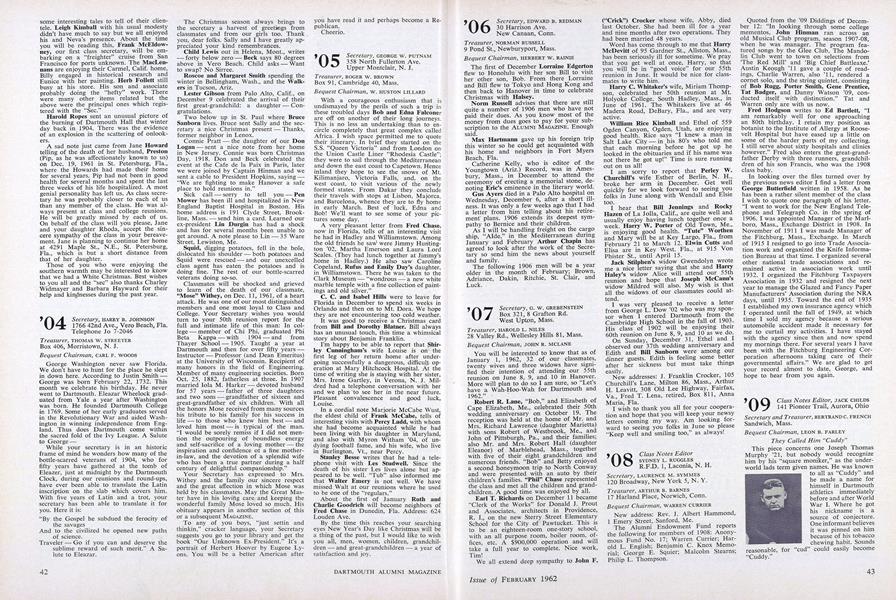
This piece concerns one Joseph Thomas Murphy '21, but nobody would recognize him by his "square moniker," as the underworld lads term given names. He was known to all as "Cuddy" and he made a name for himself in Dartmouth athletics immediately before and after World War I. Where he got his nickname is a source of conjecture. One informant believes it was pinned on him because of his tobacco chewing habit. Sounds Reasonable, for "cud" could easily become "Cuddy."
When Cuddy entered Dartmouth, after being heralded as a star prep school performer in football, baseball, basketball, and track, he was given a physical by Doc Bowler. Doc remarked at the time that Cuddy's was the finest muscular development he had ever seen. What a hunk of man Cuddy was. Some 200 pounds of brawn distributed over his 5 foot 10 frame. Evie Petot '22, my banjo playing partner in Aurora who was a Deke frat brother of Cuddy's, said you could hit Cuddy in the belly with your fist and make nary an impression.
It is in football, probably, that Cuddy is best remembered. During his three years at Hanover (less time out during part of 1918 to do a hitch in the Navy), he played with well-known football greats, such as Jack CanneLl, Swede Youngstrom, Gus Sonnenberg, Bill Cunningham, Guy Cogswell, Jim Robertson. He and Sonnenberg as tackles were a game-busting pair, as players on rival teams found out.
Being so well endowed by nature, Cuddy probably devoted less time to practice than anyone of his ability, and he constantly violated training rules. "In spite of his unconventional behavior," a friend wrote me, "he shut out Harvard in a no-hit baseball game his freshman year; possibly the only no-hit game credited to a Dartmouth pitcher. As further evidence of his natural gifts, the first time he handled a 16-pound shot (he had already established inter-scholastic records with the 12-pound) he did better than 47 feet. I think you will find he broke the Dartmouth record as a freshman."
At the age of 15, Cuddy weighed 190 pounds. As he grew older, his physical development continued. He had an immense width of shoulder and a deep chest. Yet he was astonishingly fast. As a tackle on the great Dartmouth team of 1919, he saw the Big Green win every game except to Brown which won on a fluke, 7 to 6. Penn State had a sensational back named Way who was famous for punt returns and broken field running. He ran the first kickoff through the entire Dartmouth team for a touchdown, and for another on the second kickoff. But he never ran a punt back a single yard. Cuddy and Youngstrom saw to that. They were down the field under punts ahead of the ends and the backs and their tackling was ferocious. Before the half was finished, Way was handling the ball as if it were redhot. The highlight of that season was the defeat by Dartmouth of the powerful Penn team by a score of 20 to 19.
After the 1919 football season, the brother of Jack Ingersol '11 brought together in Cleveland a team of college players and staged a post-season game. He did it for his own pecuniary benefit, without regard to injury that might be done to the amateur standing of boys still in college. They were paid their expenses and monetary rewards. Cuddy was one who accepted and, to disguise his identity, he wore a bandage about his head, and his face was almost concealed by tape. But his build was unmistakable. Someone mentioned it casually in the presence of Prof. Jim Richardson '00 and Cuddy was declared ineligible. After that, Cuddy left college before graduating.
In his post-college years, Cuddy joined the Boston Red Sox for a brief period; he played considerable professional basketball, and was active in later years as a football referee.
From Jack Cannell of Kittery Point, Me.: "Good old Cuddy. I meet people today around this area who recall stories about Cuddy. His friends were legion. Whatever he did is remembered with a laugh. If he spat a gob of tobacco juice at an opposing lineman, or sold a freshman an interest in the Ledyard bridge, there was always the Murphy touch that makes him so well remembered. He had a heart as big as an ox and as his friend, Paul Mineau, who knew him from boyhood to the end, said: 'He'd give you the shirt off his back. Lend him ten dollars, and five minutes later he'd give five to someone else.' I often think of those five linemen on Doc Spears' 1919 team - Gus Sonnenberg, later world's champion wrestler; Swede Youngstrom, Walter Camp's All-American guard; Bill Cunningham, famous writer; Norm Crisp, renowned surgeon; and Cuddy Murphy, as famous as the others, just because he was Cuddy, a truly great and lovable character."
In subjects that interested him, Cuddy was an excellent student, but like many of us, his grades, otherwise, were indifferent. With all his magnificent physical equipment, he was blessed with other skills. Professor Leland Griggs once told Bob Jackson 'OO that Cuddy would have made an outstanding surgeon. No one in all his classes had so delicate a touch with a scalpel, and none could dissect the brain of a mudworm so expertly as Cuddy.
Cuddy had an older brother George who was his exact opposite in temperament and attitudes. George, an excellent student, went to work and, like Ezekial Webster, helped his younger brother gain an education. George also enlisted in World War I and finally entered Dartmouth to graduate with the class of '24. He played fullback on the varsity and later built up a profitable insurance business in Manchester, N. H.
As a mutual friend pointed out: "Here, we have the spectacle of two brothers, each of the same inheritance and early background, but contrasting sharply in character. The elder, serious, ambitious, industrious, and upright; the younger, self-indulgent, easy-going, inclined to frivolity, honest, but with the tendency to face away from reality and choose the easiest way. Is it in the different arrangement of the genes, or because the younger, who resembled his mother physically, was coddled by her in his childhood?"
Cuddy ultimately went into the insurance business with his brother George and ten years later engaged in the shoe business in Manchester. His death on May 21, 1940, was caused by poison from a carbuncle entering his blood stream. That was before the time of miracle drugs which might have saved his life. At his death he weighed over 300 pounds.
For information which made this profile possible, my thanks go to Alyce Robertson, successor to Charlotte Ford Morrison as keeper of alumni records; to Bob Jackson '00, a wizard in recalling incidents concerning a wide range of Dartmouth men and affairs; to Jackson Cannell '19 and Evie Petot '22, contemporaries of Cuddy.
Note: two eagle-eyers — Ed Barker '07, Rutherford, N. J., and Bob Keeler '11, Cincinnati, Ohio - believe the unidentified guy in the group picture shown with the '09 notes of the December ALUMNI MAGAZINE, is George Lowe 'OB. Any other ideas?
Class Notes Editor, 141 Pioneer Trail, Aurora, Ohio
Secretary and Treasurer, Sandwich, Mass.
Bequest Chairman,
They Called Him "Cuddy"