1921
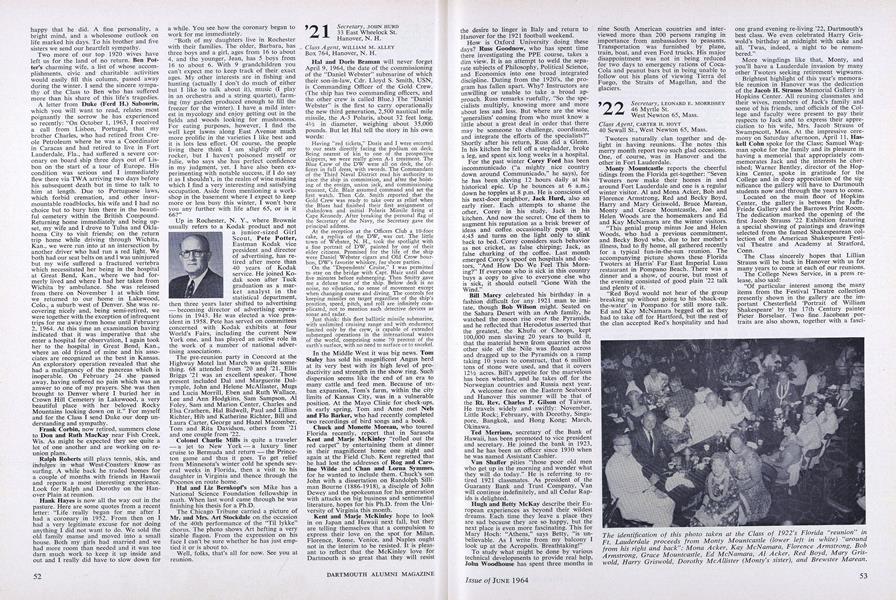
Hal and Doris Braman will never forget April 9, 1964, the date of the commissioning of the "Daniel Webster" submarine of which their son-in-law, Cdr. Lloyd S. Smith, USN, is Commanding Officer of the Gold Crew. (The ship has two commanding officers, and the other crew is called Blue.) The "Daniel Webster" is the first to carry operationally the new third generation, 2,500 nautical mile missile, the A-3 Polaris, about 32 feet long, 4½ in diameter, weighing about 35,000 pounds. But let Hal tell the story in his own words:
Having "red tickets," Doris and I were escorted to our seats directly facing the podium on deck. Being nearest of kin to one of the prospective skippers, we were really given A-1 treatment. The Blue Crew of the DW were all on deck, the officers in full dress, with swords. The Commandant of the Third Naval District read his authority to place the ship in commission, and after the hoisting of the ensign, union jack, and commissioning pennant, Cdr. Blair assumed command and set the first watch. Then Cdr. Smith reported that the Gold Crew was ready to take over as relief when the Blues had finished their first assignment of shakedown and initial Polaris Missile firing at Cape Kennedy. After breaking the personal flag of the Secretary of the Navy, the Secretary gave the principal address.
At the reception at the Officers Club a 10-foot cake, a replica of the DW, was cut. The little town of Webster, N. H., took the spotlight with a fine portrait of DW, painted by one of their elder citizens. Promised for the life of the ship were Daniel Webster cigars and Old Crow bourbon, DW's favorite whiskey, for shore parties.
On the "Dependents' Cruise," I was permitted to stay on the bridge with Capt. Blair until about five minutes before submerging. Then Smitty gave me a deluxe tour of the ship. Below deck is no noise, no vibration, no sense of movement except when changing course and diving. The controls for keeping missiles on target regardless of the ship's position, speed, pitch, and roll are infinitely complicated, not to mention such detective devices as sonar and radar.
just think: this fleet ballistic missile submarine, with unlimited cruising range and with endurance limited only by the crew, is capable of extended submerged operations in the international waters of the world, comprising some 70 percent of the earth's surface, with no need to surface or to snorkel.
In the Middle West it was big news. TomStaley has sold his magnificent Angus herd at its very best with its high level of productivity and strength in the show ring. Such dispersion seems like the end of an era to many cattle and feed men. Because of urban expansion, Tom's farm, within the city limits of Kansas City, was in a vulnerable position. At the Mayo Clinic for check-ups, in early spring, Tom and Anne met Nelsand Flo Barker, who had recently completed two recordings of bird songs and a book.
Chuck and Monette Moreau, who toured Florida recently, report that in Sarasota Kent and Marje McKinley "rolled out the red carpet" by entertaining them at dinner in their magnificent home one night and again at the Field Club. Kent regretted that he had lost the addresses of Rog and Caroline Wilde and Chan and Lorna Symmes, for he wanted to include them. Chuck's son John with a dissertation on Randolph Silliman Bourne (1886-1918), a disciple of John Dewey and the spokesman for his generation with attacks on big business and sentimental literature, hopes for his Ph.D. from the University of Virginia this month.
Kent and Marje McKinley hope to look in on Japan and Hawaii next fall, but they are telling themselves that a compulsion to express their love on the spot for Milan, Florence, Rome, Venice, and Naples ought not in the interim to be resisted. It is pleasant to reflect that the McKinley love for Dartmouth is so great that they will resist the desire to linger in Italy and return to Hanover for the 1921 football weekend.
How is Oxford University doing these days? Russ Goodnow, who has spent time there investigating the PPE course, takes a dim view. It is an attempt to weld the separate subjects of Philosophy, Political Science, and Economics into one broad integrated discipline. Dating from the 1920'5, the program has fallen apart. Why? Instructors are unwilling or unable to take a broad approach. Russ remarks ruefully, "So the specialists multiply, knowing more and more about less and less. But where are the wise 'generalists' coming from who must know a little about a great deal in order that there may be someone to challenge, coordinate, and integrate the efforts of the specialists?" Shortly after his return, Russ did a Glenn. In his kitchen he fell off a stepladder, broke a leg, and spent six long weeks in a hospital.
For the past winter Corey Ford has been incommunicado ("a mighty nice country down around Communicado," he says), for he has been slaving 12 hours daily at his historical epic. Up he bounces at 6 a.m.; down he topples at 8 p.m. He is conscious of his next-door neighbor, Jack Hurd, also an early riser. Each attempts to shame the other, Corey in his study, Jack in his kitchen. And now the secret. One of them to augment his reputation as a brisk brewer of ideas and coffee, occasionally pops up at 4:45 and turns on the light only to slink back to bed. Corey considers such behavior as not cricket, as false chirping; Jack, as false churking of the coffee. Last month emerged Corey's spoof on hospitals and doctors, "And How Do We Feel This Morning?" If everyone who is sick in this country buys a copy to give to everyone else who is sick, it should outsell "Gone With the Wind."
Bill Marcy celebrated his birthday in a fashion difficult for any 1921 man to imitate, though Bob Wilson might. Seated on the Sahara Desert with an Arab family, he watched the moon rise over the Pyramids, and he reflected that Herodotus asserted that the greatest, the Khufu or Cheops, kept 100,000 men slaving 20 years to build it, that the material hewn from quarries on the other side of the Nile was floated across and dragged up to the Pyramids on a ramp taking 10 years to construct, that 6 million tons of stone were used, and that it covers 12½ acres. Bill's appetite for the marvelous has been whetted, and he takes off for the Norwegian countries and Russia next year.
A welcome face on the Eastern Seaboard and Hanover this summer will be that of the Rt. Rev. Charles P. Gilson of Taiwan. He travels widely and swiftly: November, Little Rock;. February, with Dorothy, Singapore, Bangkok, and Hong Kong; March, Okinawa.
Ted Merriam, secretary of the Bank of Hawaii, has been promoted to vice president and secretary. He joined the bank in 1923, and he has been an officer since 1930 when he was named Assistant Cashier.
Van Shaffer pities "those poor old men who get up in the morning and wonder what they will do today." He is referring to retired 1921 classmates. As president of the Guaranty Bank and Trust Company, Van will continue indefinitely, and all Cedar Rapids is delighted.
Hugh and Betty McKay describe their European experiences as beyond their wildest dreams. Each time they leave a place they are sad because they are so happy, but the next place is even more fascinating. This for Mary Hoch: "Athens," says Betty, "is unbelievable. As I write from my balcony I look up at the Acropolis. Breathtaking!"
To study what might be done by various technical developments to provide real help, John Woodhouse has spent three months in nine South American countries and interviewed more than 200 persons ranging in importance from ambassadors to peasants. Transportation was furnished by plane, train, boat, and even Ford trucks. His major disappointment was not in being reduced for two days to emergency rations of CocaCola and peanut bars but in being unable to follow out his plans of viewing Tierra del Fuego, the Straits of Magellan, and the glaciers.
Secretary, 33 East Wheelock St. Hanover, N. H.
Class Agent, Box 764, Hanover, N, H.