1940's 25th
Where to begin? From the first whoop and holler Wednesday night when Louiseand Bud Hewitt came on the scene in the dorm headquarters to greet Diz and Moody, to the last, dying notes of the organ in the sun-dappled Bema of the Sunday memorial service, the 1940 Twenty-fifth Reunion was stupendous beyond expectation. Maybe some reunions have had better weather, or more people, or fancier uniforms, or lower golf scores, but certainly none has ever had more fun or more good-looking wives and children to bring back or more men glad they had returned. And certainly no reunion class had ever been able to report such a record-breaking total of giving to the College as we did. That tidy sum, symbolically presented to President Dickey at the banquet Saturday night as a barrel of money, amounted to $656,147. The leaders of the drive, Hugh Schwarz and Bob Lake and through them all the previous agents and workers who helped build up the base, were cited by the Alumni Council in recognition of their outstanding achievement. Since we all have shared in this record for the class, I think it is appropriate that you also share in the enjoyment of the fine tribute:
Resolved: That the Alumni Council, wishing to express its gratitude on behalf of the College and all Dartmouth Alumni, heartily congratulate the Class of 1940 and its able leaders for their achievements in the 25 Year Class Giving Program. During the past two years and three months, 1940 has raised over $230,000 to set a new all-time record in 25 year giving of $650,000. Class Chairman J. Malcolm DeSieyes, Class Giving CoChairmen Hugh Schwarz and Robert Lake, their able assistants, and the entire class membership have earned the grateful thanks of the Alumni Council and the College for this magnificent achievement.
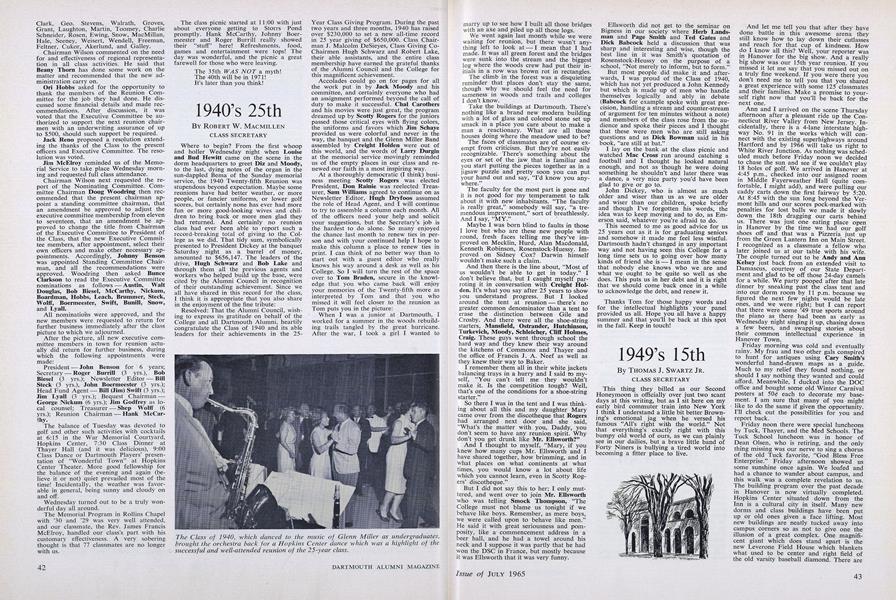
Accolades could go on for pages for all the work put in by Jack Moody and his committee, and certainly everyone who had an assignment performed beyond the call of duty to make it successful. Chal. Carothers and his movies were just great, the program dreamed up by Scotty Rogers for the juniors passed those critical eyes with flying colors, the uniforms and favors which Jim Schaye provided us were colorful and never in the way, the banquet and the Glenn Miller Band assembled by Creight Holden were out of this world, and the words of Larry Durgin at the memorial service movingly reminded us of the empty places in our class and renewed our faith in a most inspiring way.
At a thoroughly democratic (I think) business meeting Scotty Rogers was elected President, Don Rainie was reelected Treasurer, Sam Williams agreed to continue on as Newsletter Editor, Hugh Dryfoos assumed the role of Head Agent, and I will continue to try to assemble a column each month. All of the officers need your help and solicit your suggestions, but the Secretary's job is the hardest to do alone. So many enjoyed the chance last month to renew ties in person and with your continued help I hope to make this column a place to renew ties in print. I can think of no better way than to start out with a guest editor who really knows his way around a desk as well as his College. So I will turn the rest of the space over to Tom Braden, secure in the knowledge that you who came back will enjoy your memories of the Twenty-fifth more as interpreted by Tom and that you who missed it will feel closer to the reunion as Tom puts you in the picture:
When I was a junior at Dartmouth, I worked for a summer in the woods rebuilding trails tangled by the great hurricane. After the war, I took a girl I wanted to marry up to see how I built all those bridges with an axe and piled up all those logs.
We went again last month while we were waiting for reunion, but there wasn't anything left to look at — I mean that I had made. It was all green forest and the bridges were sunk into the stream and the biggest log where the woods crew had put their initials in a row was brown rot in rectangles.
The climb in the forest was a disquieting reminder that places don't stay the same, though why we should feel the need for sameness in woods and trails and colleges I don't know.
Take the buildings at Dartmouth. There's nothing like a brand new modern building with a lot of glass and colored stone set up smack in a place you care about to make a man a reactionary. What are all those houses doing where the meadow used to be?
The faces of classmates are of course exempt from criticism. But they're not easily recognizable. There's something about the eyes or set of the jaw that is familiar and you start putting the pieces together as in a jigsaw puzzle and pretty soon you can put your hand out and say, "I'd know you anywhere."
The faculty for the most part is gone and it is not good for my temperament to talk about it with new inhabitants. "The faculty is really great," somebody will say, "a tremendous improvement," sort of breathlessly. And I say, "MY."
Maybe I was born blind to faults in those I love but who are these new people with round, fresh faces telling me they've improved on Mecklin, Hurd, Alan Macdonald, Kenneth Robinson, Rosenstock-Huessy. Improved on Sidney Cox? Darwin himself wouldn't make such a claim.
And then there is the line about, "Most of us wouldn't be able to get in today." I don't believe that, but I caught myself parroting it in conversation with Creight Holden. It's what you say after 25 years to show you understand progress. But I looked around the tent at reunion - there's no greater common denominator than a tent to erase the distinction between Gile and Crosby. And there were all the shoe-string starters, Mansfield, Ostrander, Hutchinson,Turkevich, Moody, Schleicher, Cliff Holmes,Craig. These guys went through school the hard way and they knew their way around the kitchens of Commons and Thayer and the office of Francis J. A. Neef as well as they knew their way to Baker.
I remember them all in their white jackets balancing trays in a hurry and I said to myself, "You can't tell me they wouldn't make it. Is the competition tough? Well, that's one of the conditions for a shoe-string starter."
So there I was in the tent and I was thinking about all this and my daughter Mary came over from the discotheque that Rogers had arranged next door and she said, "What's the matter with you, Daddy, you don't seem to have any reunion spirit. Why don't you get drunk like Mr. Ellsworth?"
And I thought to myself, "Mary, if you knew how many cups Mr. Ellsworth and I have shared together, how brimming, and in what places on what continents at what times, you would know a lot about life which you cannot learn, even in Scotty Rogers' discotheque."
But I did not say this to her; I only muttered, and went over to join Mr. Ellsworth who was telling Smock Thompson, "The College must not blame us tonight if we behave like boys. Remember, as mere boys, we were called upon to behave like men." He said it with great seriousness and pomposity, like a commencement address in a beer hall, and he had a towel around his neck and I suppose it was partly that he had won the DSC in France, but mostly because it was Ellsworth that it was very funny.
Ellsworth did not get to the seminar on Bigness in our society where Herb Landsman and Page Smith and Ted Gates and Dick Babcock held a discussion that was sharp and interesting and wise, though the best line in it was Smith's quotation of Rosenstock-Heussy on the purpose of a school, "Not merely to inform, but to form."
But most people did make it and afterwards, I was proud of the Class of 1940, which has not yet produced a John Kennedy but which is made up of men who handle themselves logically and ably in debate (Babcock for example spoke with great precision, handling a stream and counter-stream of argument for ten minutes without a note) and members of the class rose from the audience and spoke their pieces and I thought that these were men who are still asking questions and as Dick Bowman said in his book, "are still at bat."
I lay on the bank at the class picnic and watched Mac Cross run around catching a football and I thought he looked natural enough, and not as though he were doing something he shouldn't and later there was a dance, a very nice party you'd have been glad to give or go to.
John Dickey, who is almost as much older and wiser than us as we are older and wiser than our children, spoke briefly and though I've forgotten his words, the idea was to keep moving and to do, as Emerson said, whatever you're afraid to do.
This seemed to me as good advice for us 25 years out as it is for graduating seniors and somehow it made me feel less wistful. Dartmouth hadn't changed in any important way and not having seen this College for a long time sets us to going over how many kinds of friend she is - I mean in the sense that nobody else knows who we are and what we ought to be quite so well as she does. This puts us in her debt and it is right that we should come back once in a while to acknowledge the debt, and renew it.
Thanks Tom for those happy words and for the intellectual highlights your panel provided us all. Hope you all have a happy summer and that you'll be back at this spot in the fall. Keep in touch!
The Class of 1940, which danced to the music of Glenn Miller as undergraduates,brought the orchestra back for a Hopkins Center dance which was a highlight of thesuccessful and well-attended reunion of the 25-year class.
CLASS SECRETARY