1961
This is the continuation of the very personal and interesting perspective on our first week in Hanover by a fellow '61:
"... I have always been more willing to be influenced than manipulated by my society. That some unification process was being worked on us there can be no doubt. We can learn from studying Pearl Harbor, reading "1984," or simply attending to the current wish-fulfillment fantasy of a world suddenly united by an attack from Mars, that you create cohesiveness in a group by making it feel threatened—as we were made to feel by the SOC's, an official arm of the College's orientation program. To say that our class identity was being created seemed only superficially helpful. In many respects, freshmen formed a class naturally. They were the ones in English 1, the ones doing peon duty in the dish room, etc. Everyone who goes to college has a class. Why such a big deal? Why must class ties be created? Why all the irrationality? The raids didn't ring true. Rather, we were being permitted a token retaliation against trumped-up intimidation. We were led to believe that the College's attitude towards them was about the same as its attitude towards finding a girl in your room after hours. Illegal, but human nature—or, in the case of the raids, freshman human nature. One was experiencing on the stairs of Topliff a release of tabu impulses, it seemed; Gaudreau's boys and the town police were to be seen hovering on the periphery of the action. My trouble with this schematization of the situation was that I felt very little in the way of overflowing inadmissable impulses that had not been stimulated by various punitive aspects of freshman orientation. I certainly didn't go to college expecting a riot in the first week, I hadn't found the battery of psychological and other tests so stupefying, and even the SOC's appeared as just a duster of amenable asses in black and white suits struggling manfully to maintain their identities as possibly helpful but primarily oppressive and antagonistic officials—they projected Love-Hate so consistently that it was difficult to resist the impression that they were working within guidelines. Many artificial miseries of Freshman Week revealed the same unreason at their core. The College could have ended these miseries by breathing some rationality into that first week's doings. Instead, I'm afraid they condoned and may even have given succor to the irrationality that temporarily left me feeling sick and fearful.
"I now suppose that they did so out of an unconscious hope that class unity would receive an irrational weld as a result, the hope in turn arising from the fact that the Alumni Fund is organized by class. If you can forgive the analogy, it's a little like a whiskey-smelling, seedy Mama creating the illusion of permissiveness in the belief that that's how to make Son remember her fondly in her old age. In short, we were participating in a ritual of which I believe the submerged intent was the fusion of late adolescent immaturity with benevolence towards the College.
"I am not bleeding as I write this, Joel, nor am I experiencing any desire to be judgmental. I wish only to make a point about the '61 column—namely, that up until now reading it has always reawakened in me those old fears. It's all there: the implicit assumption that for good or ill we're brothers in Dartmouth, the false enthusiasm, the private language, the oversexed anti-feminism, often the further assumption that collegiate personalities persist mostly unchanged in thirty-year-olds. That an alumnus is perpetually a freshman in the eyes of a typical class secretary suggests that the column functions largely as part of the planned last phase of the above-mentioned ritual.
"Since you're one of the first secretaries to express awareness of the many ironies underlying the columns you write, you deserve credit. I think, though, that your invitation to us to try to fit our feelings and opinions into the easy categories our society makes available is a bum steer. We don't want to be turned into one more kind of statistics any more than we want* to recapitulate the undergraduate experience. I think we do want to know how other people see life, feel life, project the future—in their own terms. Why not print one letter per month from an alumnus, not necessarily a '61, who seems to you to have vision, coupled with an acute sense of the realities of presentday living? (The vital statistics would find a more appropriate haven in a directory, or in the Newsletter which at present duplicates your function.) Such a column might have the effect of casting alumni in their true role as college-educated adults occupying fairly important positions in the world, rather than imputing to them a continuing share in a myth which probably should never have sat very well with them, even at age 17—a myth of which further acceptance will encourage a relationship with the College or ever greater mindlessness, the equality which has most frightened me about the column before now.
How do you feel about George's point of view? What are your feelings about Dartmouth today?
Here are the monthly statistics: Dick Noel is the manager of the First Agricultural Bank of Berkshire County and was National Head of the Northern Bershire United Community Fund Campaign. Tom Conger is now director of development for the Punahou School in Hawaii.
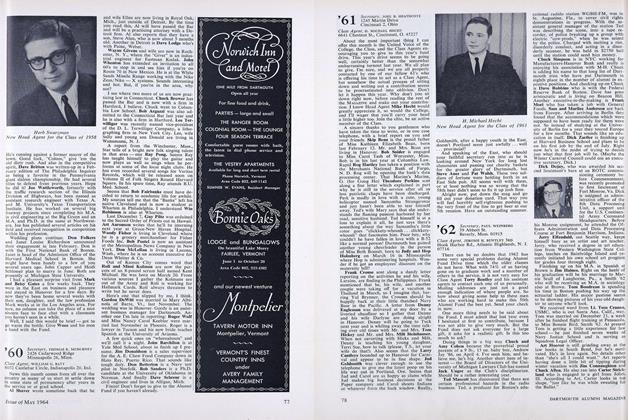
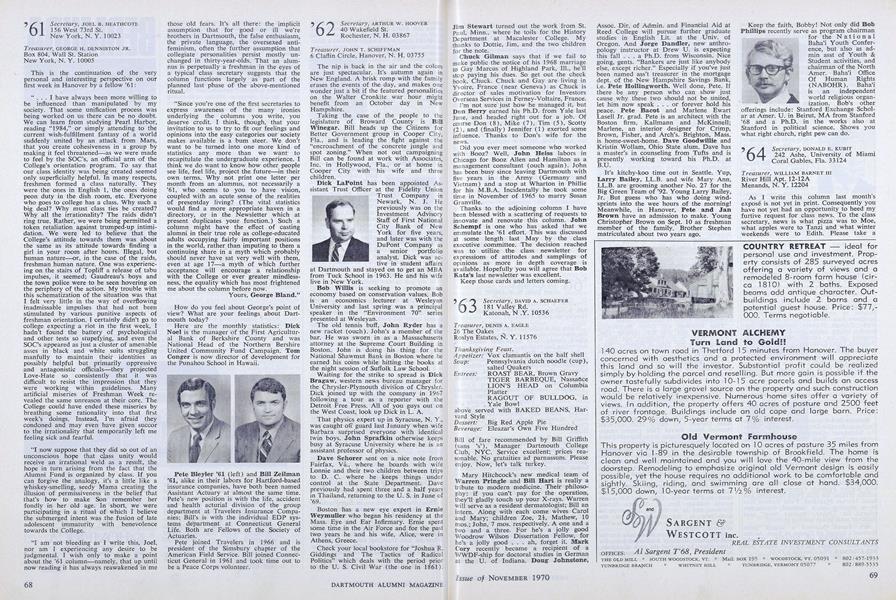
Pete Bleyler '6l (left) and Bill Zeilman '61, alike in their labors for Hartford-based insurance companies, have both been named Assistant Actuary at almost the same time. Pete's new position is with the life, accident and heatth acturial division of the group department at Travelers Insurance Companies; Bill's is with the individual EDP systems department at Connecticut General Life. Both are Fellows of the Society of Actuaries.
Pete joined - Travelers in 1966 and is president of the Simsbury chapter of the American Field Service. Bill joined Connecticut General in 1961 and took time out to be a Peace Corps volunteer.
Secretary, 156 West 73rd St. New York, N. Y. 10023
Treasurer, Box 804, Wall St. Station New York, N. Y. 10005