Liberal Arts, yes 'Core of Knowledge,' no Changing the Calendar, maybe
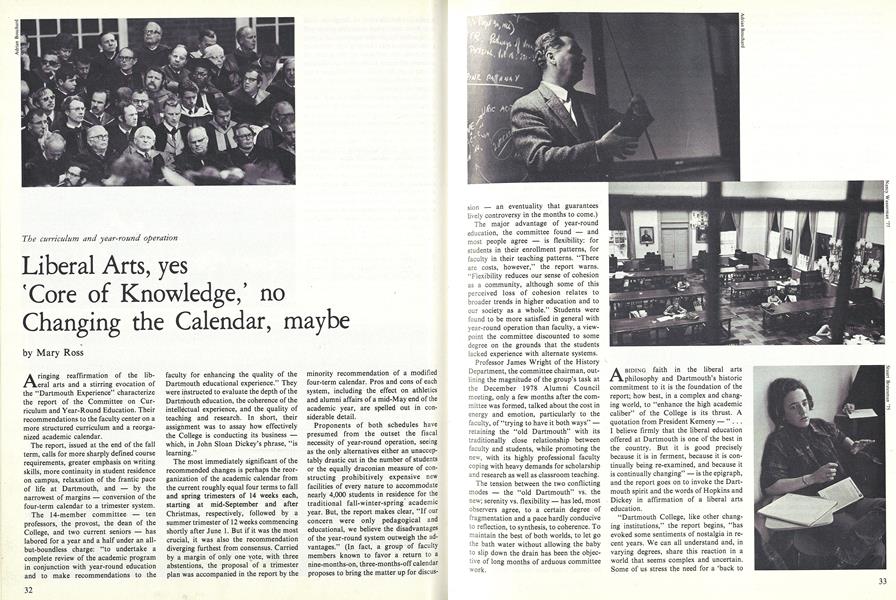
The curriculum and year-round operation
A ringing reaffirmation of the liberal arts and a stirring evocation of the "Dartmouth Experience" characterize the report of the Committee on Curriculum and Year-Round Education. Their recommendations to the faculty center on a more structured curriculum and a reorganized academic calendar.
The report, issued at the end of the fall term, calls for more sharply defined course requirements, greater emphasis on writing skills, more continuity in student residence on campus, relaxation of the frantic pace of life at Dartmouth, and by the narrowest of margins conversion of the four-term calendar to a trimester system.
The 14-member committee ten professors, the provost, the dean of the College, and two current seniors has labored for a year and a half under an all-but-boundless charge: "to undertake a complete review of the academic program in conjunction with year-round education and to make recommendations to the faculty for enhancing the quality of the Dartmouth educational experience." They were instructed to evaluate the depth of the Dartmouth education, the coherence of the intellectual experience, and the quality of teaching and research. In short, their assignment was to assay how effectively the College is conducting its business which, in John Sloan Dickey's phrase, "is learning."
The most immediately significant of the recommended changes is perhaps the reorganization of the academic calendar from the current roughly equal four terms to fall and spring trimesters of 14 weeks each, starting at mid-September and after Christmas, respectively, followed by a summer trimester of 12 weeks commencing shortly after June 1. But if it was the most crucial, it was also the recommendation diverging furthest from consensus. Carried by a margin of only one vote, with three abstentions, the proposal of a trimester plan was accompanied in the report by the minority recommendation of a modified four-term calendar. Pros and cons of each system, including the effect on athletics and alumni affairs of a mid-May end of the academic year, are spelled out in considerable detail.
Proponents of both schedules have presumed from the outset the fiscal necessity of year-round operation, seeing as the only alternatives either an unacceptably drastic cut in the number of students or the equally draconian measure of constructing prohibitively expensive new facilities of every nature to accommodate nearly 4,000 students in residence for the traditional fall-winter-spring academic year. But, the report makes clear, "If our concern were only pedagogical and educational, we believe the disadvantages of the year-round system outweigh the advantages." (In fact, a group of faculty members known to favor a return to a nine-months-on, three-months-off calendar proposes to bring the matter up for discussion an eventuality that guarantees lively controversy in the months to come.)
The major advantage of year-round education, the committee found and most people agree is flexibility: for students in their enrollment patterns, for faculty in their teaching patterns. "There are costs, however," the report warns. "Flexibility reduces our sense of cohesion as a community, although some of this perceived loss of cohesion relates to broader trends in higher education and to our society as a whole." Students were found to be more satisfied in general with year-round operation than faculty, a view- point the committee discounted to some degree on the grounds that the students lacked experience with alternate systems.
Professor James Wright of the History Department, the committee chairman, outlining the magnitude of the group's task at the December 1978 Alumni Council meeting, only a few months after the committee was formed, talked about the cost in energy and emotion, particularly to the faculty, of "trying to have it both ways" retaining the "old Dartmouth" with its traditionally close relationship between faculty and students, while promoting the new, with its highly professional faculty coping with heavy demands for scholarship and research as well as classroom teaching.
The tension between the two conflicting modes the "old Dartmouth" vs. the new; serenity vs. flexibility has led, most observers agree, to a certain degree of fragmentation and a pace hardly conducive to reflection, to synthesis, to coherence. To maintain the best of both worlds, to let go the bath water without allowing the baby to slip down the drain has been the objective of long months of arduous committee work.
ABIDING faith in the liberal arts philosophy and Dartmouth's historic commitment to it is the foundation of the report; how best, in a complex and changing world, to "enhance the high academic caliber" of the College is its thrust. A quotation from President Kemeny "... I believe firmly that the liberal education offered at Dartmouth is one of the best in the country. But it is good precisely because it is in ferment, because it is continually being re-examined, and because it is continually changing" is the epigraph, and the report goes on to invoke the Dartmouth spirit and the words of Hopkins and Dickey in affirmation of a liberal arts education.
"Dartmouth College, like other changing institutions," the report begins, "has evoked some sentiments of nostalgia in recent years. We can all understand and, in varying degrees, share this reaction in a world that seems complex and uncertain. Some of us stress the need for a 'back to basics' approach to our curriculum. Some recall wistfully an environment and a pace that was serene and reflective. Some students, alumni and faculty describe a traditional Dartmouth 'experience' that was cohesive and uniform.
"As with all nostalgia, these images involve some selective recall. In any event, we cannot set out to turn back history. We should not assume that educational policies of the past are appropriate for educating young people who must live in the future. But if we question old policies, we cannot reject out of hand old values. Some are of continuing importance and relevance.
"If by 'basics' we mean providing students with a quality education, one that introduces them to the complexity of life and of knowledge, forces them to examine and think creatively, and pushes them to develop, synthesize and express ideas, then we support these values. But we are not going back to basics. We are continuing and going forward with them.
"If by a slower pace we mean maintaining at Dartmouth College an environment that permits reflection and fosters inquiry and thoughtfulness, then we support such efforts. But we cannot pretend that the routines and the processes of the 1950s or the 1930s have a timeless value for higher education in the 1980s and 1990s.
"If by 'the Dartmouth experience' we mean a process by which we are all challenged to know ourselves better and to be sensitive to the needs of others, then this experience is not only an important but an essential part of liberal learning. The Dartmouth spirit and its sense of community have not been lost. They have changed in the way that the affective roles of all great institutions must."
"At a time when society emphasizes practicality and relevance," the report declares, "the liberal arts graduate may be most valuable. A Dartmouth education is not professional, pre-professional, or vocational in any explicit or directed way.
. . . We are educating men and women who will live much of their adult lives in the 21st century. None of us can predict with confidence what specific skills or knowledge the future will require. We can be certain, though, that sensitivity, intelligence, recognition of diversity, and an ability to examine, question, and think critically and creatively will serve our graduates well."
As for matters specifically curricular, the Wright committee review only the third such thorough study in the 20th century re-asserts support of a foreign- language requirement as an "essential component of liberal arts education"; records a dalliance with a mathematics requirement, finally discarded as superfluous in the light of Dartmouth students' general competence in math and computer skills; rejects the "core-of- knowledge" concept, recently adopted at Harvard, as "no longer practicable": "An educated person cannot be defined through limited knowledge in a world in which knowledge daily reaches new limits."
Instead, the committee chose to specify more sharply areas with which the Dartmouth graduate should be familiar noting meanwhile that the College had at no time in the sixties or seventies followed many of her sister institutions in curtailing requirements.
First, the committee proposed more attention to promoting basic skills in expository writing. Denying that "Dartmouth faces a writing crisis," the report notes an impression that writing ability has declined. It recommends that English 5, the required course in "Literature and Composition," and its more intense complements, English 2 and English 3, be redesignated Composition 2, 3, and 5, with emphasis concentrated on expository writing. The English Department would bear the major, but no longer the exclusive, responsibility for freshman composition courses. In addition, all students would be required to take five other "writing courses," defined as "courses which have as minimum requirements assignments totalling 15 pages of formal writing," the effectiveness of which must be considered in grading.
Distribution would continue to be 12 courses, but instead of the current four in each division (humanities, sciences, social sciences), not including the department of the student's major, he or she would in the future have to take three courses in the division of the major (but outside the major department), four in each of the other two divisions, and one interdisciplinary course. Only two courses in any one department could be counted toward distributive requirements; one would have to be taken in the arts; and one elective would have to be concerned with a culture or cultures other than those of Western Europe or North America.
The major would normally consist of eight courses, and more extensive requirements would have to be approved by the faculty committee on instruction. Students would have to declare a major in April of the freshman year, along with their Dartmouth Plan schedule of terms on and off campus, but it could be changed up until the final term of the senior year. No more ex post facto majors, the report suggests, in reference to the practice under which students can now change majors as late as the week before Commencement. Requirements for honors programs would be more tightly restricted.
The committee also proposes that consideration be given to a brief program during the freshman year on the nature of the liberal arts and the student's responsibility under the elective system. As a measure to counter what is euphemistically described as "deviation in individual faculty grading practices," the committee recommends that class size and median grade for the class be recorded with each student's grade for the course. All departments would also be required to review their procedures and their curricula during the 1980-81 academic year.
HAVING recorded their affirmation of Dartmouth's commitment to year- round education, the committee members set about making recommendations for alleviating the problems that calendar incurs from both the faculty and the student standpoint.
To compensate the faculty in part for the intensity of the year-round calendar, the report recommends that the trustees "enhance the current sabbatical leave policy by making members of the faculty of arts and sciences eligible for one term of sabbatical leave after every six terms of teaching" and, as a further measure, that the faculty itself "take steps to establish an institutional policy to protect the nonteaching terms . . . explicitly terms in which faculty must be free to pursue their research and professional interests." Unlike the free summer of the traditional three-season academic schedule, the nonteaching term of the instructor on a year- round calendar leaves him or her vulnerable to "small, informal" requests to participate in committees, meetings, classes, and so on, the report explains. "No activity of the faculty is perhaps more misunderstood by some students and alumni than is research. Some judge research as a hobby at best and as a selfish diversion at worst," the report charges. "Let us be clear: Research is not something to be indulged and tolerated; it is an essential part of our institutional well-being, and it must be regularly and explicitly encouraged.... An intellectually exciting classroom depends on an intellectually excited faculty. Over the long run this excitement relates directly to faculty participation in the discoveries of their discipline."
For closely related reasons of intellectual exchange and as an additional antidote to the pressures of the year-round calendar, the committee recommends the establishment of a faculty center. "The absence of any common informal meeting place, in combination with the transiency caused by our calendar, has contributed to the fragmentation and the breakdown of collegiality of our faculty. ... It is not inappropriate to remind the Board of Trustees that lounge facilities at the new Alumni Center and at the Collis Center were deemed to serve an institutional purpose. We have no quarrel with these facilities, but we do feel that a faculty center should as well have some priority."
To attenuate the discontinuity that year- round operation has imposed on the students, the committee calls for a reduction in the diversity of enrollment patterns. From a staggering variety of 560 different schedules of terms on campus or abroad, at work experience or at play elsewhere, that were recorded last summer by upperclassmen, the committee recommends the in- stitution of a moderate number of standard plans. All freshmen and all seniors would be required to be on campus for the fall and spring trimesters (or, in case a modified four-term system is adopted, for fall, winter, and spring terms), with the exception that one Dartmouth off-campus program might be elected during the senior year. Unless a mandatory summer trimester (or term) is waived for sufficient reason, all students would be in residence the summer following sophomore year. The report suggests, too, that students should normally have no more than three consecutive residence terms. Under the trimester system, the degree requirement would be 32 courses, normally taken four at a time. A complex variable course credit formula would balance courses meeting more or less frequently.
IN an epilogue on "Dartmouth as an Intellectual Community," the committee found certain truths to be evident:
"It would be misleading for us to claim that we developed all of these recommendations as part of an articulated, cohesive educational philosophy. But we have agreed on the following:
Educational quality at Dartmouth is high. There is no classroom crisis to which we felt obligated to respond with sweeping curricular recommendations.
We have been unable to agree upon a finite, cohesive "core of knowledge." The core of the liberal arts is enthusiasm for knowledge. We serve our students best by recognizing them as individuals with varied skills and complex needs.
We must encourage a review of curriculum, procedures and goals at the department, program, and division level. This review is overdue and must be undertaken in the context of our institutional purpose: undergraduate liberal arts education.
The quality of Dartmouth education depends upon a strong faculty. The Dartmouth faculty needs relief from pressures generated by year-round operation.
The discontinuity and hurried pace of Dartmouth life is taking a heavy toll in community values and shared experience.
We must recognize that among Dartmouth's most important common values are a recognition of diversity and a sharing in the commitment to Dartmouth as an intellectual community.
"The last point is important. As members of the Dartmouth community, some of us found ourselves many times this past year preoccupied with matters that were not part of our committee charge. The academic year 1978-79 was a year in which Dartmouth College faced issues relating to student life,, to conflicting values, and to the unique problems of women and minority members of our community. These are complex matters and we cannot look to their resolution in the curriculum, in faculty life, or in the calendar. However, we must begin that resolution in these areas for they are at the core of this institution. Dartmouth College is many things to many people, but primarily it is an educational institution, one dedicated to principles of inquiry, learning, and mutual respect. These are traditional principles of Dartmouth College and can provide a basis for the resolution of other problems. They should not be confused with that which is called simply 'tradition.' Dartmouth College has changed and adapted continually for 210 years. This will continue. For in a constantly changing world adaptation is a necessary condition for meeting traditional purposes and for upholding traditional principles."
The full faculty is expected to discuss the report of the Committee on Curriculum and Year-Round Education at a series of eight meetings scheduled for the winter and spring terms. Once agreement on specific proposals is reached, the recommendations will go to the trustees for their reaction and whatever action they see fit to take.
More From This Issue
-
 Feature
Drinking
January | February 1980 -
 Feature
SCORE!
January | February 1980 -
 Feature
They Don't Even Filch the Silver Here
January | February 1980 -
 Article
A Matter of Directness
January | February 1980 -
 Class Notes
1948
January | February 1980 -
 Article
The Undergraduate Chair
January | February 1980
Mary Ross
Features
-
 Features
Reconstruction Radical
MARCH | APRIL 2021 -
 Feature
Class Notes
September | October 2013 -
 Cover Story
HOW TO AVOID INDIGESTION (AND STAY HAPPILY MARRIED AT THE SAME TIME)
Sept/Oct 2001 -
 Feature
Robert Frost Keeps Me Company Often Uninvited
APRIL 1984 -
 Feature
John Turkevich '28 on Leon Richardson
NOVEMBER 1991 -
 Feature
For the Love of Dal Bat
APRIL • 1987


