1929
Names should make the news in these notes, but some of our finest items come from classmates who ask not to be quoted. They know we're miles and years from the Hanover scene and don't want to make waves without knowing what they're doing. In this spirit our executive committee tabled a plan to poll us on the Indian symbol. So these notes come mostly from thoughts of anonymous members.
One who has given Dartmouth more of himself than most of us writes, "I don't want this broadcast; in the present situation it might do harm; the Indian symbol is that on which various forms of discontent can focus and receive expression. The problem of admitting and educating Native Americans is genuine and serious. They are having serious problems and dropping out in relatively large numbers; there is a real question about what 'affirmative action' steps should be taken." On the hockey rink incident: "This was picked up by the blacks and feminists, who had never before joined forces with the Native Americans, and this doubtless played an important part in the administration's attitude."
From another. "The policy-making bodies have discarded many traditions and institutions, conceded too willingly to some few minority groups, and made important and farreaching changes. A divisiveness has been created, in many instances of far greater magnitude than the changes have warranted. The basic problem may lie in the trustees' laps. One has to appreciate the unselfish dedication and the tremendous work they accomplish, but can it be that they have become inbred by their self-perpetuation?" He questions the new rules for selection of Alumni Council nominees and asks, "Why can't other conscientious and dedicated, organized groups such as Class Officers or regional alumni clubs be encouraged and not discouraged from doing so?"
Another writes, "I don't believe one should raise an opinion on coeducation or on three or four semesters ... without intimate knowledge," and adds, "I doubt if we could have the quality of applicants we now have if we were not coeducational." He questions the size of the present administrative bureaucracy, saying, "In the current directory there are 31 persons listed as in the Admissions Department. As far as I can recall, Dean Bill did it all in our day. I doubt if Al Dickerson had more than three or four assistants." He allows for extra people needed because of federal regulations, the need to administer grants, and changes in fundraising, but wonders if when someone new comes in and brings others they don't just find jobs for those already there.
No one speaks more forthrightly lest the old traditions fail than John Moxon did in a recent newsletter. He writes from more than sentiment. John and his Roz have spent years wrestling with college problems, she as a trustee of Rutgers, and he with 20 years of service for Albright College, from which he recently resigned as trustee and was given their LL.D., which they don't lightly bestow.
Several have spoken and written about the brash approach of the new Dartmouth Review and accused it of lack of fair-minded reporting. A mild comment is, "I'm not sure I agree with the way the Review is acting, but it does recognize a need." More seem to regret than approve the Review, but do agree it could be a help.Its passionate attacks have much in common with the outraged cries of wounded alumni. They both see beyond the mirages that give allure to socialism and both fear it at Dartmouth.
At the Cape Cod Dartmouth Club February meeting there was general agreement that some of us try to hang on John Kemeny all the social changes we dislike in the past decade. One comment was, "The man who pulled a sane report out of the hysteria of Three Mile Island is a national treasure. We should appreciate his devotion to Dartmouth." Mostly '29ers think with the perspective of their years added to the grounding we had in Hanover. We don't expect a new president to turn one key and restore the past. Generations of students and faculty who are trained in new ways are very much with us. Their resolve to do good is as strong as ours was in 1929, and often just as misguided.
No one knows Dartmouth today better than Dave McLaughlin '54. A " '29 Up" for Dave. And now:
Your modest meins and self restraint May seem becoming at your age, But names and news are what there ain't To grace our column on this page. The guys who write are not your betters. Just come up with some cards and letters.
Box 246, 21 Emmons Road Monument Beach, Mass. 02553
More From This Issue
-
 Feature
Tenure: an academic necessity
April 1981 -
 Feature
Question: Who are the Arts for and, Indeed, Who Owns Dartmouth?
April 1981 -
Feature
Tenure: the tragedy of the slaughterhouse
April 1981 -
 Cover Story
Tops in Their Class
April 1981 -
 Cover Story
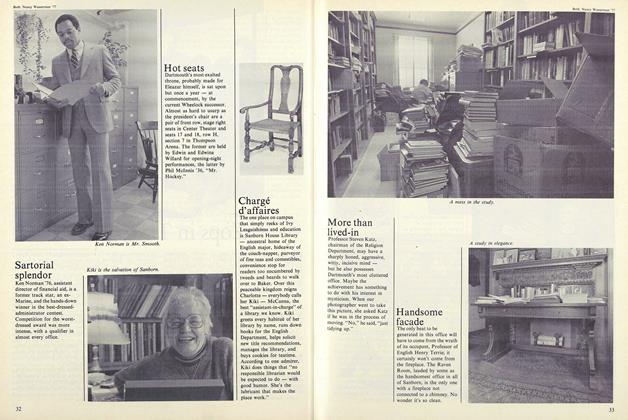
Chargé d'Affaires
April 1981 -
 Cover Story
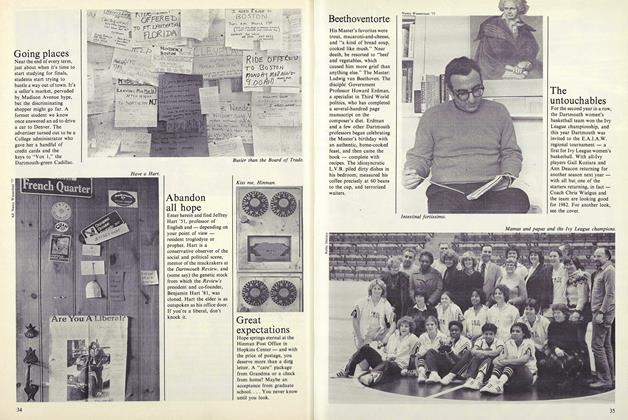
Beethoventorte
April 1981