1948
These notes are written in early March just after word from Hanover was received by alumni announcing election by the Board of Trustees of Dave McLaughlin '54 as the 14th president of the College.
Although, probably like most '48s, I have never met the new president, he is not unknown in view of his active role as chairman of the Board of Trustees over the past four years when a host of problems has faced the College. He also just happens to be known to me from one other source. One Saturday morning back in the autumn of 1974 I was in a small grandstand in the countryside south of Miami watching a high school football game in which one of the teams was from my daughter's small school. Looking around in the stands I saw a face and form that looked familiar. After puzzling the matter a moment I realized they belonged to Elmer Lampe, a well known sports figure around Hanover following WW II and for many years thereafter. Many '48s will remember him. Among his other positions in Hanover, he was the highly successful gridiron end coach during the football reigns of Tuss McLaughry and Bob Blackman. (Elmer played end position on the University of Chicago's varsity when the latter was a Big Ten power in the twenties and when Dartmouth's national champions under Nate Parker '26 took Chicago 33-7 in 1925.)
In 1974 Elmer was closing out his life at a prep school in Florida, still doing what he loved to do - coaching football. We talked at Thanksgiving dinner at our house a few days later when he and Gert joined the Drurys in a Hanover reunion in Miami. What a panoramic recollection of great games, seasons, and people in Dartmouth football history. Harvard. Yale. Cornell. Princeton. It was fascinating to me as a longtime follower of the Big Green football legend who had seen his first game on Memorial Field in 1936. Earl Blaik was coach, Gordon Bennett '37 captain, and all-American Bob MacLeod '39 was in his first varsity season. (I'm a follower who still believes the Fifth Down Game in 1940 was the most exciting game I'll ever see.)
In the course of the discussion someone asked Elmer who in all his career was the greatest end he had coached. Elmer didn't consider very long. "I worked with many great ends over the years, especially at Dartmouth," he said. "I'd have to say, though, that the greatest of all was Dave McLaughlin." This was before McLaughlin had again become very active in Hanover and was high praise from a man who had also tutored such greats as Red Rowe and Dave Beeman of '5O, Dave Thielscher '54, Monte Pascoe '57, Scott Creelman '64, and Bill Calhoun and Bob MacLeod of '67. Our new president is clearly a man of many parts.
In looking at the task taken on by the new chief executive, his fellow Dartmouth men will sympathize with the extent of the economic problems which will probably be the subject receiving his primary continuing attention: How to have sufficient funds consistently available to enable the College to continue providing the best and broadest possible educational experience to its students in keeping with Dartmouth's traditions of excellence.
As a voice from the wide alumni body I respectfully submit, however, that the president may find it of almost equal importance to measure alumni opinion and outlook on some of the policy matters his administration will face. A certain amount of disaffection and disgruntlement are abroad among segments of the alumni. The sources of such discontent need, in the estimation of this Dartmouth man, to be given the opportunity to be brought forth and fully aired. By doing this some of the questions and problems can perhaps be effectively resolved. The morale and loyalty and even the economic support of the alumni (as well as the good of the College), I again submit, could be enhanced by the opportunity for such an open examination of some of the troubling questions at issue.
One of these questions, a matter that on its face seems of small import but which nevertheless affects morale and still exercises many an alumni gathering at which "the way it was" is discussed, is that of the Indian symbol. The matter just won't seem to go away, won't stay dusted under the rug, and still gets stuck in the craw of many an alumnus when the subject is raised. We hope the new president will make it possible for alumni again to discuss and consider this question so that a broader consensus one way or the other may, in time, be achieved and the rancor that exists dissipated.
Wid Washburn recently made a positive contribution to such an objective airing. Wid is a noted historian, a student and scholar of American Indian affairs, director of the Office of American Studies at the Smithsonian, and the author of several books on Native Americans. His recent article specifically discussed the Indian symbol at Dartmouth, cited a fascinating array of fact and reason, and raised fundamental questions over the advisability of any repression of the symbol. In my opinion it could well be read, along with the essay written several years ago by Trustee Bob Kilmarx '50, as bases on which to bring the question before the alumni. Airing and discussion and consideration of the issue may result in a symbol policy for our College that Dartmouth men can be satisfied with as being the best for Dartmouth.
In hoping the new chief will give consideration to this suggestion, I'm sure all '48s join me in wishing Dave McLaughlin the best in keeping Dartmouth the best after he receives the pipe from President Kemeny in June.
10214 del Monte Drive Houston, Tex. 77042
More From This Issue
-
 Feature
Tenure: an academic necessity
April 1981 -
 Feature
Question: Who are the Arts for and, Indeed, Who Owns Dartmouth?
April 1981 -
Feature
Tenure: the tragedy of the slaughterhouse
April 1981 -
 Cover Story
Tops in Their Class
April 1981 -
 Cover Story
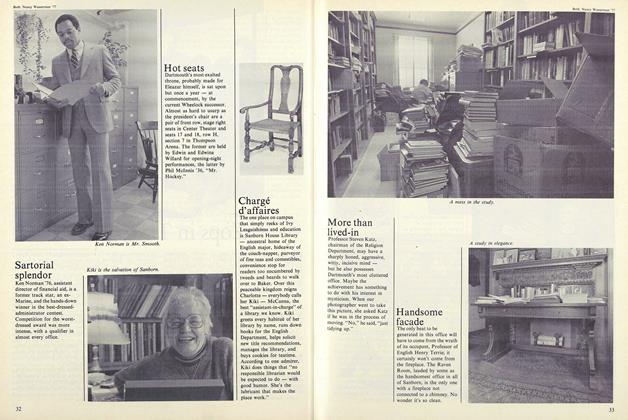
Chargé d'Affaires
April 1981 -
 Cover Story
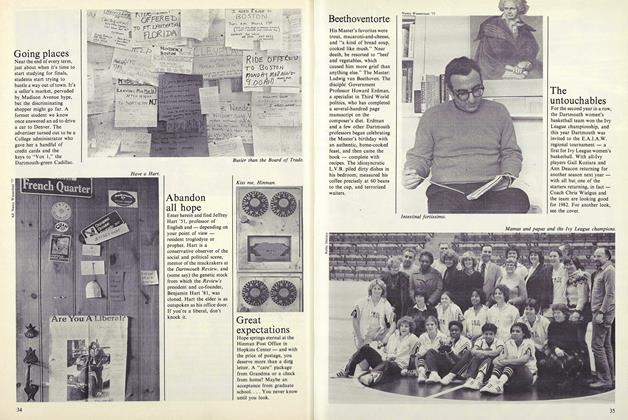
Beethoventorte
April 1981