1934
As we celebrate the 40th anniversary of the end of World War II, it seems appropriate to review our military service. Based on our 1984 questionnaire, 57 percent of '34 had service in one of the military branches: 25.2 percent served in the navy, 24.8 percent in the army, six percent in the air force, one percent in marines. Karl Weber and Bob Wildman were in both army and navy. Goose Goss and Perkins Bass were our two marines. In addition, five percent had other types of service-connected duties: Coast Guard, aviation ground service, railroads, navy research, foreign economics administration, and for EmmonsBrown it was work on atomic arms development at Oak Ridge and Marshall Islands. That was a total of 62 percent. The rest of the class were involved with keeping the homefront machinery churning and supporting families that were still very young.
Now to another anniversary. Just a year ago we occupied the honor seats reserved for the graduates of 50 years ago at Commencement, while 1,019 students received their A.B.'s. An amazing 94 percent of the class of 1984 had stayed the course all the way from matriculation to graduation. They'll have the advantage of a liberal arts education which, as President McLaughlin expressed to us last June, should make them better companions to themselves and more efficient forces in today's world.
it is pertinent to note that currently 70 percent of Dartmouth undergraduates receive scholarships or loans in some form. We can be warmed by knowing we helped with our Alumni Fund giving. By now, most of you will have sent in your gifts, but if by chance you were in the mountains and let your good intentions pile up, send in your check pronto. We want a very high participation so everyone will "know that '34 still sends Golden thoughts back to the Green.
Also, as our bequest chairman, Art Leonard, points out, we can still be there through the far distant future by arranging for a life income trust now or by setting in place a future bequest.
In addition to financial gifts and our direct impact on family, friends, and communities, our contributions to the learning process can continue in unexpected ways after we're gone. From his brother Louis '40 comes word that our late classmate, Henry Rose, was pictured in an old Maiden, Mass., photo that appeared in a newly published book: The FirstJew: Prejudice and Politics in an American Community, 1900-1932. The photo of the Rose family, which had come from Lithuania, was taken in Maiden.
We reviewed our community activity in a previous column and said that political activity would be separately treated. Many, of course, are community-related. All told, we had 28 of those replying to the questionnaire who were elected to local or state offices. A number were named to head the local governing bodies as village, trustee, selectman or town councilor (Board Veazie, HowellChickering, George Beal, Perkins Bass, JimDunn, Stan Smoyer, Isaac Sulzbacher, and A 1 Cotton). Others were elected to school boards (Phil Eckels, Merrill Dubay, BillDaniells, and Sam Carson). We had a lister elected (Walt Bryant) and a justice of the peace (Mayo Cohen) and a member of a state legislature (Ward Harvey).
The difference between elected or appointed was not always clear. For example, George Thomas said he was appointed town constable, but Joe Swenson had to be elected. Nick Nanos and Leland Hunt were elected to the zoning board, and Mac Collins got appointed! Bill Ramsey was on the Nebraska board of education. And we all know we had one elected congressman, Perkins Bass.
Then there were 18 percent of the questionnaire repliers who had accepted appointments to local or state jobs. These ranged from Stan Neill on the finance board, to Henry Necarsulmer on a judiciary relations commission, to Alan Tawse on the draft board, Al Levenson handling rent control, and development review boards claiming ser- vice of Howell Chickering and Bob Singleton. Leon Lindheim had an appointment to the U.S. Annual Assay Commission a few years ago. A number, like Bill Wyne, served on hospital boards.
How about our activity in a political party? Well, one in five stated they were active now or had been in the past.
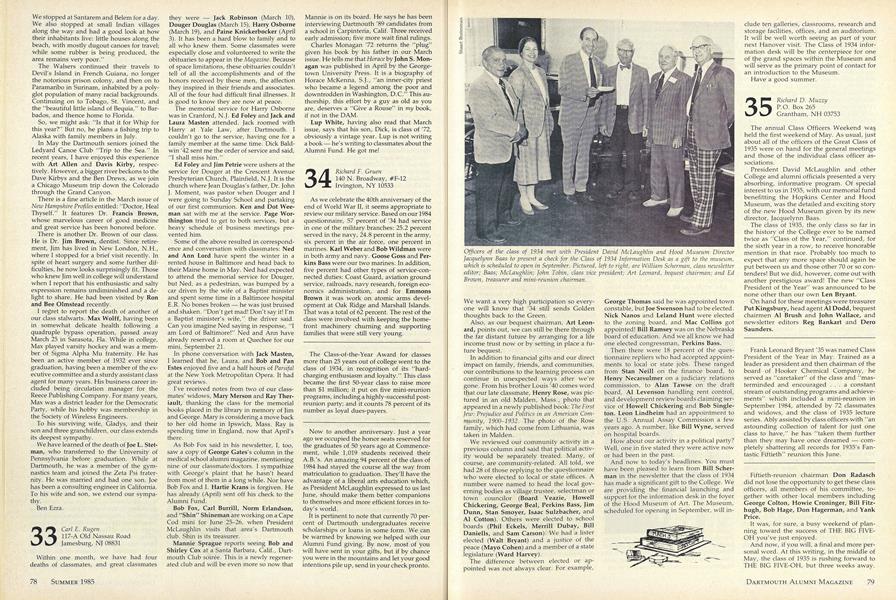
And now to today's headlines. You must have been pleased to learn from Bill Scherman in the newsletter that the class of 1934 has made a significant gift to the College. We are providing the financial launching and support for the information desk in the foyer of the Hood Museum of Art. The Museum, scheduled for opening in September, will inelude ten galleries, classrooms, research and storage facilities, offices, and an auditorium. It will be well worth seeing as part of your next Hanover visit. The Class of 1934 information desk will be the centerpiece for one of the grand spaces within the Museum and will serve as the primary point of contact for an introduction to the Museum.
Have a good summer.
Officers of the class of 1934 met with President David McLaughlin and Hood Museum Directorfaccjuelynn Baas to present a check for the Class of 1934 Information Desk as a gift to the museum,which is scheduled to open in September. Pictured, left to right, are William Scherman, class newslettereditor; Baas; McLaughlin; John Tobin, class vice president; Art Leonard, bequest chairman; and EdBrown, treasurer and mini-reunion chairman.
140 N. Broadway, #F-12 Irvington, NY 10533
The Class-of-the-Year Award for classes more than 25 years out of college went to the class of 1934, in recognition of its "hardcharging enthusiasm and loyalty." This class became the first 50-year class to raise more than $1 million; it put on five mini-reunion programs, including a highly-successful postreunion party; and it counts 78 percent of its number as loyal dues-payers.