How to Savor the Heavens
ALEXA HALFORD | POSTDOCTORAL ASSOCIATE, DEPARTMENT OF PHYSICS AND ASTRONOMY
ALEXA HALFORD | POSTDOCTORAL ASSOCIATE, DEPARTMENT OF PHYSICS AND ASTRONOMY
How to Savor the Heavens
CAMPUS
ASK THE EXPERT
ALEXA HALFORD | POSTDOCTORAL ASSOCIATE, DEPARTMENT OF PHYSICS AND ASTRONOMY
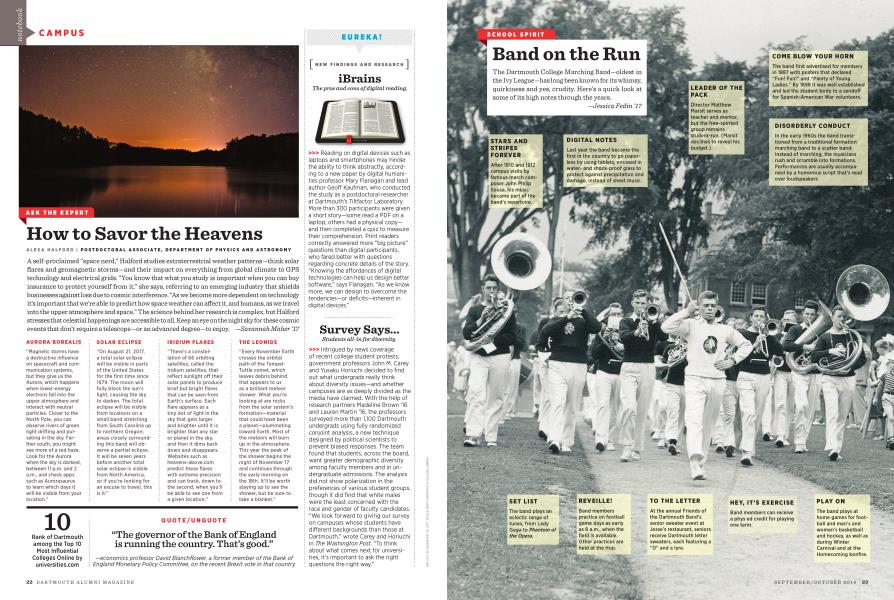
A self-proclaimed “space nerd,” Halford studies extraterrestrial weather patterns—think solar flares and geomagnetic storms—and their impact on everything from global climate to GPS technology and electrical grids. “You know that what you study is important when you can buy insurance to protect yourself from it,” she says, referring to an emerging industry that shields businesses against loss due to cosmic interference. “As we become more dependent on technology it’s important that we’re able to predict how space weather can affect it, and humans, as we travel into the upper atmosphere and space.” The science behind her research is complex, but Halford stresses that celestial happenings are accessible to all. Keep an eye on the night sky for these cosmic events that don’t require a telescope—or an advanced degree—to enjoy.
Savannah Maher ’17
AURORA BOREALIS
“Magnetic storms have a destructive influence on spacecraft and communication systems, but they give us the Aurora, which happens when lower-energy electrons fall into the upper atmosphere and interact with neutral particles. Closer to the North Pole, you can observe rivers of green light drifting and pulsating in the sky. Farther south, you might see more of a red haze. Look for the Aurora when the sky is darkest, between 11 p.m. and 2 a.m., and check apps such as Aurorasaurus to learn which days it will be visible from your location.”
SOLAR ECLIPSE
“On August 21, 2017, a total solar eclipse will be visible in parts of the United States for the first time since 1979. The moon will fully block the sun’s light, causing the sky to darken. The total eclipse will be visible from locations on a small band stretching from South Carolina up to northern Oregon; areas closely surrounding this band will observe a partial eclipse.
It will be seven years before another total solar eclipse is visible from North America, so if you’re looking for an excuse to travel, this is it.”
IRIDIUM FLARES
“There’s a constellation of 66 orbiting satellites, called the Iridium satellites, that reflect sunlight off their solar panels to produce brief but bright flares that can be seen from Earth’s surface. Each flare appears as a tiny dot of light in the sky that gets larger and brighter until it is brighter than any star or planet in the sky and then it dims back down and disappears. Websites such as heavens-above.com predict these flares with extreme precision and can track, down to the second, when you’ll be able to see one from a given location.”
THE LEONIDS
“Every November Earth crosses the orbital path of the TempelTuttle comet, which leaves debris behind that appears to us as a brilliant meteor shower. What you’re looking at are rocks from the solar system’s formation—material that could have been a planet—plummeting toward Earth. Most of the meteors will burn up in the atmosphere. This year the peak of the shower begins the night of November 17 and continues through the early morning on the 18th. It’ll be worth staying up to see the shower, but be sure to take a blanket.”
10
Rank of Dartmouth among the Top 10 Most Influential Colleges Online by universities.com
QUOTE/UNQUOTE
“The governor of the Bank of England is running the country. That’s good.”
—economics professor David Blanchflower, a former member of the Bank of England Monetary Policy Committee, on the recent Brexit vote in that country

More From This Issue
-
 Feature
The Party Crashers
September | October 2016 -
 FEATURE
Peacemaker
September | October 2016 -
 THE DAM INTERVIEW
State of the Union
September | October 2016 -
 RETROSPECTIVE
Valediction
September | October 2016 -
 FACULTY OPINION
I Read, Therefore I Think
September | October 2016 -
 classnotes
Deaths
September | October 2016