Mountain Man
The Antarctic adventures of Sam Silverstein ’58 made history and left his name on one of the continent’s tallest peaks.
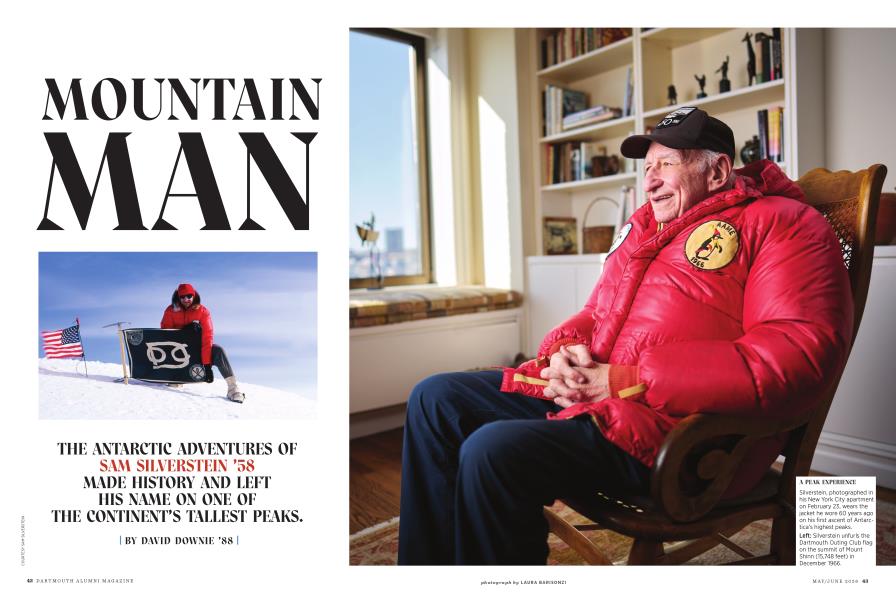
The Antarctic adventures of Sam Silverstein ’58 made history and left his name on one of the continent’s tallest peaks.
MOUNTAIN MAN
THE ANTARCTIC ADVENTURES OF SAM SILVERSTEIN ’58 MADE HISTORY AND LEFT HIS NAME ON ONE OF THE CONTINENT’S TALLEST PEAKS.
DAVID DOWNIE ’88
It was the morning of December 8, 1966, and a 10-man team of experienced mountaineers had just been deposited on the vast ice sheet at the foot of the Sentinel Range in Antarctica, the most desolate and isolated continent on Earth. Sam Silverstein, then 29, looked toward the majestic peaks some 20 miles in the distance.
“It’s all ours!” Silverstein shouted to his fellow climbers over the scream of the Navy C-130 that transported them.
Their mission was audacious. This team—the American Antarctic Mountaineering Expedition (AAME)—hoped to be the first to climb Antarctica’s tallest mountain, the 16,050-foot Mount Vinson, a peak so remote it had been discovered from the air only nine years earlier. No human had ever set foot on its slopes.
As the plane faded into the distance and the snow plumes settled, the climbers realized they had a problem: Where was the fuel for their Polaris snowmobile, essential for transporting 2,000 pounds of supplies to the foot of the mountains? The gas had been left for them days earlier, but all Silverstein and the others could see was a wide expanse of white.
The pilot had given only approximate directions about where to find the red fuel barrel. “Just go to the south of the nunataks [rock outcroppings in the ice sheet] and you’ll see it,” he had instructed. But that was from the air. “On the ground, the snow undulates,” says Silverstein. “So, when you’re on one rise, you can see into that depression but can’t see into the next one.” The drum, they realized, was some 10 miles from where they were standing—but where?
It was an unexpected start to an adventure four years in the planning that had come together through the herculean efforts of many different parties and no small amount of good luck. Now, the team was on the brink of winning the “race to the summit” of Mount Vinson—if they could only find a gas station.
Life threatening? No. But radioing the U.S. Navy base 800 miles away for help finding the barrel was distinctly unappealing. “What a bunch of amateurs we would have felt like,” Silverstein says.
ON A COLD JANUARY DAY 60 YEARS LATER, I rang the doorbell at Silverstein’s apartment on the Upper West Side of Manhattan. I was greeted by an octogenarian with a sparkle in his eye. When I addressed him as Dr. Silverstein, he corrected me: “Just Sam.” It was an elegant setting for the climbing legend, with a breathtaking view of Riverside Park and the Hudson Palisades beyond. He was enthused to recount adventures of his youth and, thankfully, possessed an iron-clad memory of his lifetime of achievements.
Those accomplishments are many. The 1966-67 Antarctica mountaineering expedition has been called one of the most successful of all time, with the AAME summiting six mountains on the continent, including the four tallest, for the first time. For his troubles, Silverstein has a peak in the Sentinel Range named after him, giving him a little piece of immortality. But his youthful exploits have also sometimes overshadowed a lifetime of accomplishments in medicine, science, and biomedical research.
“It never occurred to us that the expedition would be historic,” reflected Silverstein. “But in addition to climbing the highest peaks in Antarctica, it opened Antarctica to ecotourism so others could explore the continent’s nature and climb its mountains.”
He arrived at Dartmouth in 1954 from Fountain Valley School, aboarding school close to 14,115-foot Pikes Peak in Colorado, where one of his teachers and the school’s rock-climbing instructor was Robert Ormes, who had written the preeminent guide to climbing and hiking in the state. Climbing nearby Cheyenne Canyon with Ormes nurtured Silverstein’s lifelong passion for mountaineering.
"IT NEVER OCCURRED TO US THAT THE EXPEDITION WOULD BE HISTORIC.” SIX FIRST ASCENTS IN AN UNEXPLORED RANGE IN AS MANY WEEKS, INCLUDING THE FOUR HIGHEST SUMMITS IN ANTARCTICA
U ONE OF THE MOST SUCCESSFUL MOUNTAINEERING EXPEDITIONS OF ALL TIME”
-DAMIEN GILDEA, AUTHOR OF THE DEFINITIVE MODERN REFERENCE ON ANTARCTIC CLIMBING
He was drawn to Dartmouth in part for the same reason as many prospective students: proximity to good skiing. But the fit extended far beyond that.
Outside the classroom, Silverstein was busy. He joined a fraternity, wrote for The Dartmouth, served on the student council, and played squash. But he felt most at home in the Dartmouth Outing Club and Mountaineering Club.
As often as he could, Silverstein climbed in the White Mountains and elsewhere with like-minded classmates, including Dave Dingman ’58, Jake Breitenbach ’57, and Barry Corbet ’58, a longtime friend whose climbing accomplishments and later advocacy for those living with spinal cord injuries inspired many. (These three—with Barry Bishop ’53 and Barry Prather ’61—would go on to join the first American expedition to summit Mount Everest in 1963.) It was while Silverstein was reviewing materials from the Mountaineering Club that described unmapped and unclimbed peaks in British Columbia that he had an epiphany: “You didn’t have to go to the Himalayas” to make a first ascent.
He graduated from Dartmouth in 1958 with a clear path to medical school and an epiphany that would direct his next steps: “For the first time, I realized that there were unclimbed mountains in North America, and that really appealed to my sense of adventure—and being/zrst.”
It didn’t take him long.
Shortly after graduation, Silverstein achieved his first “first” when he and several Dartmouth friends ascended and mapped the principal peaks of the Battle Range in British Columbia, a popular destination for mountaineers. They went on to publish their findings and photographs in the Canadian Alpine Journal in 1960.
Later, while at the Albert Einstein College of Medicine in 1962, Silverstein persuaded the dean to allow a short sabbatical to research “high-altitude physiology,” and he traveled to Alaska’s Mount McKinley (aka Denali), at 20,310 feet the highest peak in North America. With high school classmate Charles Hollister, Chris Wren ’57, and three others, Silverstein made the first successful ascent along McKinley’s steep southeast spur. The climb was featured in Look magazine, which described it as “one of the most dramatic feats in North American mountaineering.”
Four years later, when Silverstein was a postdoctoral fellow at Rockefeller University, the AAME finally received the green light to tackle Mount Vinson. The Antarctic Treaty of 1959 had designated Antarctica as a continent of peace, and international competition to claim Antarctica’s highest summit was heating up. The AAME team, led by Nicholas Clinch, included some of the top mountaineers in the United States, most of whom Silverstein already knew, including Hollister and Corbet. All the familiar faces made him even more excited: “One of the things I learned very early on is that you don’t go into the mountains with people you don’t know and you don’t trust.”
From the moment they arrived in Antarctica on December 8, the team operated in brutal, unforgiving conditions: 24-hour sunlight, temperatures that dipped below minus-30 F, high winds with gusts at 70 mph, and sudden, blinding snowstorms. When asked about the Antarctic cold, however, Silverstein was unfazed: “Freshman year, I had to take swimming because I hadn’t passed the swimming test in the fall. I remember getting up in the morning and walking to the gym when it was minus-20 or minus-25. That wasn’t a great way to wake up in the morning.”
To be sure, the expedition got off to an inauspicious start when the team couldn’t find the gasoline for the snowmobile. After sending out three search parties during two days, they recovered the fuel barrel and approached their objective: Mount Vinson.
After establishing base camp at Vinson, they worked like a well-oiled machine to open a route to the summit. This was textbook, siege-style climbing: As one part of the team was setting up a camp, another was ferrying 40to 60-pound loads from below and a third was moving higher to set up the next camp and cache supplies—crossing icefall and skirting avalanche debris in temperatures that dipped to minus-20. Again and again, working in three teams, the mountaineers repeated this deliberate, coordinated procession up the mountain, moving like a giant inchworm clad in red down parkas.
On December 18—just 10 days after landing—the four-member assault team reached the summit in one final, six-hour push from Camp III at an altitude of more than 14,000 feet. The team planted flags of the 12 signatory nations of the Antarctic Treaty of 1959 and took ceremonial summit photos. During the following two days, the remaining six members of the expedition summited under similar conditions.
As they took in the grandeur of the Sentinel Range from Vinson’s summit, the mountaineers were already turning their attention 8 miles away to Mount Tyree, Antarctica’s second-highest peak at almost 16,000 feet. Tyree was only 131 feet shorter than Vinson, but it promised a far greater technical challenge thanks to its sweeping, 6,000-foot cliff faces, snow-plastered headwalls, and jagged ridge spines. Vinson had been an “easy mountain,” nothing more than a “long walk,” says Silverstein. “But the reason I wanted to go to Antarctica was not to climb Vinson but to climb Tyree.”
Tyree would ultimately yield—but not without a fight.
In their assault on Mount Tyree, the mountaineers climbed rugged terrain that was by turns steep snow, hard ice, and rock face while exposed to high winds attempting to wrench them from their precarious holds. For the first time on the expedition, they were forced to use heavy-duty mountaineering hardware—steel pitons and carabiners—and the crampons on their boots struggled to bite into the hard ice. Progress was slow and exacting.
Barry Corbet and John Evans were the team chosen to attempt to summit. Through two days, the pair tried several summit pushes along a knife-edge ridge of intermittent rock, snow, and ice with 8,000-foot sheer drops on both sides. One later described it as a “gale-whipped tightrope.” Their path to the summit was blocked by two 500-foot steep rock formations. On a final attempt, the pair climbed down the glacier on one side and bypassed the obstacles—a detour later described as “skilled evasion” by Corbet. After more than 12 hours of treacherous climbing, they reached the summit at 6 p.m. on January 6.
“It was just a beautiful day,” says Silverstein. “I can still remember that day and the feeling of satisfaction that we’d actually climbed Tyree.”
Silverstein recalls Tyree as a “very good climb” but also very risky, primarily because the camp where the backup team waited at 14,000 feet was so far away. That meant any help would take precious time to arrive. “If a big storm had come, you were way out on a limb,” he says.
During the course of six weeks in the Sentinel Range, the team also conquered Antarctica’s thirdand fourth-highest peaks, Mounts Shinn (15,748 feet) and Gardner (15,371), and two others for good measure, Ostenso (13,714) and Long Gables (13,616). Each had its challenges but none as difficult as Tyree.
As the mountaineers waited on the polar plateau at the aircraft landing site for the ride home on January 17, the magnitude of their accomplishment began to sink in: six first ascents in a totally unexplored range in as many weeks, including the four highest summits in Antarctica. Damien Gildea, author of Mountaineering in Antarctica: Climbing in the Frozen South, described it as “one
of the most successful mountaineering expeditions of all time.” “That range of mountains was gorgeous,” Silverstein says, “and it was a real privilege to get a first crack at them.”
Silverstein returned from Antarctica, then married Jo Ann Kleinman, his wife of 59 years. He shifted focus to medicine and then scientific research in his quest for more firsts. During the next five decades, he conducted groundbreaking research in cell biology, cellular physiology, immunology, and infectious diseases. He is recognized for advancing understanding of the structure and functions of white blood cells and their roles in defending humans against microbial pathogens. His achievements in science, education, and public policy fill an extraordinary, 11-page GV listing multiple professorships, honors, awards, patents, research papers, and publications.
As our interview was winding to a close and light began to fade over the Hudson River, Silverstein was clear about how he wants to be remembered: “Physician-scientist, first; then mountaineering.”
History may well agree. How can one compare a career spent advancing science through half a century with a six-week adventure almost 60 years ago? Yet the story of the AAME on the ice in Antarctica in 1966-67 captures the imagination—and today there stands a prominent peak in the Sentinel Range that bears his name. The honor came in 2006 at the suggestion of Gildea of the Advisory Committee on Antarctic Names. “I had no idea he was doing that,” Silverstein says with a smile.
Silverstein Peak—a 15,715-foot mass of rock, ice, and snow— will appear on the maps of West Antarctica in perpetuity and surely outlast us all.
DAVID DOWNIE is an associate general counsel with Bank of America. He wrote the Susan Blader tribute in the January/February issue.