AROUND THE GREEN Securing a Safe Haven
Mass shooting at Brown prompts Dartmouth to review protocols.
Mass shooting at Brown prompts Dartmouth to review protocols.
AROUND THE GREEN Securing a Safe Haven
Notebook
Mass shooting at Brown prompts Dartmouth to review protocols.
The shooting deaths of two students and the wounding of nine others at Brown University by a lone gunman in midDecember—and the fatal shooting two days later of an MIT physics professor—sent shock waves through colleges and universities across the country. During winter break, Dartmouth immediately increased security patrols on campus, as it does for busy weekends such as Homecoming, Winter Carnival, and Green Key.
In an early January message to the community, President Beilock expressed sympathy to colleagues and friends of the victims and said the College is reviewing its emergency notification systems and protocols for responding to a violent intruder. “Protecting our community’s safety is something my entire leadership team takes very seriously,” she said.
On an idyllic campus where many buildings are unlocked and readily accessible, security is a balancing act, says Josh Keniston, senior vice president for operations. “One of the things that makes Dartmouth a special place is the openness and the allowing of community on our campus. So right now, our thinking is not to lock everything down. I think that would really be counter to the culture and ethos of Dartmouth, but how do we then balance that? What else do we need to do to make sure we’re keeping people safe?”
He emphasizes that the College already has “pretty comprehensive emergency response plans. We’re not starting from scratch. And within those plans are a bunch of scenarios in different situations: How would we respond? How would we communicate? What would we do?”
The College planned to review its emergency preparedness plans in late January to improve information flows and address concerns. “We may decide to make some tweaks or adjustments to reflect where we are today,” Keniston says.
One question is whether additional buildings on campus should require a Dartmouth ID for entry. Residence halls already are key-locked, and the College has a well-established policy about security cameras. It requires outward-facing cameras on buildings such as residence halls, where there’s an expectation of privacy inside.
Keniston encourages everyone on campus to utilize the LiveSafe app, a free download for smartphones that the College introduced in 2015. It enables people to easily ask for help if they feel threatened. He also wonders whether the DART alert system that sends out emergency messages is reaching community members in the best way: “A question we’re asking ourselves right now is, ‘Do they have it on the right device and at the right time?’ ”
He says it’s essential to learn from tragedies elsewhere. “We don’t have the answers today. I think we’re always cautious about not being too reactive to the most recent thing. But the Brown and MIT tragedies offer a chance to say, ‘These played out in new ways, in ways that we haven’t necessarily seen in recent history,’ and to ask, ‘What could we learn that we should incorporate into our own processes?’ ”
Nancy Schaeffler
VISITING VOICE
“I think since World War II, what we’ve learned is a collective response is the most effective response.”
-MARK BRZEZINSKI ’87
FORMER U.S. AMBASSADOR TO POLAND AND SWEDEN, SPEAKING AT HALDEMAN CENTER ON JANUARY 13
WINNING 76-68
Score of the men’s basketball win over Harvard, the team’s first victory in an Ivy League opener on the road since the 1998-99 season
ART ON LOAN
65
Students who live with artworks borrowed from the Hood Museum as part of the second year of its Student Art Lending program
WHEN DR. SEUSS EMAILS ...
Thousands of students spilled onto the Green for the annual midnight snowball fight in January, which The D calls “Snowballapalooza!” “It’s all about the footwork,” one ’26 told reporter Leila Brady ’27. Another put his engineering chops to work and built a snowball catapult. (It didn’t work.) And, braving the cold and the flying snowballs, a few students streaked.




Nancy Schaeffler
Notebook
-
 notebook
The Mural of the Story
NOVEMBER | DECEMBER 2019 -
 notebook
Virtual Sendoff
JULY | AUGUST 2020 -
 notebook
How to Maintain Your Bike
MARCH | APRIL 2018 -
 notebook
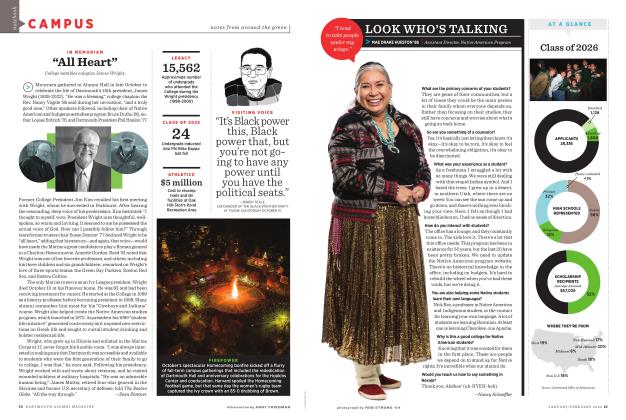
LOOK WHO’S TALKING
JULY | AUGUST 2023 -
 notebook
The Call to Lead
JULY | AUGUST 2018 -
 notebook
IN MEMORIAM “All Heart”
JANUARY | FEBRUARY 2023
