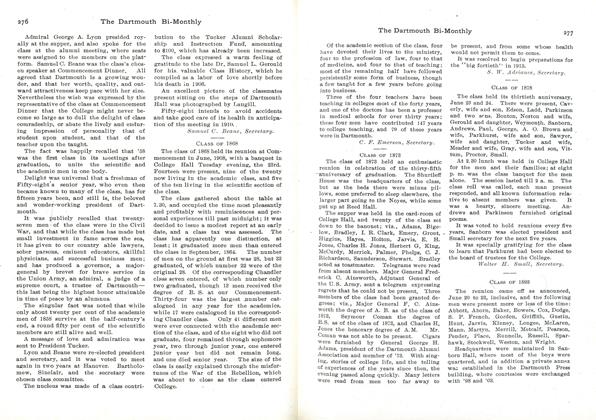
CLASS OF 1858
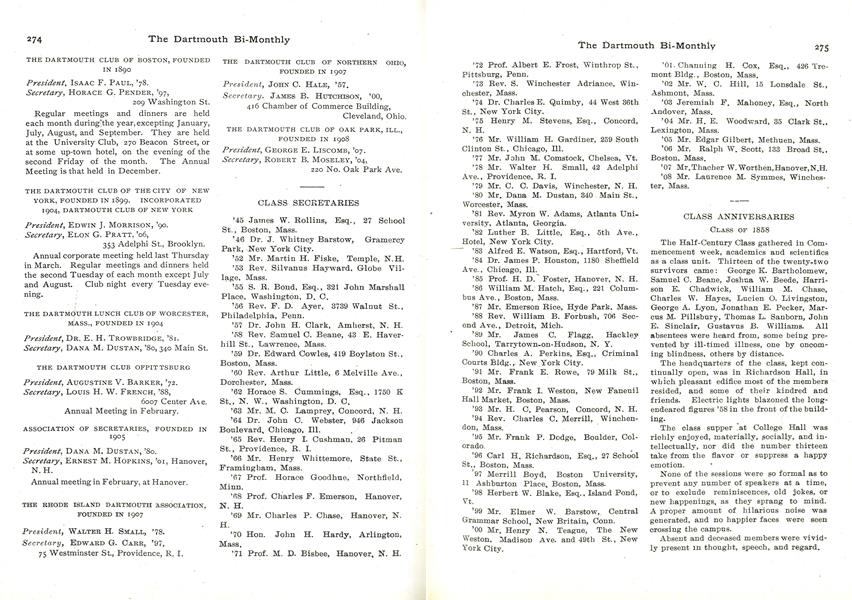
The Half-Century Class gathered in Commencement week, academics and scientifics as a class unit. Thirteen of the twenty-two survivors came : George K. Bartholomew, Samuel C. Beane, Joshua W. Beede, Harrison E. Chadwick, William M. Chase, Charles W. Hayes, Lucien O. Livingston, George A. Lyon, Jonathan E. Pecker, Marcus M. Pillsbury, Thomas L. Sanborn, John E. Sinclair, Gustavus B. Williams. All absentees were heard from, some being prevented by ill-timed illness, one by oncoming blindness, others by distance.
The headquarters of the class, kept continually open, was in Richardson Hall, in which pleasant edifice most of the members resided, and some of their kindred and friends. Electric lights blazoned the longendeared figures '58 in the front of the building.
The class supper .at College Hall was richly enjoyed, materially, socially, and inellectually, nor did the number thirteen take from the flavor or suppress a happy emotion.
None of the sessions were go formal as to prevent any number of speakers at a time, or to exclude reminiscences, old jokes, or new happenings, as they sprang to mind. A proper amount of hilarious noise was generated, and no happier faces were seen crossing the campus.
Absent and deceased members were vividly present in thought, speech, and regard.
Admiral George A. Lyon presided royally at the supper, and also spoke for the class at the alumni meeting, where seats were assigned to the members on the plat" form. Samuel C. Beane was the class's chosen speaker at Commencement Dinner. All agreed that Dartmouth is a growing wonder, and that her worth, quality, and outward attractiveness keep pace with her size. Nevertheless the wish was expressed hy the representative of the class at Commencement Dinner that the College might never become so large as to dull the delight of class comradeship, or abate the lively and enduring impression of personality that of student upon student, and that of the teacher upon the taught.
The fact was happily recalled that '58 was the first class in its meetings after graduation, to unite the scientific and the academio men in one body.
Delight was universal that a freshman of Fifty-eight's senior year, who even then became known to many of the class, has for fifteen, years been, and still is, the beloved and wonder-working president of Dartmouth.
It was publicly recalled that twentyseven men of the class were in the Civil War, and that while the class has made but small investment in fame across the sea, it has given to our country able lawyers, sober parsons, eminent educators, skillful physicians, and successful business men; and has produced a governor, a major-general by brevet for brave service in the Union Army, an admiral, a judge of a supreme court, a trustee of Dartmouth—this last being the highest honor attainable in time of peace by an alumnus.
The singular fact was noted that while only about twenty per cent of the academic men of 1858 survive at the half-century's end, a round fifty per cent of the scientific members are still alive and well.
A message of love and admiration was sent to President Tucker.
Lyon and Beane were re-elected president and secretary, and it was voted to meet again in two years at Hanover. Bartholomew, Sinclair, and the secretary were chosen class committee.
The nucleus was made of a class contribution to the Tucker Alumni Scholarship and Instruction Fund', amounting to $100, which has already been increased.
The class expressed a warm feeling of gratitude to the late Dr. Samuel L. Gerould for his., valuable Class History, whioh he compiled as a labor of love shortly before his death in 1906.
An excellent picture of the classmates present sitting on the steps of Dartmouth Hall was photographed by Langill.
Fifty-eight intends to avoid accidents and take good care of its health in anticipation of the meeting in 1910. .
More From This Issue
-
 Article
ONE HUNDRED AND THIRTY-NINTH COMMENCEMENT OF DARTMOUTH COLLEGE
August | September 1908 -
 Article
THE CONFERRING OF DEGREES
August | September 1908 -
 Article
THE CURRENT INCOME AND EXPENSES OF THE COLLEGE
August | September 1908 -
 Class Notes
LOCAL ASSOCIATIONS
August | September 1908 -
 Class Notes
CLASS OF 1898
August | September 1908 -
 Class Notes
CLASS SECRETARIES
August | September 1908