THE FRATERNITY SITUATION

No better summary of the fraternity situation up to September 28, can be given than that which appeared in TheBoston Evening Transcript for that date. To quote from the Transcript:
In June, 1912, "two seasons were proposed, one, subsequently adopted, to terminate September 28, and another, to be taken up in the second semester, and to terminate March 15. Both were discussed by the fraternity council, but a disgust with the whole problem, a desire to make the pledging season as short and as unobtrusive as possible, and a general distrust of the ability of all the chapters to abide by the agreements necessary to the honorable conducting of a long season, induced the short season to be adopted by a vote of twelve to six. At the time of the council the six minority chapters served notice of their dissatisfaction, but attempted no definite action before the closing of College. During the summer, however, five chapters, .... prepared a letter to the freshman class, advising them that they would issue no invitations before March 15, stating in a fair way the reasons for the action, and, asking the freshmen to accept no invitation until they had been given opportunity to consider all the available ones.
"The matter stood at this point at the opening "of College. Since that time the breach has been widened appreciably by the natural activities of both sides in their attempts to secure or prevent the success of the season terminating September 28. Both sides have employed all available methods to impress their side of the case upon the entering class. Letters have been sent, pamphlets issued, and press statements made in abundance. On September 20, moved by the passage of resolutions warning freshmen that a pledge once accepted would be considered as binding, and re-enacting the short season rules adopted in June, the five long season chapters withdrew from the council, giving as their reason the fact that their former advocacy of the long season had been no violation of the letter of the interfraternity council's ruling, which merely forbade the issuance of a pledge before September 28."
After the short-season pledge-day it at once became evident that fraternity rushing was by no means at an end, but, on the contrary, was certain to continue until March. The seriousness of the outlook was sufficient to cause President Nichols to state plainly that some action must be taken. Whatever that action was to be, it must be based on the desire to uphold the democracy of the College, upon the supposition that gentlemen ought to keep their agreements with one another, and upon the desire to give every freshman a chance to show his worth and to get a foothold in the College. In view of the gravity of President Nichols' warning, for such it was, the five fraternities upholding the long season and the twelve short season fraternities once more united to confer on an adjustment which should regulate all future fraternity relations with the unpledged members of the class of 1916. At this first meeting of the once more united fraternity council, it was proposed that an agreement be ratified which provided that no fraternity should rush or pledge any member of the class of 1916 until at least two weeks after the opening of College in the fall of 1913. To fulfill, the immediate demands of the situation it was voted that all fraternity rushing activities should cease from that date until a final 'chinning method should be decided upon.
On October 15, Sigma Alpha Epsilon pledged a freshman, thereby acting in direct violation of the interfraternity compact. Palaeopitus requested the interfraternity council to take steps in the matter, which resulted in a resolution being drawn up reprimanding the offending group. This resolution was published in The Dartmouth, sent to the local chapter, and to the national council of the fraternity. The interfraternity council then voted to address a letter to President Nichols regarding further action which may be taken.
Viewed from a calm and reflective standpoint the fraternity upheaval is not altogether without hopeful signs. A realization of the failure of a double system and of the attempt to maintain two unrelated factions is general among the fraternity men. That a genuine desire to find and to enforce some agreement embodying the three heads stated by President Nichols is evidenced by the action taken regarding the violation of the temporary agreement. It would seem that the majority of the fraternities are beginning to realize the seriousness of rank dishonesty. When once this spirit is thoroughly imbued in the policies of every fraternity, the biggest step towards a working solution of the problem will have been taken.
More From This Issue
-
 Article
THE COLLEGE TEACHER IN POLITICS
November 1912 -
 Article
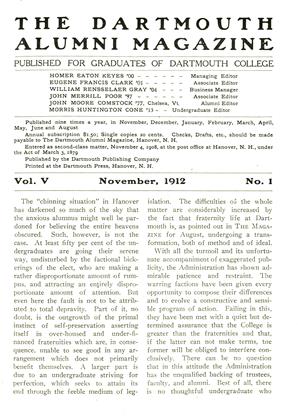
The "chinning situation"
November 1912 -
 Article
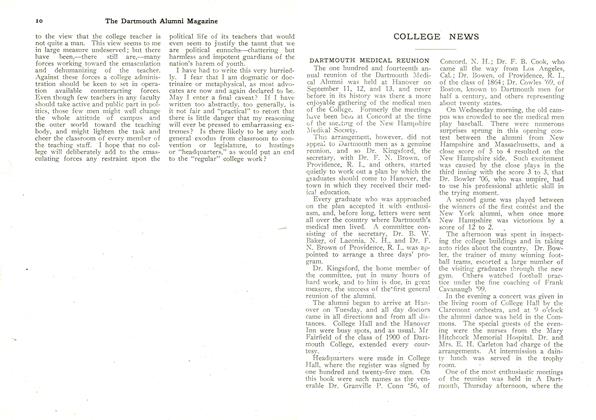
DARTMOUTH MEDICAL REUNION
November 1912 -
 Class Notes
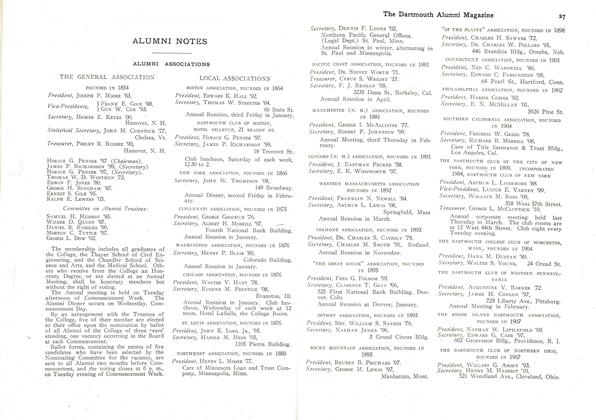
LOCAL ASSOCIATIONS
November 1912 -
 Article
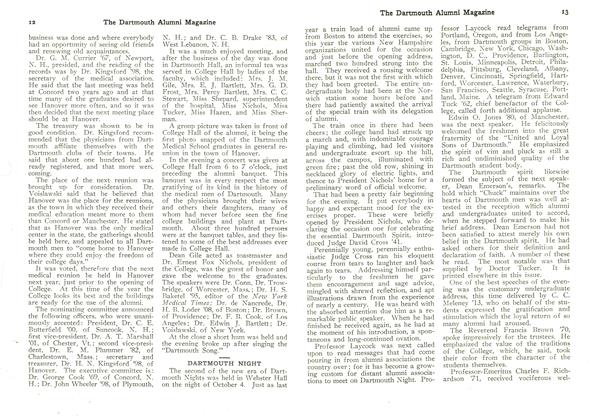
DARTMOUTH NIGHT
November 1912 -
 Article
ADDRESS TO STUDENTS ON THE OCCASION OF OF THE OPENING OF COLLEGE SEPTEMBER 19, 1912
November 1912