SEASON OF THE CLUBS
Dartmouth clubs thrive in the winter time and it is surprising to see the assortment offered when the season is at its height. Not only are there musical clubs, athletic clubs, language clubs, literary clubs, political clubs, and eating clubs; but there are sectional clubs, preparatory school clubs, and faculty clubs; not to mention a press club, an aero club, a camera club, a scientific fraternity, and a bird society.
Latest among the political clubs is the one for the discussion of woman's suffrage, mentioned in the last issue. This club is particularly liberal in that it admits not only suffragists but antisuffragists as well. The club plans to secure popular speakers on the suffrage question to address the College, the first to be Dr. Anna Shaw, who will come to Webster' Hall within a week or two.
Through the efforts of Edward Tuck '62 and Professor Dow, Le CercleFrançais has recently been affiliated with the national Alliance Française. The circle secured Professor Diehl of the Sorbonne to give an illustrated French lecture on Constantinople at Dartmouth Hall the nineteenth of last month. The public was admitted to this as it will be to subsequent lectures of a similar nature not yet definitely arranged for. The generosity of Mr. Tuck will make available annually as speakers in Hanover, two official lecturers of the Alliance.
At its first meeting the Webster Club elected L. B. Schell '12 to fill the vacancy caused by the marriage and with- drawal from College of its presidentelect P. E. Martin '12. Faculty and possibly outside speakers will address future meetings of the club on political, social, and economic questions. The usual, presidential-year Democratic and Republican clubs have so far failed to appear, although a Wilson Club was rumored a short while ago.
The preparatory school and locality clubs are of a very transitory nature. They come and go as the number of men from different parts of the country varies or as the groups prove convenient or the reverse. Some of them meet, elect officers, select a committee to make plans for the year, then adjourn sine die and meet again the next year to elect other officers and make new plans. It has even been claimed in a few instances that meetings were held for the sole purpose of getting the names of members into the Aegis. Yet a number of these clubs are thoroughly alive, and especially so this year. No less than five new sectional clubs have been formed in the last two months. It may be of interest to graduates to see how these correspond to the alumni associations.
Three of the new clubs based on locality are of Massachusetts: the Brookline club, the City of Worcester club, and the Southeastern Massachusetts club; one is of New Hampshire, the Concord club, and one hails from the West, the Mile High club of Denver. Some of these may have existed before, but if so they have lapsed, for none of them appear in recent volumes of the Aegis. Only two sectional clubs were given in the 1912 annual, the Lynn Club with twenty-eight members and the Cleveland Club with thirteen members.
Of the several preparatory school clubs, the Phillips club has been the most active. Formerly it has been made up of men from both Phillips Exeter and Phillips Andover, but a few weeks ago the men from the two schools separated into Exeter and Andover clubs. They plan to hold a joint dinner each year. On the occasion of the Freshman-Andover football game, the Phillips club entertained the visiting team. Several of these clubs entertain track teams from their schools at the time of the Interscholastic Meet. Worcester boasts a Worcester Academy club as well as its city club.
Other school clubs are: The Gushing club; the Erasmus Hall club of Brooklyn; the Clinton club of DeWitt Clinton High school, New York City; and the University High club of Chicago.
More From This Issue
-
 Article
ACADEMIC AND INDUSTRIAL EFFICIENCY
February 1912 -
 Article
It is to the younger alumni only that the Reverend Frank L. Janeway
February 1912 -
 Class Notes
CHICAGO ASSOCIATION
February 1912 -
 Article
THE THAYER SCHOOL OF CIVIL ENGINEERING
February 1912 -
 Article
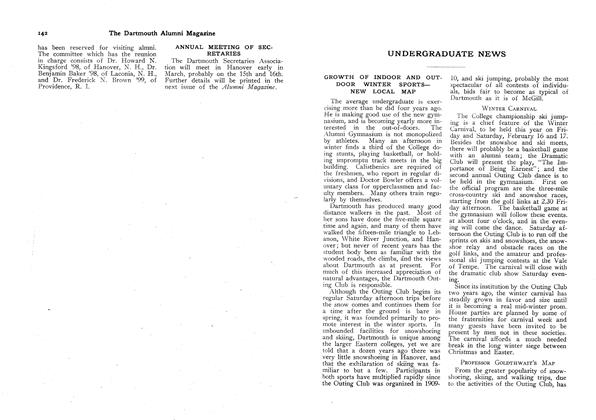
GROWTH OF INDOOR AND OUTDOOR WINTER SPORTS-NEW LOCAL MAP
February 1912 -
 Class Notes
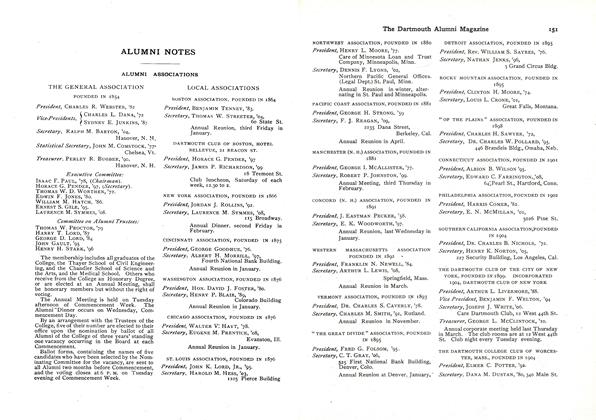
LOCAL ASSOCIATIONS
February 1912