CLASS OF 1884
Joseph Arend DeBoer died at his home in Montpelier, Vt., on the morning of Christmas Day, of cancer of the throat, after a painful and lingering illness.
The son of Jan Arend and Anje Peiter (Kuiper) DeBoer, he was born June 17, 1861, at Warffum, Province of Groningen, Holland. His father died soon after, and Joseph came to America with his mother and stepfather at the age of seven, and lived in Albany, N. Y. The family were in humble circumstances, and the boy aided in his own support and that of the family by selling papers and in other ways. He passed through the city schools, graduating from the high school in 1880.
In College he was a member of Kappa Kappa Kappa. He maintained an excellent record for scholarship, taking prizes in oratory sophomore and junior years and in Greek junior year, and was elected to Phi Beta Kappa at graduation. In senior year he was business manager of The Dartmouth.
For the first year after graduation he was master in Holderness School for Boys, at Plymouth, N. H., and then came to Montpelier as principal of Montpelier Union and Washington County Grammar Schools.
After four years he resigned this position to become actuary for the National Life Insurance Company of Montpelier. With this company his main life work was done, and he saw it rise to a place in the first rank among insurance companies of the country,— an advance which was due largely to his own efforts. In 1897 he became director and secretary of the company, in 1900 second vice-president, in 1901 first vice-president, and in March, 1902, its president. In recognition of his high standing as an expert in insurance matters, the College bestowed upon him in 1909 the honorary degree of Doctor of Science.
Mr. DeBoer was recognized as the first citizen of his adopted city, and one of the ablest and most public-spirited men in the state. He served the state in its Senate in 1900 and in its House of Representatives in 1908. In 1912 he was a candidate for the Republican nomination for governor, and was defeated only because he refused to adopt methods in the canvass which he deemed unworthy. His successful competitor had no such scruples, but was nearly defeated at the polls, while Mr. DeBoer, if he had been nominated, would without doubt have received a substantial majority. If he had lived and retained his health, there is little doubt that he would have been nominated and elected this coming fall.
Among the other public positions which he had held were those of secretary of the Vermont Historical Society, trustee of the Washington County Grammar School, trustee of the Wood Art Gallery, president of the Montpelier Board of Trade, member and secretary of the Permanent School Fund Commission of the state, and chairman of many important local civic committees. He was a communicant and officer of Christ (Episcopal) church, and held important positions in the diocese.
December 22, 1885, Mr. DeBoer was married to Augusta Charles Featherly of Albany, N. Y. Of their five children, three daughters and a son survive, with their mother, the son being a member of the present freshman class at Dartmouth. Another daughter died in childhood.
This sketch of Mr. DeBoer would be incomplete if it failed to mention his unusual loyalty and devotion to his class and to the College. He is the only member of 'B4 who has been present at every reunion of the class, and those who have been most intimate with him could testify to the depth of his affection for his classmates and his Alma Mater.
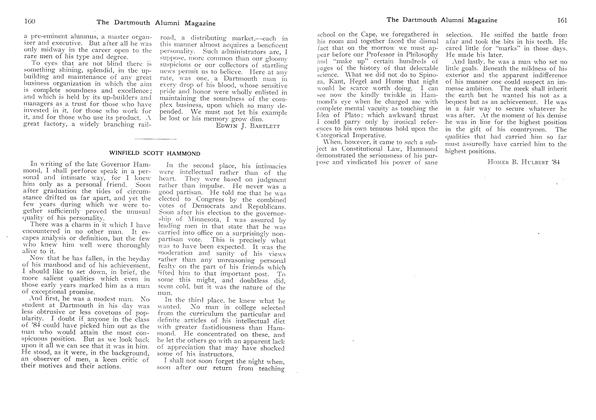
Winfield Scott Hammond was born in Southboro, Mass., on the 17th of November, 1863. He was the son of John W. and Ellen Harding Hammond. He grew up in his native town, and attended its public schools, graduating from the Peters High School in 1880 as valedictorian of his class. He entered Dartmouth College the following September, taking the classical course. He was a member of the Kappa Sigma Epsilon freshman society, and at the end of freshman year joined Kappa Kappa Kappa fraternity. He was president of the class during the fall term of senior year, and Class Day orator at Commencement.
In September, 1884, Hammond went to Minnesota, and for the school year of 1884-85 he was principal of the Mankato High School. He was superintendent of schools of Madelia, Minn., from 1885 till 1890, when he was admitted to the bar and began the practice of law. In 1895 he removed to St. James, where he has since resided. He soon after entered the public service, and served for six years as county attorney of Watonwan County, and was for eight years a member of the State Board of Normal School Directors. In 1892 he was defeated for Congress in the second district of Minnesota, but in 1906 he defeated his old rival, the Hon. James Thompson McCleary, for the coveted seat, and served his district for four terms in Congress, receiving at each recurring election an increased majority of the votes cast. During his last two terms in Congress he served on the important Ways and Means Committee, which in these two Congresses was also the Committee on Committees in the House, and made all committee assignments. He had now attained a position of prominence among the leaders of his party, and had no small part in shaping the legislation enacted by these two Congresses. At the Democratic convention of 1908 he presented the name of Governor John A. Johnson as Minnesota's candidate for the nomination in a speech that gave him high rank as an orator and showed him to be among the foremost thinkers of his party. In 1914 he became a candidate for the nomination for governor of Minnesota before the primary election held in June of that year. He was in Hanover in attendance on the Thirty Year reunion of his class when he received the news of his success at the primaries, and was compelled to start at once for St. Paul in order to conform to the requirements of the primary law. In the campaign which followed Hammond was able to make only a few speeches in the state, because the long session of the 63rd Congress demanded his attendance at Washington. He was elected by a plurality of 12,574 votes. The other candidates on his ticket were defeated by pluralities exceeding 85,000 votes. In political parlance, Hammond ran nearly 100,000 votes ahead of his party, a splendid tribute to his personal popularity. The Minneapolis Tribune, a Republican paper, in its issue of November 3, the day before the election, said among other things in summing up the gubernatorial situation: "A third among predominant contributory causes of the unexpected strength of the Democratic candidate is that the people have a firm impression that Mr. Hammond is one of the big men of the nation, and that were he elected, Minnesota would have a really big man for governor." Hammond was inaugurated governor early in January, 1915. He died on the morning of December 30 of apoplexy in Clinton, La., whither he had gone with an associate to inspect some large land interests he had there. For five years Hammond has had a place among the ablest men, in the Democratic party. His election to the governorship of the state of Minnesota under conditions before detailed made him without question one of the strongest men in his party. His public career seems cut off in the morning of its promise, and the state and nation are greatly poorer because of his death. His life was a sturdy exemplification of the ideals he cherished of public service. The people of his state trusted him and gave him the highest honor in their power to bestow.
Hammond loved Dartmouth, and was one of the most loyal members of the class of 1884. He was present at all class reunions save two. He was a regular attendant on the annual banquets of the Alumni Associations at Washington and Minneapolis, holding at the time of his death the presidency of the Northwest Association. He gave of his means to the support of the College, his name appearing on the lists of contributors to the various enterprises undertaken for the benefit of the College. In his death, Dartmouth has lost one of her honored sons, and the class of 1884 one of its loyal and greatly esteemed members.
More From This Issue
-
 Article
DARTMOUTH SECRETARIES ASSOCIATION
February 1916 -
 Article
RICHARD NELVILLE HALL '15
February 1916 -
 Article
DARTMOUTH AND THE SECONDARY SCHOOLS
February 1916 -
 Class Notes
LOCAL ASSOCIATIONS
February 1916 -
 Class Notes
CLASS OF 1861
February 1916 -
 Article
Bravery, self-sacrifice, the large spirit
February 1916