HONORARY
Henry William Blair, who received the honorary degree of Master of Arts in 1873, died at Casualty Hospital, Washington, D. C., March 14, from congestion of the lungs, joined to the infirmities of old age.
He was born in Campton, N. H., December 6, 1834, studied and practiced law, served in the Civil War in the 15th New Hampshire Regiment, returning with the rank of lieutenant colonel, sat in both branches of the state legislature, represented his district in Congress from 1875 to 1879, and then served for two terms in the United States Senate. He achieved prominence in the Senate as an advocate of national aid to education, was the first to propose in Congress a constitutional amendment prohibiting the liquor traffic, and was an early advocate of woman suffrage. At the expiration of his senatorial term, he was appointed minister to China, but proved to be persona non grata to the Chinese government owing to his opposition to Chinese immigration. In 1903-05 he served another term in the national House, and since the last date had resided in Washington in the practice of his profession. His only surviving son is Henry P. Blair, Dartmouth 1889.
Theodore Newton Vail, who died at Johns Hopkins Hospital, Baltimore, April 16, is enrolled as a Dartmouth man by virtue of the degree of Doctor of Laws conferred on him in 1911.
Born in Carroll county, Ohio, July 16, 1845, he removed with his parents to Morristown, N. J., when four years old. Beginning active life as a telegraph operator, he next became a clerk in the railway mail service, and had recently become general superintendent of that service when in 1877 he accepted an offer to undertake the general managership of the American Bell Telephone Company. Here began the career which has led him to be characterized "the biggest telephone man on earth." In 1895 he became the first president of the American Telephone and Telegraph Company. Except for a short interval he retained that position until last June, when he became chairman of the board of directors of the company. He was the pioneer and principal developer of long distance telephony.
Among Mr. Vail's avocations was the management of his model farm at Lyndonville, Vt., and among his philanthropies the founding near his estate of the Vail School of Agriculture.
More From This Issue
-
 Article
THE DRESDEN PRESS*
May 1920 -
 Article
DANIEL CROSBY GREENE
May 1920 -
 Article
REPORT OF TRUSTEES' MEETING
May 1920 -
 Article
Former President Ernest Fox Nichols has recently given up his professorship
May 1920 -
 Article
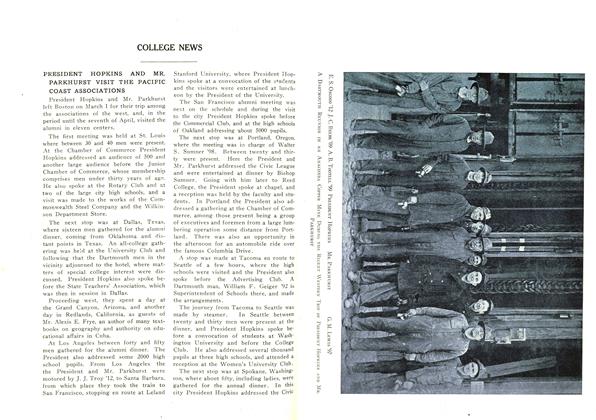
PRESIDENT HOPKINS AND MR. PARKHURST VISIT THE PACIFIC COAST ASSOCIATIONS
May 1920 -
 Class Notes
CLASS OF 1917
May 1920