THE IDEAL REUNION
Professor of Business Organisation and Management in the Tuck School
The following paper on the organization and carrying out of a reunion was presented at the last meeting of the Secretaries Association. It is here printed not only on account of its intrinsic interest, but in the thought that it may prove of assistance to other class secretaries in preparing for coming reunions.
At its tenth reunion, the class of 1911 had the distinction of returning for its reunion the largest number of graduates and non-graduates who had ever come back on such an occasion. The reason for this attendance is well indicated in the following article. [EDITOR]
I do not take it that I am expected to describe an ideal reunion, because such a description is a matter merely of one sentence: namely, that it consists of 100% of its members back with as many wives and children as they may happen to possess, together with the fact that the costs of the reunion should be as low as possible in order to make possible the securing of the maximum number. This ideal reunion, however, may be somewhat interfered with, owing to the lack of capacity in Hanover and for that reason it is very likely that certain classes, the larger and younger classes particularly, will be limited in the number of incumbrances that they may bring with them.
Neither do I consider the program very important as to the bearing it may have on the success of the reunion. Most of the events are regularly scheduled by the College. Then there is always a class meeting, an outdoor picnic, and other rather stereotyped matters, leaving opportunity for but few special parties such as teas for the ladies, vaudeville shows, dances or other events of that nature. I might, however, mention our "Sacred Concert" on Sunday evening, the special feature of which was the showing of one of the Outing Club reels together with about eighty lantern slides that were made up from pictures of various kinds of men and events while we were undergraduates. These events, however, should be well planned and conducted, and intended to appeal to the different elements found in every class. Some would not come back if they could not attend the Baccalaureate service, others must have their singing contests, the ladies must have their doings,—everybody must be made happy.
The matter of costumes is also rather unimportant, because one will have just as good a time regardless of his costume. Some costume, for the younger classes at least, undoubtedly adds pleasure and informality and lends to more fun and opportunity for mirth-making, just as the Carnival ball and other parties at which costumes are worn are thereby made much pleasanter than a formal dress suit affair. I would suggest that the costumes be neat and striking, rather than eccentric, except possibly for the very youngest classes. All that is necessary is to get hold of a good costumer and get the men to send in their measurements promptly. The first is easy!
But I assume that the real purpose for assigning this subject was that somebody foolishly supposed I might make some suggestions as to how a reunion might be staged. For, unless it is properly run and all arrangements made far in advance and thoroughly carried out, the reunion will not be ideal. And it is in that connection that I shall refer to the things which the class of '11 did in staging our reunion last June. I feel it may be worth while to do this, because all members of the class at least agree that we did have a very good reunion and much the nearest to ideal that we have ever had. Furthermore, I can speak authoritatively about it, for I had very little to do with it.
I think, for the very start of the thing, we must get back to a very splendid class unity that we fortunately possess, which has been due largely to the fact that we never have had any serious class splits, but is also due more particularly to the type of organization which we have had for the past few years. At reunion time we elect an Executive Committee of five men, who are to be responsible during the succeeding period of five years for all class activities, including the work of the class agent for the Alumni Fund, who is appointed by this committee either within or without their own number. 1 he officers are chosen by the committee itself from their own number. The basis of selection of the committee is three men from New England, at least two of them from Boston; one from New York and the South; and one from Chicago and the West. Until last June at least, and since last June in the case of at least four of the five of the present committee, we have been very fortunate in the selections made by the class, and they have been able to rely upon complete loyalty and have secured an unusual degree of cooperation from the class at large.
I consider this matter of organization and its personnel the fundamental of our success. By changing officers every five years, it means that no man need be reluctant to serve, because it is not going to demand his time for a longer period; and it also gives the class opportunity to check up on its officers and to replace those who may be falling down on the job.
It was this committee of five, then, that handled the last reunion, with the greater part of the work falling upon the three men from New England, and particularly the secretary—in this case all being located in Boston. In this connection I want to say that whoever is selected to head up the men that are going to do the work, may make or break the success of the party. It was our secretary's good management and drive that made our reunion, more than any-other single factor. The committee made all the plans and then delegated work to other individuals in the class whom they knew they could rely upon to do the job. This is a very definite job of thoroughly planning all the details and scheduling all of the things that must be done, and then—what is very important —following up these plans and schedules in such a way as to make sure that the results are accomplished. Coincident with planning the reunion itself, there must be a large amount of selling work done; not to get back the third of the class or possibly the half of the class that will come anyhow; but in order to get as many of the other two thirds or 50% that either are too poor, or don't think they can afford it, or, as is often the case, don't have sufficient interest to make the effort. Unfortunately, every class has such individuals in its membership, and they are the ones that cause us our greatest trouble. Many of these are fellows who were here only one or two years and who perhaps do not lack interest themselves but who have a feeling of reluctance in forcing themselves upon us, thinking we do not consider them a part of our class. It is hard work to disabuse them of that belief.
The Executive Committee in Boston started meeting regularly at luncheon once a week the first of October preceding reunion, where they worked out the various plans; at the same time corresponding with the other two members of the committee, and yet having authority as a majority of the committee to go ahead. They selected committees. In this connection, I would suggest that the fewer committees there are and the fewer members each committee has, the more likely is the job to be done and the better the job when it is done. A few men who are willing to devote their time will accomplish much more than a larger number of men with less responsibility, for, after all, there are not in any class many men who are willing to give the time and effort to class affairs that the work of a big reunion involves. They are glad to come back and enjoy the fun, but they want the stage all set when they arrive. We had a committee on costumes with the chairman of the committee, as a matter of fact, doing practically all the work. The program was taken care of by the Executive Committee itself. Publicity was also handled through the Executive Committee and was considered one of its chief functions, the committee going directly to individuals for information, asking some to send in write-ups to be used, and picking up information from the class at large as they could. Then there are always a number of arrangements that must be made in Hanover; and if there is a member of the class in Hanover, and if he is willing to take the time, it is one of the best ways for those arrangements to be made right. In our case I had some of that particular work, and do know that it was very much easier to accomplish such things being on the ground than it would have been had I had to do the same things by correspondence.
The basis of nearly all of the work in connection with our reunion was the man in the class whom we did not expect to come back unless strongly urged or appealed to in some unusual way. Therefore, all our propaganda and efforts were directed to this type of man rather than the more loyal and interested members whom we knew would come anyhow. I do not mean by that statement to exclude from the loyal group many of the class who for one reason or another found it utterly impossible to come. In many cases there were very definite reasons of health, family, business, or finance which made it impossible.
We knew that many men of the class had automobiles, and that many of those automobiles had more than two seats, so that if a classmate and his wife were coming from Providence and if there were another classmate and wife coming from Pawtucket who had no car and couldn't afford the trip, we arranged that the Pawtucket classmate should accompany the Providence classmate. Then we even went so far as to be willing to make loans to men who were temporarily "strapped", feeling that the investment would be returned with much interest if we could make it possible for this or that -particular classmate to return. We went after non-graduates just as hard as graduate members of the class and, as in every class, some of our most loyal men are those who did not graduate from the college. And so, as members of the class of 1911 there is no distinction.
The matter of financing reunions is generally covered by a special assessment, that assessment to cover cost of banquets, costumes, band, music, hiring of halls, etc. We, however, did not charge in this tax the cost of the literature which was sent out relative to the reunion, but took it out of the class treasury, because we felt that it was perfectly good propaganda and that it was of interest as much to the members of the class who didn't return as to those who did,—and thus saved five dollars on the class tax, which was worth while.
Of course, every class will have its different methods of announcing its reunion and of trying to get back as many classmates as possibe. But in case it may be of some interest, I am going to give an account of the things that our committee did. They sent out two class reports, post cards and six articles of reunion propaganda, and with all mailing matter was enclosed a postcard calling for an answer relative to some phase of the reunion or other, each time trying to get those who hadn't yet signed up to signify their assent. Also from the replies received they got a lot of information which they were able to turn into propaganda,—stories of how Hank Doomuch from Arizona was starting on the first of May with his family, Ford, tent, etc.; or, how this man was going to cut his crop of cane in Cuba so that he might have the wherewithal to journey to Hanover. In addition to all this were numberless personal letters. The subject matter of all the propaganda was so varied that some part of it would appeal to everybody. There were references to dances, golf links, outing club activities, a jubilee at Mink Brook, the changes in the college and campus in the past five years, and so forth. We must remember that some fellows went to college to use books and others to borrow them when they could take a few minutes from their pleasure. Therefore, it is necessary to appeal to the jovial fellow, the out-of-door man, the serious minded fellow, the rich man and the poor man. Having done this, the rest is easy.
Our first report was one of the annual class reports and was sent out in August preceding reunion. This was a collection of letters from each of the class with some remarks about the reunion, which was to be entitled The Titanic Tenth. If you believe in catch-phrases, make one. With this report was enclosed a postcard to be returned, stating whether the classmate was coming; if so, if he had an auto and how many passengers he could carry besides himself and family.
About the first of October, the Executive Committee picked eighty-five men who were called "squad leaders". These were chosen from class lists of various kinds, from the Aegis of freshman year, and other such sources, and to each one of these squad leaders were assigned, upon the basis of friendship, fraternity, geographical proximity, etc., two to five men. Each squad leader was to write each of his men and report back at a stated time, how many would come. If any man did not report back, he was followed up by the Executive Committee until his answer was secured. I might say that each of these eighty-five were men upon whom the committee knew they could rely to do this particular job and who wouldn't procrastinate until after the first of June before starting. Those men who were found not planning to return were re-divided among other squad leaders, and this was continued until each man of the class was written to at least three times by some man or other, in many cases this being done by some member of the Executive Committee itself. This personal letter writing probably had more real effect than any other single thing we did. Then, to many of the last minute ones were sent prepaid night letters, urging them to come if possible. Ido not know how succcessful this was, but one man at reunion said that if the class thought enough of him to send a prepaid night letter, he thought it was his job to come and having come, he would never miss another. Also, in nearly every case where a doubtful one was finally persuaded, the secretary took pains to write him to let him know how genuinely pleased he was that he had decided to come.
Also, about the first of October they started sending out birthday greetings, congratulating each man on his growing maturity and reminding him that 1911 also had a birthday in June and they wanted him back to help celebrate it. In December was sent another class report, which gave a geographical list of all the members with addresses, occupations, and further propaganda. In this report was enclosed a postcard asking each man to reply if he was coming and to give measurements for his costume. The first of December they started the first number of " 'Leven Up", which was strictly reunion propaganda, listing particularly regulars and their wives who had at this time promised their presence in Hanover. Nick-names of both were used as far as possible,—discretion was thrown to the winds. In this number was enclosed a postcard, giving a man opportunity to state that his name should be on the list of regulars, and opportunity for remarks. Incidentally, a large number of the class availed themselves of this opportunity, either to tell the committee they were doing good work, or to offer suggestions or criticisms,— sometimes good material which was used in the next " 'Leven Up" number. In each number of the " 'Leven Up", there was a column entitled "What Others Say", in which appeared clippings from various men in the class, care being taken that all the different groups, so far as possible, were represented.
January first was sent out a rather novel little almanac, in which there was an entry for every day from January 1 to July 1. This was especially good in that there was something about every man in the class. This was quite a job, but was made up from a diary which one of the boys had kept in college, in which he made entries about many of the boys. I think, personally, this was a valuable piece of propaganda.
Then, in February the second number of " 'Leven Up" was issued, with additional lists of regulars and more propaganda, together with a postcard for return with a second request for measurements for costumes, as many had not returned the first.
Meanwhile, personal letters were going out from each squad leader and from the Executive Committee and various individuals. By this time the committee had appointed territorial leaders in addition to the squad leaders, one for New England, one for New York and the surrounding territory, another for Cleveland and Chicago, and one for Washington and the South, and another for the far West. It was the job of these men to make sure that every man in his territory was written to, not only once but at least three times, then if he had failed to sign up it was the leader's job to get him if possible.
About this time also certain intersectional interests were started, such as the Association of the New York June Bugs, who issued a challenge to the Boston men or any other group who wished to accept the bait.
The first of April the third issue of 'Leven Up" appeared, followed by the fourth in the middle of May, and the fifth and last on June first, each of these still featuring the list of regulars and their wives, the last containing a letter from President Hopkins relative to the desirability of all returning.
Starting the middle of May there was also sent weekly for six weeks a post-card to every member of the class with certain propaganda on it and asking that the return card be used, answering certain questions relative to reunion.
For the first time I think, we took it upon ourselves as one of our jobs to help Perry Fairfield in the matter of room reservations. We were anxious to do this because, unless early reservations were made, not all the class could be together since it was possible to hold the dormitories only until the first of June. So, about the middle of May the committee sent out letters, in addition to what Mr. Fairfield regularly sends, urging the men to make reservations promptly. Incidentally, Mr. Fairfield said he had the best response from our class that he got from any class, as a result of this feature.
It is worth while to give some thought to the matter of music. We engaged a student orchestra of four pieces for the four days of Commencement, had a piano at our headquarters, and they played every noon, at night, or any other time when we wanted them. Then, when occasion demanded it, the orchestra became a band and gave us march music. A great many of the class spoke of how much the music added to their pleasure. We also have enrolled in our class a wonder at writing lyrics, poetry and otherwise, who gave many hours preparing original songs and adaptations, which together with standard songs were published in a 1911 Hummer's Hand book and furnished to all members of the class. He who once said that music hath its charms knew well whereof he spoke.
Possibly a few figures will tell the story of the success of this work better than I can. We had 166 men and 88 wives return to Hanover from South America, Canada, and all four corners of our own United States. This is over half of the number who at one time or another were connected with the class. There were 73% of our living graduates, and if we could have cheated to the extent of calling three of our nongraduates bachelors of something or other, we would have deprived the class of fifty years ago of that silver cup that they so fairly earned. That number is greater by fifty than any other class ever returned for a reunion.
It is not always possible of course, for a class to stage a post-reunion, but in our case, owing to the kindness of Frank Dodge, we were able to advertise a post-reunion for the week following Commencement at his splendid hotel at Whitefield. About sixty-five of us took advantage of his offer, and I think the post-reunion did more to make reunions worth while than any other single thing. Those who were there not only enjoyed it themselves but they spread the news about to other members of the class who did not go, until the class now not only counts on its reunion at Hanover but also on its continuation at Whitefield, many of the class not being willing to wait five years for a regular reunion but planning to get together at Whitefield sooner. Ido know that there has never been such an opportunity offered so many of us to get together and get acquainted with one another and with one another's wives as that week. It is fine to know all the men in your class by their first names, but when you get to know their wives just as well—or better—then reunions are worth whijle—because they will come often and at various places. The Whitefield reunion did a lot for class solidarity. As in Hanover, there were no cliques, no fraternity groups—there was just one group—that was the class of 1911.
And there is a lot in these informal reunions. Why not make the most of them and keep the class spirit flowing continually. It is easy. We have had several since June. We get together every time there is an excuse,—a ball game, an alumni dinner or what not, or just plain ordinary class parties which are always well attended whether in New York, Boston, or Chicago. We had sixty, including a few wives, back for the Columbia game last fall. We shall have as many at the Harvard game next fall as we had in Hanover last June. They are already signing up from Cuba to lowa, and we are going to have a real party, too. I expect Spunk Troy will be there from California.
I think there is one more step to be taken in staging a reunion, and that is to follow it by a corking good report of the reunion. This should contain a lot of pictures and should be well written and should remind everybody of the events they have enjoyed. It makes everyone who was present doubly glad they were there and it makes the others take a sacred oath to come next time.
One outstanding thing about our reunion was that there was no question about the success of anything. Everything had been so well planned, there was no balling up of the carrying out of the plans, we were blessed with splendid weather, and everybody just had to have a good time. That fact makes us feel sure there will be no doubt about future reunions of 1911. Our advertising has been done, as far as our class is concerned. To be sure, we have the job of getting back next time those who did not come this time, but from references I have had from many of those as a result of our reunion report, I do know that they will not be found wanting next time. As in the business world, a satisfied reuner is the best advertisement. Ours were not satisfied, they were enthusiastic.
N. G. BURLEIGH.
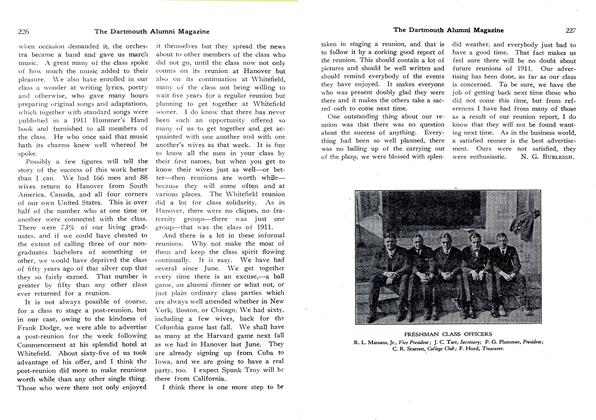
FRESHMAN CLASS OFFICERS R. L. Marsans, Jr., Vice President; J. C. Tarr, Secretary; P. G. Plummer, President; C. R. Starrett, College Club; F. Hurd, Treasurer.