VERMONT'S LAND GRANT TO THE COLLEGE*
The land grant has been a favorite device for aiding American schools and colleges in a country where land has been plentiful, money scarce. While the West has been the scene of the great land grant universities, this method of giving aid has by no means been unknown in the East. In the case of Dartmouth there have been four land grants,—the Township of Landaff, N. H., the Township of Wheelock, Vt., First College Grant, now Clarkesville, N. H., Second Grant, N. H.
Landaff was lost on an early date, after expensive litigation, to claimants under an earlier grant. Clarkesville was surveyed by the College and parcels sold from time to time; the last remnants were disposed of in 1872 and the College title in the tract is now extinguished. The Second College Grant is still owned by the College; it, unlike the other townships, has not been developed by means of settlement, having been handled as timber producing land (See article by Dr. Gile in the March, 1922 issue of this MAGAZINE).
In 1788 a township was granted by the State of Vermont to Dartmouth College and its small companion, Moor's Charity School. The occasion of the grant was a request from President John Wheelock to the Legislature of Vermont, then assembled at Norwich, for a grant "to the institution embracing Dartmouth College and Moor's Charity School." The Assembly without delay granted 23,000 acres of land, one half to the College, one half to the School. There was at that time considerable feeling on the part of the people of Vermont that the institu tion at Hanover was of joint interest to Vermont and New Hampshire. It was partly because of this feeling that the grant was so easily secured.
At the time of this grant there were in all nearly a score of townships that had been granted but not located,—"hovering townships" as they were called. It was feared by authorities and friends of the College that the grant to Dartmouth might with difficulty find a place on which to alight.
A location to the northwest of St. Johnsbury was finally secured, a survey made, and in 1788 an order obtained from the Council for the issue of a charter. At first the proposed name was Santa Maria which was changed at John Wheelock's request to Wheelock. A fortunate change,—much more appropriate for the rock-ribbed, unyielding township to be named for the Wheelocks than for Saint Mary. The charter bore date 1785 but was actually issued '1788.
It was provided in the Charter that College and School should each have one moiety of the township; that 150 acres of land should be for the support of a minister and a like amount for support of an English school; that the lands of the township should forever be free and exempt from public taxes.
Settlement was begun in 1789 and completed by 1810, at which time the town had the largest population it has ever had. Very active in securing settlers was Sergeant Abraham Morrill, contractagent of the College and School for that purpose. Between 1790 and 1796 the greater part of the township was divided by survey into 100 acre lots. These lots were distributed among the settlers on leases for 998 years. The method of assignment was unusual, being based on the fact that only about two-thirds of the township was considered fit for farming, the remaining one-third being back land mostly on mountain tops; in order to dispose of the undesirable land along with the good land, each settler was given a "right" and to his right was "pitched" 2 lots, that is, 200 acres of the farming land, and "drawn" I lot of the back land. This method gave each settler who took a full right 300 acres, 200 in one parcel near other settlers and 100 "away on the mountains, wild and bare." It was many a year before the Trustees heard the last of this method of getting rid of the back land.
The rental was £2 lawful money or its equivalent per year for each 100 acres. "Lawful money" meant £3 equals $10. Accordingly the rent for the 300 acres which went to a full right became $20 a year. The rental was at the same rate regardless of location or quality of the land, regardless also of whether it was pitched land or drawn land.
At an early date by deeds back and forth one certain half of the lots, being distributed in all parts of the township, became the specific property of the College, and a similar half became School Lots. So a particular lot would have attached to it, when it entered fully into the service of the institution, a lot number according to the original survey, a right number (there would be two other lots having the same right number), the name of the original settler, and a "C" or "S", depending on whether it belonged to College or School.
Most of the settlers came from southern New Hampshire. A great many migrated to Wheelock from Canterbury on the Merrimac which was the home of Sergeant Morrill. Other settlers came from Barrington, Sanbornton and Bow, N. H. One or two of the settling families came from Maine, a few also from Rhode Island and Massachusetts.
In the early leases it was provided that at any time within thirty years the tenants might pay such sum as would yield at interest the annual rent and be freed from paying rent thereafter. This was described in the leases as "the Privilege of paying a Capital", but locally in Wheelock it has been known as "Paying the Crowns". Just how this expression arose has been the matter of some conjecture. It may have had some reference to "Crown Land", it may have been based on the fact that the capital was approximately a crown an acre.
Payment did not necessarily have to be of the whole of a Capital but it might be of any part, provided no one payment was less than three pounds. Payment was required to be in silver or gold or in good beef cattle equivalent. No rate of interest was stated in the leases, but it has been taken to be six percent. Accordingly a tenant who had a full right, the annual rent being $20, could be relieved of further payments of rent during the term of the lease by paying to College or School a capital of $333.34.
The time was extended by the Trustees beyond the original thirty years, the privilege having been allowed until recent years, when the Trustees gave up receiving "the Crowns". A considerable number of the tenants have from time to time availed themselves of this privilege, it being the regular procedure on the part of the institution to execute quit claim deeds releasing the land in question from the rent reserved, except one mill per year "if demanded on the premises".
The Wheelock rents during the administration of John Wheelock and for years thereafter were a very substantial portion of the income of the institution. When the rents were slow in coming in the College was crippled in its activities. And often the rents were slow in coming in for it was early found that it was one thing to reserve a rent and quite another matter to collect it from a townspeople who gradually came to look upon this system of land tenure with disfavor.
We will examine the reasons why the inhabitants of Wheelock became restive under the terms of their leaseholds.
The joint interest of Vermont with New Hampshire in Dartmouth activities fell into a decline at an early date. This removed all sentimental background tending to create a favorable attitude on the part of the inhabitants of Wheelock toward College and School.
The method of locating rights resulted in the tenant paying rent on 100 acres of back land whose chief utility was to help hold the world together; as far as the tenant was concerned, it was of such inferior quality and so far distant from the rest of his land that it was more of an encumbrance than a help. He had signed up for it at a time when land-hunger had led him to think he could not have too much, but as time went on its lack of economic utility made the rent charge upon it an annual hardship. It is to be remembered that at the time spoken of, timber as such was a burden on the land, the test of good land being its suitability for farming operations.
In addition, the payment of $20 each year was too much, that is,—the leases were written on too large a unit. The tenants would have been just as well off with 100 acres apiece as with 300, but the rent went on at $20 a year just the same. Part of the land was very hilly, early stories being current of people falling off their farms and landing on farms farther down. It was not a farming country.
Besides, there was a feeling that the rent money went out of the township and state never to return. This was a natural enough feeling—probably an economic application of the cult of the chosen people. The argument is, a dollar spent in your neighborhood is still physically lurking in your vicinity, it is potentially retrievable, but a dollar remitted far away is as irrevocably gone as though it had been thrown into the lake. It is a line of thought which at a later date gave great joy to the Populist, nor was the Protectionist too proud to raise his silk hat to it,—one of those specious ideas which have myriad possibilities of application; in the course of fireside discussion and cracker barrel debate it found a home in Wheelock.
It was also considered that the rents were really taxes, which, instead of going to nourish and benefit the State including the Town as they normally would, were being diverted to a foreign institution, an absentee landlord.
And finally there was a feeling that these ground rents, being practically unknown elsewhere in New England, were unusual and un-American and resulted in making the tenure of their land by the inhabitants of Wheelock a kind of serfdom or peonage. It is probably apparent by this time that, while relations have always been civil enough, the classic attitude of the inhabitants of Wheelock toward the College has pot been one which involved the loss of a great deal of love. The College authorities have perhaps been inclined to ascribe to ingratitude a dissatisfaction which had more substantial grounds, and the tenants for the most part have been quite willing to seize any opportunity to stop paying rent. There have been two general opportunities (almost any time was a sufficient specific opportunity),— the University controversy, and the threatened controversy between Vermont and the institution.
During the University controversy (1815-1820) each faction forbade the tenants in Wheelock from paying rent to the other faction. Nothing could have pleased the tenants more and they went rent free for several years. It was only with difficulty and after considerable loss that they were brought back to a rent paying relation. Although the legal right of the College and School authorities to collect the rents has never been successfully questioned, it was at this time and for a long period afterwards exceedingly difficult to make the actual collections.
In 1831, for the purpose of simplifying administration of Wheelock affairs, it was proposed by the College authorities to the Legislature of Vermont that the School lots should be transferred to the College. This proposition while eminently well intended had a most unfortunate and unforeseen effect; instead of doing what it had been asked to do, the Vermont Assembly did just the opposite and passed a resolution for the appointment of an agent to institute legal proceedings for the recovery of lands in Wheelock belonging to Moor's School! This resolution was based on the theory that the grant, so far as the School was concerned, had become forfeited through non-user. If it had become so forfeited, it was thought by the Legislature that it would be unwise to grant the lands to the College, a foreign institution.
This serves as an example of the many vexations which arose from the peculiar nature of Moor's Charity School. Nobody ever certainly knew the nature of that strange being; doubts had not been resolved but in some ways multiplied by the incorporation act of 1807. When called upon by President Brown to construe that act, Jeremiah Smith replied:
"The act was a creature of the late President (John Wheelock), and I have not sufficient confidence in my own powers to venture on a construction of anything from his pen. Like Oliver Cromwell, he did not always intend to express himself clearly... Originally the School and the College were one. After some time they came to be treated as separate. The act seems to aim at a closer connection.... but how far, my means of information does not enable me to determine."
We do know that whenever it was desired to make trouble either for the College or the Wheelocks, the School was always the point attacked, it being claimed that it had no existence, that its purposes were being diverted, or that its funds were being misapplied for the unjust enrichment of the Wheelock family.
Nothing was. ever done as a result of the resolution described above, and the agitation came to an end in a few years, but it had the effect of rekindling the old trouble with Wheelock tenants, making it again necessary to hail some of them into court, with consequent, friction, delay and loss.
Soon after Vermont's threat, as above described, action was taken by the Trustees designed to remove some of the long standing grievances on the part of the tenants. Although the thirty year period had long since expired it was permitted that a capital to provide for the annual rent might still be paid, it was provided that lease-holds might be split up and new leases given for holdings collectively the same but individually reduced in size, it was also provided that if the rents were fully paid the drawn land might be given up and the rent correspondingly decreased. In pursuance of an enabling act passed by the Legislature of Vermont in 1851, the Trustees began to sell outright to tenants desiring to purchase. All this action on the part of the Trustees was taken with the desire of removing ancient obstacles to good feeling and to help the tenants in their struggle to gain a living from the rocky, unproductive soil.
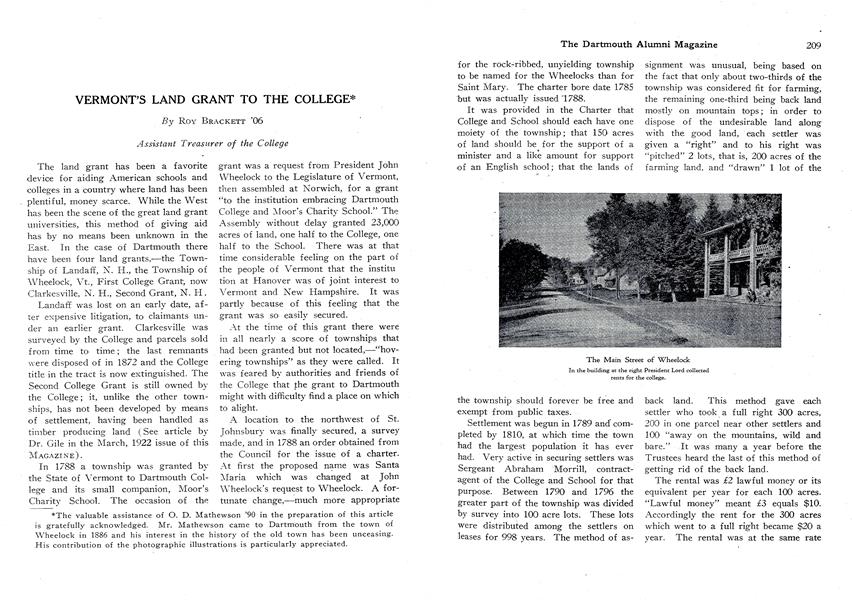
The importance of the Town to the College is shown by the method of collecting rents. As late as President Lord's time it used to be customary for the President, accompanied by certain administrative officers of the institution, to go annually to Wheelock to receive the rents. It was a trip which lasted several days. In the town the period was observed as one of holiday and people generally came to the village to pay the rent in person to President Lord who used to occupy as temporary office the southeast room on the ground floor of the old brick hotel. The President would sit in state while the tenants, cap in hand, filed by to pay the rent due or offer excuse for non-payment. Being on familiar terms with the tenants, the President would make inquiry, bestow praise, or administer rebuke as circumstances required.
On Sunday the townspeople were given opportunity to hear a sermon by the learned divine from the College Plain. It was all very dignified and fine,—cost the College quite a lot for those days, too, for rum and other concomitants of good collecting and fervent preaching.
The business of the trip being concluded there returned to Hanover quite a caravan, including the dignitaries of the College in coach or on horseback, wagons of grain, and a drove of beef cattle, for money was scarce and the rents and crowns were payable in kind. From that trip had to be extracted all that it could properly be made to yield, for the College was poor and its bills habitually in arrears.
It would be hard to overstate the importance of the Town to the College. At the time when the people of Vermont made this splendid gift the pioneer days with their quaint, dramatic incidents were passed, but the College was entering upon the most critical period in its history. In many respects the generation which followed that of the pioneer in New England has had heavier burdens to bear than those borne by the pioneer himself.
This period was made especially trying for the College by lack of funds. The grant by Vermont came at a time when the College was well nigh impoverished by the building of the first Dartmouth Hall, and when the income from Wheelock began to come in it supplied an almost desperate need. In 1815 the lands in Wheelock comprised at least one half of the permanent.funds of College and School combined, the annual rents then being about $1400. As late as 1840 this township constituted about one third of such funds. Vermont's generosity could not have been extended at a more opportune time.
The present relation of College to Town is much the same as it always has been. There is how no distinction between College and School, the School having in 1913, with the consent of the Legislature of Vermont, conveyed all of its property to the College and become dissolved; so finally School and College came to be one and the College that one. A resident agent, successor of a long line of such representatives beginning with Sergeant Morrill of Revolutionary days, represents the College in the Town so far as the rents are concerned. The lands held under paying leases are only about one quarter of what they once were, having been reduced by sale and by payment of the crowns.
The population also is greatly reduced; it was between 800 and 900 in 1861 when Lincoln issued his first call for volunteers, it is now about 500. Much of the land that once was cultivated has reverted to woodland. There are fairly sizeable graveyards which, lacking fence or wall, are so entirely abandoned to a natural state that they are scarcely recognizable as having once been burial places.
The town sent the equivalent of a company of men to the front at the time of the Civil War. Thirty, an enormous number for so small a town, were killed. Like most of the hill towns of New England, its decline dates from those red days, for it was the young manhood of such towns with their populous villages that supplied the long casualty lists of the Wilderness, Spottsylvania, Gettysburg. It was easier to send a company of men than to bring them back and towns like Wheelock never were able to fill the places of its sons who are keeping silent watch in Southern fields.
During the Civil War there was an outbreak of diptheria, epidemic and of a very virulent type. With pathetic ignorance, people were not understanding of its contagious nature and looked upon it as a chastening by the Lord. By such neighborly offices as "watching" with the sick, "sitting up" with the dead, and attending public funerals, everything possible was done to help spread the dread visitation. More than sixty persons died, many of them children. Several entire families were wiped out.
The specific heavy decline in the town's population appeared in the decade 1880-90 and this is what one should expect, for the actual loss in numbers due to war and pestilence, 1861-65 was not so many, but the kind lost, with special reference to age, was such that the next generation was virtually cut off. As has been many times pointed out, the human wastage of war constitutes a special class whose loss is felt out of all proportion to numbers by the group to which they belonged.
The coming of the railroad helped dwarf the relative importance of the town ; in the good, old days it stood on the high road through Peacham and Danville to Rock Island, but the coming of the iron road was a growing advantage to such towns as Lyndon where people could gather to watch the truly urban spectacle of a train "coming in".
While President Lord was on one of his annual trips to the town he told the inhabitants that if any of their boys would get himself fitted for College, he would not have to pay any tuition when he came to Dartmouth. This peculiar scholarship was acknowledged by President, Dr. Bartlett, who told a Wheelock boy of his day that "any promise made by Dr. Lord, the College was ready to make good." I believe it to be unique that we should have a scholarship thus granted orally to the inhabitants of a town so many years ago. It is a pleasant reminder of the long continued relations between the ancient College and the old Town, and is here set down lest it—perhaps the least of the old traditions—fail.
*The valuable assistance of O. D. Mathewson '90 in the preparation of this article is gratefully acknowledged. Mr. Mathewson came to Dartmouth from the town of Wheelock in 1886 and his interest in the history of the old town has been unceasing. His contribution of the photographic illustrations is particularly appreciated.
The Main Street of Wheelock In the building at the right President Lord collected rents for the college.
An Abandoned Road in Wheelock
The Civil War Memorial
A Typical View of Wheelock Landscape
An Old Farm Near Wheelock Hollow
The Old Town Pound
ROY BRACKETT '06 Assistant Treasurer of the College