Editorial Comment
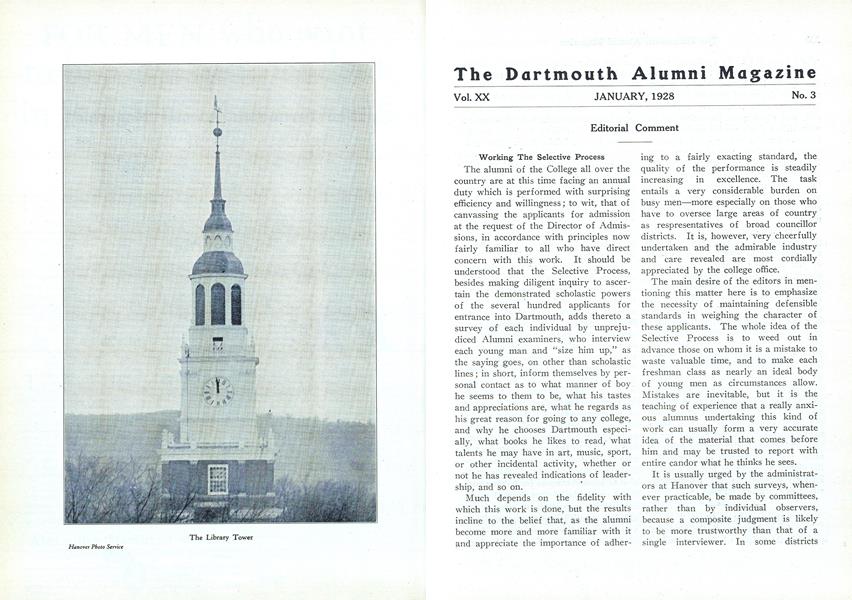
Working The Selective Process
The alumni of the College all over the country are at this time facing an annual duty which is performed with surprising efficiency and willingness; to wit, that of canvassing the applicants for admission at the request of the Director of Admissions, in accordance with principles now fairly familiar to all who have direct concern with this work. It should be understood that the Selective Process, besides making diligent inquiry to ascertain the demonstrated scholastic powers of the several hundred applicants for entrance into Dartmouth, adds thereto a survey of each individual by unprejudiced Alumni examiners, who interview each young man and "size him up," as the saying goes, on other than scholastic lines; in short, inform themselves by personal contact as to what manner of boy he seems to them to be, what his tastes and appreciations are, what he regards as his great reason for going to any college, and why he chooses Dartmouth especially, what books he likes to read, what talents he may have in art, music, sport, or other incidental activity, whether or not he has revealed indications of leadership, and so on.
Much depends on the fidelity with which this work is done, but the results incline to the belief that, as the alumni become more and more familiar with it and appreciate the importance of adhering to a fairly exacting standard, the quality of the performance is steadily increasing in excellence. The task entails a very considerable burden on busy men—more especially on those who have to oversee large areas of country as respresentatives of broad councillor districts. It is, however, very cheerfully undertaken and the admirable industry and care revealed are most cordially appreciated by the college office.
The main desire of the editors in mentioning this matter here is to emphasize the necessity of maintaining defensible standards in weighing the character of these applicants. The whole idea of the Selective Process is to weed out in advance those on whom it is a mistake to waste valuable time, and to make each freshman class as nearly an ideal body of young men as circumstances allow. Mistakes are inevitable, but it is the teaching of experience that a really anxious alumnus undertaking this kind of work can usually form a very accurate idea of the material that comes before him and may be trusted to report with entire candor what he thinks he sees.
It is usually urged by the administrators at Hanover that such surveys, whenever practicable, be made by committees, rather than by individual observers, because a composite judgment is likely to be more trustworthy than that of a single interviewer. In some districts where there are many applicants within a narrow territory, as in the larger cities, this system has been carried to a commendable degree of perfection. In the broader areas it is naturally more difficult, and often quite impossible, to get more than a single verdict on the personal characteristics and apparent worth of the young man who wishes to come to us. But the unanimity with which Dartmouth graduates the country over respond to this annual appeal for personal service on behalf of the College convinces us anew that our alumni body is virtually unique.
,Let us, however, stress above all else the need of a strict adherence to standards calculated to insure the high quality of our incoming classes. There is, of course, an occasional temptation to play favorites, when a religious regard for the Selective Process should forbid; but the evidence is that as a rule this temptation is resisted, sometimes at the cost of a personal qualm. The aim is to keep out the obvious dead-wood, the chaff, the idlers who have only the vaguest of reasons for thinking it would be "nice" to go to college, the boys who only want to play football or other sports, rather than to learn anything, and the many who apply only because custom makes that the fashionable thing to do. Dartmouth's present situation enables her to pick and choose, with quality solely in mind; and it is pleasant to observe that the alumni so generally and so discriminatingly respond to the requirements which that situation imposes.
Hanover and the Floods
The flood disasters of the autumnal period in the vicinity of Hanover sufficed among other things to enable a unique exhibition of college spirit applied to humanitarian lines, when some 900 students took a day off from their regular duties and devoted themselves to straightening out the appalling tangle produced at Hartford, Vermont, by the swollen waters of the White river. This energetic army of strong young men worked wonders in a few hours, and the labor has been supplemented since by smaller bodies of volunteers from Hanover,, prompting the approving comment of the press everywhere. It was no snap course which these volunteers elected, one may well believe—and furthermore it was one in which faculty, as well as undergraduates, participated with a will.
The further project to assist the flood sufferers by playing in some populouscentre, like Boston, a post-season football game, the proceeds to go to a flood, relief fund, came to nothing—and we believe rightly. The curious errorobtained momentary credence that the Dartmouth athletic authorities stood, ready to play a post-season game with. Georgetown, but it was promptly revealed that this was a hoax; and the statement was speedily forthcoming from the President of the College that the assent of the administration could not, in any case, have been expected. The wholepoint is that post-season games of football are not to be favored, save in veryrare and exceptional conditions; and that there is bound to be a lurking suspicion of avowed excuses for holding such,, based on the belief that the real reason, for wanting a post-season game is less altruistic than it is made to appear. There was no ground whatever that we know of for assuming that the Athletic Council was any more agreeably disposed toward the idea of a post-season game than the President and faculty; but the excuse advanced for such a project was tempting and the shortness of Dartmouth's playing season—a week shorter than that of most colleges—would add a further temptation. Nevertheless everything was against the idea. The team had disbanded, had gone out of training, and was entitled to its honorable discharge. Most of all, the theory at Hanover is that post-season playing is based on a vicious principle, likely to add to the over-emphasis of sports; and that in consequence only a very exceptional incentive should lead to a relaxation of the rule in a time when it is important not to let football kill itself as an intercollegiate sport by tolerating excesses.
Cramming for Examinations
A rather interesting discussion has been going on in the columns of the Daily Dartmouth, precipitated by editorial suggestions in that paper, with respect to the most useful system of preparation for examinations in courses where comprehensive tests are required, the Dartmouth's idea being that for, say, three days immediately preceding the examination period there be established a "reading period" in which the student shall be free to do his own reviewing of a course, rather than be held to classroom review. This has prompted the comment of at least one undergraduate that it amounts only to an official recognition of an extended "cramming period" during which a student who has been inattentive throughout a semester may, by frenzied efforts, make up for his deficiency at least sufficiently to enable a serviceable mark in his examination. Rejoinder appears to be made that the examination period covers about ten days, and that the suggested free reading period of three days is intended mainly to benefit the unfortunate who finds himself scheduled for three difficult tests in the first three days of the ten— a disadvantage to him which does not bear so heavily on the man whose tests are better spaced.
Making every just allowance, it is probable that even the best students find reviewing prior to an examination desirable ; and it is certain that the mediocre ones, not consciously neglectful of daily work but still not especially diligent therein, find such intensive recapitulation of a term's labors absolutely imperative if they are to do even tolerable credit to themselves. No matter how much one may deplore it, the fact remains and will always remain that the average student cannot be expected to have in mind, without a more or less concentrated process of hasty reviewing, the degree of knowledge of any extended course which will enable a praiseworthy mark—or perhaps even a passing grade. It is the way of the world, and scolding about its deviation from the ideal will not change it. In theory, a student who has been faithful in his prosecution of any course of study will acquire knowledge of it which should need only a little brushing up before starting to write a blue-book in response to questions designed to elicit a revelation of what he knows. In practice, probably eight men out of ever)- ten need more than this hasty resurvey of the ground their classes have been coveringsome of them, of course, having practically to secure a delusive sort of information, good for a few hours' time only and sufficient merely to deal with that particular blue-book. Young men are what they are—and it would be rash indeed to say that their elders differ to any marked degree in the respect above mentioned.
Whether a free reading period of three days is the appropriate remedy for the congenital defect of all students who are not special prodigies, may be open to question. Cramming for examinations is as old as the world itself, and will continue to be the practice down to the last syllable of recorded time. Presumably every instructor in the world knows it, and is very far from making a single examination paper the sole ground for deciding what the man before him has really learned. There will always be such cramming, under some system or other and one rosy as well seek out the one most likely to produce the best results. The best results, it is needless to say, are those which inspire the most real knowledge, rather than the most deceptive appearance thereof. Imperfect as the examination is, it remains virtually the only practical method of assessing the lore absorbed by the student; and the student is forced by circumstances to assume the appearance of knowing, even if he doesn't really know but has only acquired the ability to look as if he did by dint of frenzied memorizing at the eleventh hour.
After all, it is the man himself who pays in the end. He alone suffers at the last for his own neglects, even where he succeeds in deluding examiners into giving him a mark based on a parrotlike performance which has no deepness of foundation. One doesn't recognize this until it is too late, alas. Who of us has not said within himself, "If I could go through college now, I'd get more out of it?" Cramming for an exam is a good deal like death-bed repentance.
"Rules is Rules"
The outstanding thing about this autumn's football season was the episode involving Bruce Caldwell, Yale's superstar halfback, who was discovered just before the Yale-Princeton game to be ineligible under the rules relating to athletes transferring from one college to another. Yale promptly and commendably announced that she would disqualify Caldwell from further participation in that sport, and stuck to it in the face of a natural temptation to differentiate between the letter and the spirit of the rule; though urged to such discrimination by both Princeton and Harvard. Discrimination, in one view of it, would have been defensible enough, because no one for a moment suggested that Caldwell was a "tramp" athlete such as the rule in question aims to discourage. He had transferred in apparent good faith from Brown to Yale, according to a long cherished plan, and not at all because some avid alumnus of the greater university had taken note of Caldwell's performance as a member of the Brown freshman team and made him in consequence a furtive offer. None the less we must regard Yale's determined stand in favor of observing the rules as a most praiseworthy thing, because the rule itself is clearly a good one and is aimed at an evil that was all too common prior to its adoption.
The absence of Caldwell from the Yale line-up made no discernible difference in the immediately subsequent game with Princeton, although no doubt it did increase the difficulty of attaining Yale's success. This was widely received as poetic justice. Meantime it may be pertinent to quote a typical comment, made by Edward Hope who conducts "The Lantern" column in the New York Herald Tribune:
"The agreement under which Caldwell is disbarred was necessary when it was made and is necessary today in spite of all that our colleagues on this page and elsewhere may say.
"A college can keep its passionate Old Grads in check only by stringent and inflexible ordinances. Give them an inch, and they will take all the football stars of all the small colleges in the country and enroll them under the unseeing stone eyes of their alma mater. Gentlemen's agreements count for nothing when there are football games to be played and won.
"We believe that Caldwell has been tripped on a technicality that was not laid for him, but an exception made now would be the rule of three years hence, or we don't know our Old Grads.
"And if any one feels worse at Caldwell's ineligibility than we do, he will have to send a sworn statement of his blood-pressure to prove it."
That this salutary rule worked an injustice and a hardship in this particular instance we incline to believe; but we can easily see that, once exceptions were permitted in special cases, the rule would be in serious danger of being undermined. It is probably better for the sport as a whole to insist on rigid adherence so long as this rule remains in force, even though one sympathizes with the victim.
Whether the rule can be amended to take care of such cases is open to debate. There again would arise the danger of nullification. Speaking broadly, the rule is a good one and is necessary. It specifically provides that a player who takes part in duly recognized games as a regular member of a freshman team at College A is thereby made ineligible later on to participate as a player in that same sport if he transfers to College B. The reason is obvious. We all know the temptation of scouts to persuade promising freshmen, or promising prep school players, to enroll as students in other institutions—purely as an athletic proposition ; and while it is difficult to devise a rule relating to preparatory school teams, it is possible at least to deal with the transfer situation. Yale has added a most valuable testimony to the anxiety of collegiate managers to keep the amateur character of college sport far above the level of suspicion.
How About Next Season
As usual, the Alumni Fund committee is preparing the ground for its 1928 campaign by endeavoring to ascertain from those alumni who contributed in former years, but who for some undiscovered reason have lately abstained, whether or not their absence from the lists is permanent, or only temporary, and whether or not the reasons for that absence, if still persisted in, are capable of being answered to the satisfaction of the abstinent.
It is pointed out that if a man really and firmly intends to remain a non-contributor to the Alumni Fund, it will save money for the college if he will make candid avowal of that intention; because in that case fruitless expenditures in an effort to enlist his aid may be avoided and by so much the overhead costs of the campaign may be lightened. But it is devoutly hoped that in the great majority of cases the response of such men will be to the effect that they do hope to come in this next year and desire that the usual literature of the campaign be sent to them. The purpose of this paragraph is merely to supplement the Committee's request for definite information as to the feeling of the men who used to contribute, but who, for one reason or another, have refrained in recent years from doing so.
It is our conviction that most Dartmouth men who are in position to do so are disposed to bear a hand, to the extent of their individual capacity in this matter, since it is clear that the college stands in great need of steady and trustworthy support if it is to hold the ground it has gained. The campaign proper, to be sure, does not begin until several weeks later; but the preliminary work of clearing the ground is important, and those who receive these requests for information as to their probable attitude in 1928 will greatly assist the Committee if they make prompt and cordial response to the request.
Tuition Fees Again
Apropos of recent discussions of the relation of tuition fees in the colleges of this country to the costs of education, attention may be directed for a moment to an interesting compilation of statistics lately published by the John Price Jones Corporation of New York—a concern the chief business of which is the management of fund-raising campaigns. This table of figures is accompanied by a graphic chart designed to reveal the course of tuition charges, bank deposits, costs of living, prices of food and income per capita in the United States. The data as to educational charges are based on returns from 21 men's colleges and nine colleges for women. It is stated, and we imagine with substantial accuracy, that 20 years ago theaverage tuition charge at the men's colleges was $125 (Dartmouth was then asking only $100) whereas today the average is $329 (Dartmouth now asking $400). Even so, it is notorious that the tuition fee, even in the case of Princeton, which asks $450 and has the highest figure in the list here considered, does not meet the actual cost per man.
The interesting phase of the comparison is that which contrasts the jump in average tuition charges with the other elements represented in the graph. Theindex figure for college tuition started 20 years ago well above the index figuresfor living costs, income, bank deposits,, etc., and continued above them until about 1913-14, at which point all the elements, as represented by various lines,, came together and remained in substantial agreement until 1917—at which point,, although tuition fees continued to rise, the other elements soared much more abruptly and to this day remain—with the sole exception of retail food pricesat index figures well above that of college tuition.
In other words, while tuition fees haveclimbed to extraordinary altitudes in a score of years, they have not climbed so fast nor so high as have bank deposits,, per capita wealth, and so on. There is consequently no disproportion in the present average tuition fee of $329, as related to the available wealth of the: land.
At least the situation differs from that prevailing when the average charge for tuition was much lower. When it stood at $125, it was well above the available average of wealth—and now it is apparently below.
The main question, as has been intimated before, is one of positive, as well as comparative, requirements. The equalization of college income and outgo has come to be a very vital question. If education costs $800 and is sold for $400, the difference has to be made up on a basis very similar to charity, alike for those who could afford to pay the full price at once, and for those who could not. Should the tuition fee of a college be fixed with an eye single to the needs of the college, or with an eye single to the convenience of the student?
There is so much to be said for asking purchasers to pay at least the cost price of what they get, that more and more advocates of this rudimentary business policy are being heard. There is on the face of it no reason for making an exception of education. Those who want education badly enough to pay for it will get it—and it is questionable that others should seek it. There is growing up a sentiment that the colleges would better fix first a tuition charge that closely approximates the actual cost of the teaching—and then find ways and means to alleviate the condition of such students as cannot afford the immediate payment of that full cost. At present no one,, rich or poor, pays much more than half ; and scholarship aid is apportioned to* that standard, when in justice it ought to be apportioned to paying the whole.
The J. P. Jones Corporation's chart: seems to us to reveal that a very considerable advance can be made in charges without exceeding the average ability to pay—certainly without reproducing the; disproportion which obtained a score of. years ago.
These students started for the North Country Picture taken between Lyme and Orford
Lettter from the Editor
-
 Lettter from the Editor
COMMUNICATIONS
January, 1925 -
 Lettter from the Editor
REGARDING CLASS FUNDS
December, 1925 -
 Lettter from the Editor
COMMUNICATIONS
January, 1926 -
 Lettter from the Editor
Editorial Comment
NOVEMBER 1927 -
 Lettter from the Editor
Editorial Comment
MARCH 1932 -
 Lettter from the Editor
To an old friend
NOVEMBER • 1985


