Letters to the Editor
A DEFECT IN THE SUNDIAL
Dumont, N. J.
Editor Alumni Magazine: I was much interested in the sundial depicted in the current issue of the MAGAZINE. It looks like an exquisite piece of workmanship, but I wonder whether anyone has discovered a defect.
In the center is a regular Mariner's compass and you will notice that on both sides of the S (South) equidistant, are the letters SSW, signifying south south west. It is quite obvious that the two fingers pointing in different directions cannot both be correctly lettered. One of them should be SSE.
I have stood many weary hours at a ship's wheel behind the compass but if I had followed the leading of one such as this I should have been disrated.
Oberlin, Ohio
Dear Editor: Your enlarged size and style of ALUMNI MAGAZINE is a big improvement, and the contents most interesting. Best of wishes for continued growth and success.
THE BALL TEAM IDENTIFIED
18 Tremont St., Boston, Mass.
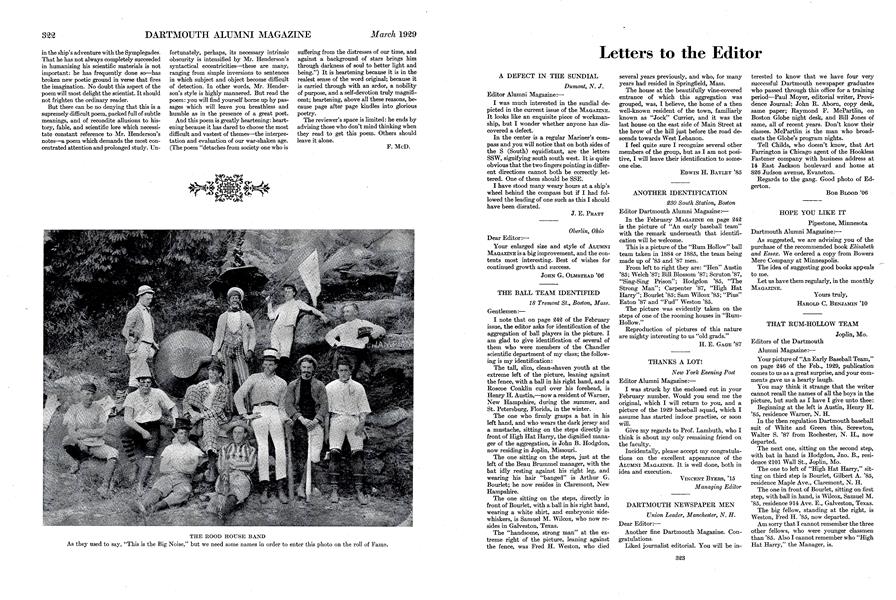
Gentlemen: I note that on page 242 of the February issue, the editor asks for identification of the aggregation of ball players in the picture. I am glad to give identification of several of them who were members of the Chandler scientific department of my class; the following is my identification : The tall, slim, clean-shaven youth at the extreme left of the picture, leaning against the fence, with a ball in his right hand, and a Roscoe Conklin curl over his forehead, is Henry H. Austin,—now a resident of Warner, New Hampshire, during the summer, and St. Petersburg, Florida, in the winter.
The one who firmly grasps a bat in his left hand, and who wears the dark jersey and a mustache, sitting on the steps directly in front of High Hat Harry, the dignified manager of the aggregation, is John B. Hodgdon, now residing in Joplin, Missouri.
The one sitting on the steps, just at the left of the Beau Brummel manager, with the bat idly resting against his right leg, and wearing his hair "banged" is Arthur G. Bourlet; he now resides in Claremont, New Hampshire.
The one sitting on the steps, directly in front of Bourlet, with a ball in his right hand, wearing a white shirt, and embryonic sidewhiskers, is Samuel M. Wilcox, who now resides in Galveston, Texas.
The "handsome, strong man" at the extreme right of the picture, leaning against the fence, was Fred H. Weston, who died several years previously, and who, for many years had resided in Springfield, Mass.
The house at the beautifully vine-covered entrance of which this aggregation was grouped, was, I believe, the home of a then well-known resident of the town, familiarly known as "Jock" Currier, and it was the last house on the east side of Main Street at the brow of the hill just before the road descends towards West Lebanon.
I feel quite sure I recognize several other members of the group, but as I am not positive, I will leave their identification to someone else.
ANOTHER IDENTIFICATION
230 South Station, Boston Editor Dartmouth Alumni Magazine:
In the February MAGAZINE on page 242 is the picture of "An early baseball team" with the remark underneath that identification will be welcome.
This is a picture of the "Rum Hollow" ball team taken in 1884 or 1885, the team being made up of '85 and '87 men.
Erom left to right they are: "Hen" Austin '85; Welch '87; Bill Blossom '87; Scruton '87, "Sing-Sing Prison"; Hodgdon '85, "The Strong Man"; Carpenter '87, "High Hat Harry"; Bourlet '85; Sam Wilcox '85; "Pius" Eaton 'B7 and "Fud" Weston '85.
The picture was evidently taken on the steps of one of the rooming houses in "Rum Hollow."
Reproduction of pictures of this nature are mighty interesting to us "old grads."
THANKS A LOT!
New York Evening Post
Editor Alumni Magazine: I was struck by the enclosed cut in your February number. Would you send me the original, which I will return to you, and a picture of the 1929 baseball squad, which I assume has started indoor practise, or soon will.
Give my regards to Prof. Lambuth, who I think is about my only remaining friend on the faculty.
Incidentally, please accept my congratulations on the excellent appearance of the ALUMNI MAGAZINE. It is well done, both in idea and execution.
Managing Editor
DARTMOUTH NEWSPAPER MEN
Union Leader, Manchester, N. H.
Dear Editor: Another fine Dartmouth Magazine. Congratulations. Liked journalist editorial. You will be in- terested to know that we have four very successful Dartmouth newspaper graduates who passed through this office for a training period—Paul Moyer, editorial writer, Providence Journal; John R. Aborn, copy desk, same paper; Raymond P. McPartlin, on Boston Globe night desk, and Bill Jones of same, all of recent years. Don't know their classes. McPartlin is the man who broadcasts the Globe's program nights.
Tell Childs, who doesn't know, that Art Farrington is Chicago agent of the Hookless Fastener company with business address at 14 East Jackson boulevard and home at 826 Judson avenue, Evanston.
Regards to the gang. Good photo of Edgerton.
HOPE YOU LIKE IT
Pipestone, Minnesota
Dartmouth Alumni Magazine: As suggested, we are advising you of the purchase of the recommended book Elizabethand Essex. We ordered a copy from Bowers Merc Company at Minneapolis.
The idea of suggesting good books appeals to me.
Let us have them regularly, in the monthly MAGAZINE.
Yours truly,
THAT RUM-HOLLOW TEAM
Joplin, Mo.
Editors of the Dartmouth
Alumni Magazine: Your picture of "An Early Baseball Team," on page 246 of the Feb., 1929, publication comes to us as a great surprise, and your comments gave us a hearty laugh.
You may think it strange that the writer cannot recall the names of all the boys in the picture, but such as I have I give unto thee:
Beginning at the left is Austin, Henry H. '85, residence Warner, N. H.
In the then regulation Dartmouth baseball suit of White and Green this, Screwton, Walter S. '87 from Rochester, N. H., now departed.
The next one, sitting on the second step, with bat in hand is Hodgdon, Jno. 8., residence 2101 Wall St., Joplin, Mo.
The one to left of "High Hat Harry," sitting on third step is Born-let, Gilbert A. '85, residence Maple Ave., Claremont, N. H.
The one in front of Bourlet, sitting on first step, with ball in hand, is Wilcox, Samuel M. '85, residence 914 Ave. E., Galveston, Texas.
The big fellow, standing at the right, is Weston, Fred H. '85, now departed.
Am sorry that I cannot remember the three other fellows, who were younger classmen than '85. Also I cannot remember who "High Hat Harry," the Manager, is.
The above aggregation was The Rum Hollow Base Ball Nine with its Manager.
The place is the J. G. Courier house, on the east side of Main St. at the top of the hill.
Some of the other men whom I have mentioned may be able to give better information; perhaps Samuel H. Hudson, Atty., 14 Beacon St., Boston, Mass., could help out some.
Reading Period
The Dartmouth for the last eight months off and on has urged editorially the reading period adopted at Harvard and declared a success there. The Harvard provision is that two or three weeks before the semester examinations classes are suspended and students are assigned to tutors. Extra reading is done and it is the experience of Harvard that more books are used at their library and that in the semesters the period has been used grades have gone up.
W. L. Scott '29, editor of The Dartmouth, realizing the difficulties of making over the annual program and doubting the possibility of the Dartmouth faculty's taking care of the tutoring necessary because of size of the faculty, suggested a reading period of three days. The advantages of a general review of the subjects covered in the examinations were stressed in his editorials and the unfairness of the frequently unbalanced examination schedules was mentioned. Often men will have three or four examinations in the first three or four days while other men will have a review period during the first week before taking their examinations the last few days of the period.
The Administration has not officially answered The Dartmouth's editorials but it is understood that the faculty members of the committee on educational policy believe that a three day period might better be called a
"cramming period" and that an effect of allowing three free days at the end of the semester would be to encourage reviewing only at the last moment.
The reading period at Dartmouth is still an open question, but it is commonly expected among both faculty members and students that something will be done about it within a few years.
The Green Book
The Green Book, the annual put out for the freshmen, burst out at an early date this year, comparatively speaking, with an excellent number. Much credit is due Editor Collier Hudson Young, of Indianapolis, Ind., and Business Manager John Adams Cooper, of Denver, Colo., both juniors. The book is dedicated to Professor William H. McCarter '19. A new note in The Green Book is the use of color prints; a very effective picture of The Library is included as a frontispiece.