Carnival's In Town Again
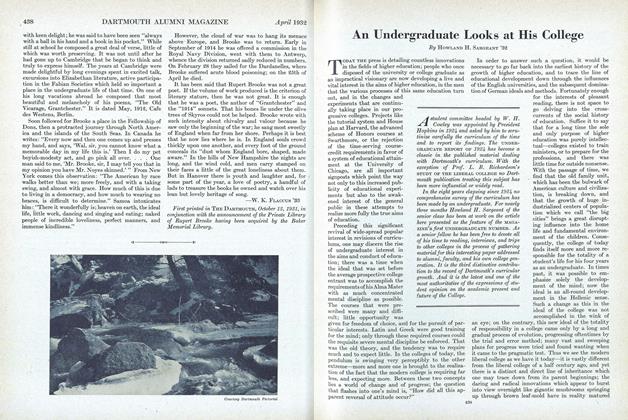
lATE on Thursday afternoon of February 6 two long trains will pull into the Hanover station -4 where hundreds of students will be eagerly awaiting their arrival, for Carnival has come to town again and these trains are bringing with them some six hundred fair young ladies to be the guests of the Outing Club for the next three days. They come from all over the country—from Boston, New York, the middle west and the south—demure freshmen, sophisticated seniors, from Wellesley, Smith, Holyoke, Skidmore, from schools and colleges throughout the east. We will follow them and see what has attracted them to this isolated and winter-bound town of Hanover.
At the station there is a scene of wild confusion while the students eagerly seek their respective guests. Barges and taxis carry the couples across Ledyard Bridge and up into town where they are the immediate object of discussion and criticism by numerous individuals who are unfortunate enough to be stag for the week-end. Main street is gaily decorated in welcome and the spirit of Carnival has now begun. From now on there will be something to do every minute; Father Time will be forgotten for the King of Carnival now reigns and exuberant youth is not to be denied.
At 6:45 amid the fanfare of trumpets, the booming of cannon and the bursting of sky-rockets the torchlight parade forms for Outdoor Evening, this year to be the greatest by far that the Outing Club has ever attempted. The parade moves slowly up Main Street, ever swelling in numbers, to the entrance on Occom Pond where bleachers enfold the spectators. On the farther side of the ice rises a massive snow and ice castle, a replica of Lord Dartmouth's in England, with towers and parapets, turrets and portcullis.
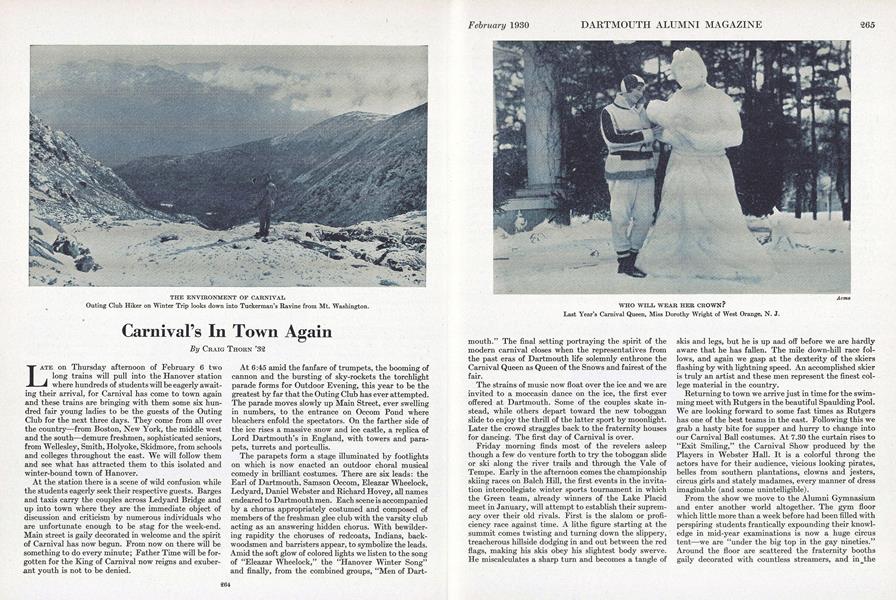
The parapets form a stage illuminated by footlights on which is now enacted an outdoor choral musical comedy in brilliant costumes. There are six leads: the Earl of Dartmouth, Samson Occom, Eleazar Wheelock, Ledyard, Daniel Webster and Richard Hovey, all names endeared to Dartmouth men. Each scene is accompanied by a chorus appropriately costumed and composed of members of the freshman glee club with the varsity club acting as an answering hidden chorus. With bewildering rapidity the choruses of redcoats, Indians, backwoodsmen and barristers appear, to symbolize the leads. Amid the soft glow of colored lights we listen to the song of "Eleazar Wheelock," the "Hanover Winter Song" and finally, from the combined groups, "Men of Dartmouth." The final setting portraying the spirit of the modern carnival closes when the representatives from the past eras of Dartmouth life solemnly enthrone the Carnival Queen as Queen of the Snows and fairest of the fair.
The strains of music now float over the ice and we are invited to a moccasin dance on the ice, the first ever offered at Dartmouth. Some of the couples skate instead, while others depart toward the new toboggan slide to enjoy the thrill of the latter sport by moonlight. Later the crowd straggles back to the fraternity houses for dancing. The first day of Carnival is over.
Friday morning finds most of the revelers asleep though a few do venture forth to try the toboggan slide or ski along the river trails and through the Vale of Tempe. Early in the afternoon comes the championship skiing races on Balch Hill, the first events in the invitation intercollegiate winter sports tournament in which the Green team, already winners of the Lake Placid meet in January, will attempt to establish their supremacy over their old rivals. First is the slalom or proficiency race against time. A lithe figure starting at the summit comes twisting and turning down the slippery, treacherous hillside dodging in and out between the red flags, making his skis obey his slightest body swerve. He miscalculates a sharp turn and becomes a tangle of skis and legs, but he is up aad off before we are hardly aware that he has fallen. The mile down-hill race follows, and again we gasp at the dexterity of the skiers flashing by with lightning speed. An accomplished skier is truly an artist and these men represent the finest college material in the country.
Returning to town we arrive just in time for the swimming meet with Rutgers in the beautiful Spaulding Pool. We are looking forward to some fast times as Rutgers has one of the best teams in the east. Following this we grab a hasty bite for supper and hurry to change into our Carnival Ball costumes. At 7.30 the curtain rises to "Exit Smiling," the Carnival Show produced by the Players in Webster Hall. It is a colorful throng the actors have for their audience, vicious looking pirates, belles from southern plantations, clowns and jesters, circus girls and stately madames, every manner of dress imaginable (and some unintelligible).
From the show we move to the Alumni Gymnasium and enter another world altogether. The gym floor which little more than a week before had been filled with perspiring students frantically expounding their knowledge in mid-year examinations is now a huge circus tent—we are "under the big top in the gay nineties." Around the floor are scattered the fraternity booths gaily decorated with countless streamers, and in the center is the orchestra dividing the tent into two rings. At the south end appears a brilliantly lighted ferris wheel; at the north are fantastic pictures depicting a circus side-show. The laughing couples go whirling by, milk-maids and dragoons, chorus girls and brigands the Dartmouth Indian has returned to the social world.
Saturday we find ourselves busy from morning to night with hardly a pause for breath. At 10 the sevenmile cross-country ski race starts from in front of the Outing Club House, the fast moving contestants soon disappearing within the woods. Then the snow-shoe racers are off and are soon lost to sight. Meanwhile on Occom Pond the skaters have been warming up to vie for speed skating and fancy skating honors. After watching these a while the boom of a cannon calls us back to the Outing Club House to view the finish of the ski races. Then hurrying downtown we enter the new covered rink to watch the Harvard and Dartmouth sextets battle for the Carnival hockey title.
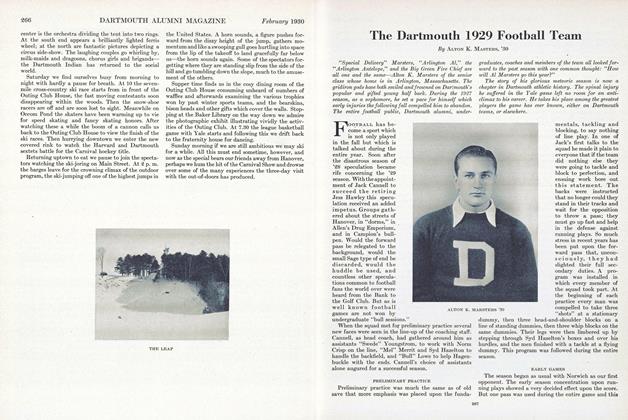
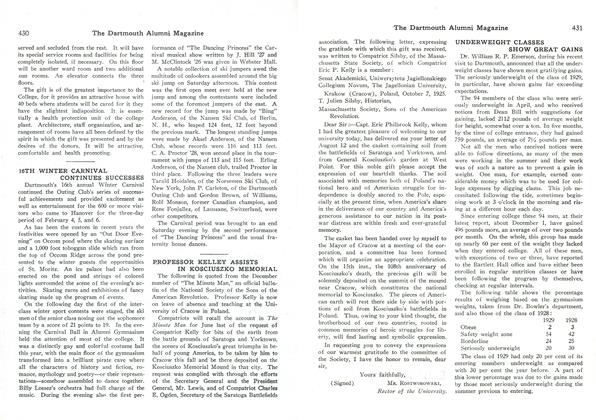
Returning uptown to eat we pause to join the spectators watching the ski-joring on Main Street. At 2 p. m. the barges leave for the crowning climax of the outdoor program, the ski-jumping off one of the highest jumps in the United States. A horn sounds, a figure pushes forward from the dizzy height of the jump, gathers momentum and like a swooping gull goes hurtling into space from the lip of the takeoff to land gracefully far below us—the horn sounds again. Some of the spectators forgetting where they are standing slip from the side of the hill and go tumbling down the slope, much to the amusement of the others.
Supper time finds us in the cosy dining room of the Outing Club House consuming unheard of numbers of waffles and afterwards examining the various trophies won by past winter sports teams, and the bearskins, bison heads and other gifts which cover the walls. Stopping at the Baker Library on the way down we admire the photographic exhibit illustrating vividly the activities of the Outing Club. At 7.30 the league basketball game with Yale starts and following this we drift back to the fraternity house for dancing.
Sunday morning if we are still ambitious we may ski for a while. All this must end sometime, however, and now as the special bears our friends away from Hanover, perhaps we hum the hit of the Carnival Show and drowse over some of the many experiences the three-day visit with the out-of-doors has produced.
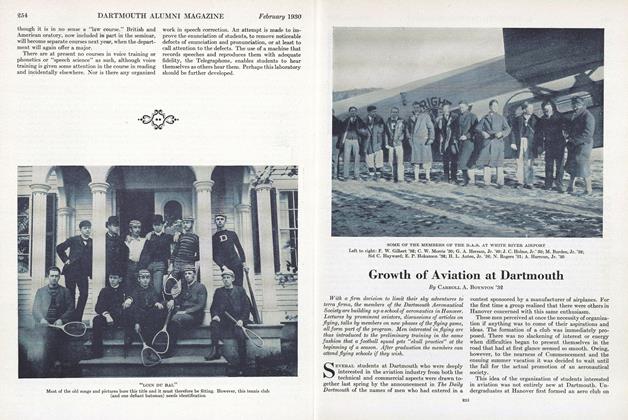
THE ENVIRONMENT OF CARNIVAL Outing Club Hiker on Winter Trip looks down into Tuckerman's Ravine from Mt. Washington.
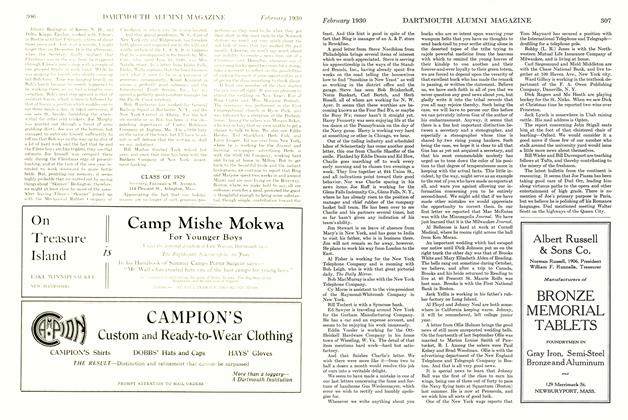
WHO WILL WEAR HER CROWN? Last Year's Carnival Queen, Miss Dorothy Wright of West Orange, N. J.
THE LEAP