Dartmouth in the New Deal
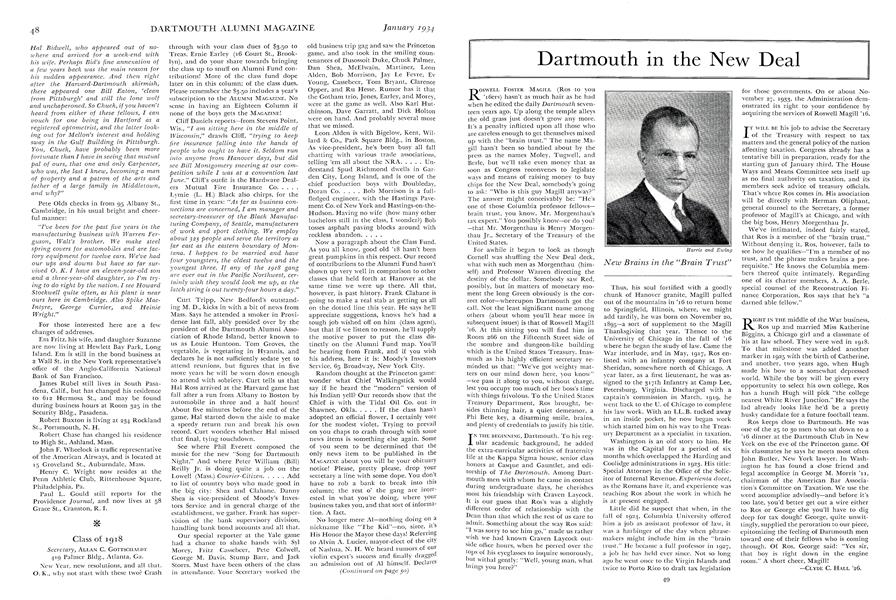
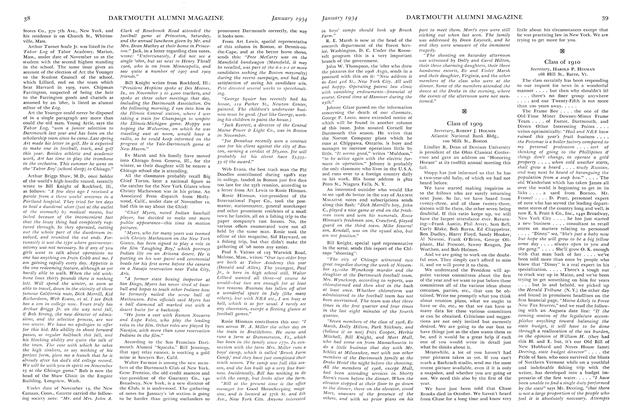
ROSWELL FOSTER MAGILL (ROS to you '16ers) hasn't as much hair as he had when he edited the daily Dartmouth seventeen years ago. Up along the temple alleys the old grass just doesn't grow any more. It's a penalty inflicted upon all those who are careless enough to get themselves mixed up with the "brain trust." The name Magill hasn't been so bandied about by the press as the names Moley, Tugwell, and Berle, but we'll take even money that as soon as Congress reconvenes to legislate ways and means of raising mopey to buy chips for the New Deal, somebody's going to ask: "Who is this guy Magill anyway?" The answer might conceivably be: "He's one of those Columbia professor fellowsbrain trust, you know. Mr. Morgenthau's tax expert." You possibly know—or do you? —that Mr. Morgenthau is Henry Morgenthau Jr., Secretary of the Treasury of the United States.
For awhile it began to look as though Cornell was shuffling the New Deal deck, what with such men as Morgenthau (himself) and Professor Warren directing the destiny of the dollar. Somebody saw Red, possibly, but in matters of monetary moment the long Green obviously is the correct color—whereupon Dartmouth got the call. Not the least significant name among others (about whom you'll hear more in subsequent issues) is that of Roswell Magill 'l6. At this sitting you will find him in Room 266 on the Fifteenth Street side of the sombre and dungeon-like building which is the United States Treasury. Inasmuch as his highly efficient secretary reminded us that: "We've got weighty matters on our mind down here, you know" —we pass it along to you, without charge, lest you occupy too much of her boss's time with things frivolous. To the United States Treasury Department, Ros brought, besides thinning hair, a quiet demeanor, a Phi Bete key, a disarming smile, brains, and plenty of credentials to justify his title.
IN THE BEGINNING, Dartmouth. To his regular academic background, he added the extra-curricular activities of fraternity life at the Kappa Sigma house, senior class honors at Casque and Gauntlet, and editorship of The Dartmouth. Among Dartmouth men with whom he came in contact during undergraduate days, he cherishes most his friendship with Craven Laycock. It is our guess that Ros's was a slightly different order of relationship with the Dean than that which the rest of us care to admit. Something about the way Ros said: "I was sorry to see him go," made us rather wish we had known Craven Laycock outside office hours, when he peered over the tops of his eyeglasses to inquire sonorously, but withal gently: "Well, young man, what brings you here?"
Thus, his soul fortified with a goodly chunk of Hanover granite, Magill pulled out of the mountains in 'l6 to return home to Springfield, Illinois, where, we might add tardily, he was born on November 20, 1895—a sort of supplement to the Magill Thanksgiving that year. Thence to the University of Chicago in the fall of '16 where he began the study of law. Came the War interlude, and in May, 1917, Ros enlisted with an infantry company at Fort Sheridan, somewhere north of Chicago. A year later, as a first lieutenant, he was assigned to the 317 th Infantry at Camp Lee, Petersburg, Virginia. Discharged with a captain's commission in March, 1919, he went back to the U. of Chicago to complete his law work. With an LL.B. tucked away in an inside pocket, he now began work which started him on his way to the Treasury Department as a specialist in taxation.
Washington is an old story to him. He was in the Capital for a period of six months which overlapped the Harding and Coolidge administrations in 1923. His title: Special Attorney in the Office of the Solicitor of Internal Revenue. Experienta docet, as the Romans have it, and experience was teaching Ros about the work in which he is at present engaged.
Little did he suspect that when, in the fall of 1924, Columbia University offered him a job as assistant professor of law, it was a harbinger of the day when phrasemakers might include him in the "brain trust." He became a full professor in 1927, a job he has held ever since. Not so long ago he went once to the Virgin Islands and twice to Porto Rico to draft tax legislation for those governments. On or about November 27, 1933, the Administration demonstrated its right to your confidence by acquiring the services of Roswell Magill '16.
IT WILL BE his job to advise the Secretary of the Treasury with respect to tax matters and the general policy of the nation affecting taxation. Congress already has a tentative bill in preparation, ready for the starting gun of January third. The House Ways and Means Committee sets itself up as no final authority on taxation, and its members seek advice of treasury officials. That's where Ros comes in. His association will be directly with Herman Oliphant, general counsel to the Secretary, a former professor of Magill's at Chicago, and with the big boss, Henry Morgenthau Jr.
We've intimated, indeed fairly stated, that Ros is a member of the "brain trust." Without denying it, Ros, however, fails to see how he qualifies—"l'm a member of no trust, and the phrase makes brains a prerequisite." He knows the Columbia members thereof quite intimately. Regarding one of its charter members, A. A. Berle, special counsel of the Reconstruction Finance Corporation, Ros says that he's "a darned able fellow."
RIGHT IN THE middle of the War business, . Ros up and married Miss Katherine Biggins, a Chicago girl and a classmate of his at law school. They were wed in 1918. To that milestone was added another marker in 1925 with the birth of Catherine, and another, two years ago, when Hugh made his bow to a somewhat depressed world. While the boy will be given every opportunity to select his own college, Ros has a hunch Hugh will pick "the college nearest White River Junction." He says the lad already looks like he'd be a pretty husky candidate for a future football team.
Ros keeps close to Dartmouth. He was one of the 25 to 30 men who sat down to a '16 dinner at the Dartmouth Club in New York on the eve of the Princeton game. Of his classmates he says he meets most often John Butler, New York lawyer. In Wash- ington he has found a close friend and legal accomplice in George M. Morris '11, chairman of the American Bar Associa- tion's Committee on Taxation. We use the word accomplice advisedly—and before it's too late, you'd better get out a wire either to Ros or George else you'll have to dig deep for tax dough! George, quite unwittingly, supplied the peroration to our piece, epitomizing the feeling of Dartmouth men toward one of their fellows who is coming through. Of Ros, George said: "Yes sir, that boy is right down in the engine room." A short cheer, Magill!
New Brains in the "Brain Trust"