Traveling by Trailer
TO ANYONE who has enjoyed the charm of New England and is unable to visit it frequently there seems to be a constant yearning to return. For many of us it is impracticable to join the throng who are establishing country homes there and so it was that we met the situation by the purchase of a camping trailer with which for comparatively low cost we are able to make our trips when it is convenient but without being re- stricted to any one particular locality. Mountains, lakes or seashore, one or all, become available on a single trip and in the interim we do not have the concern of a substantial idle investment or its upkeep as would be the case with a camp, cottage, or farm.
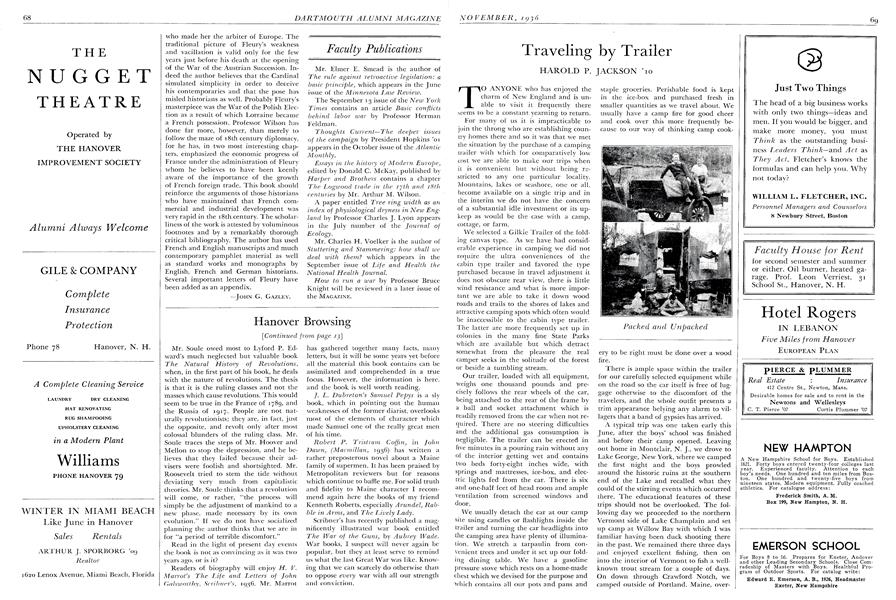
We selected a Gilkie Trailer of the folding canvas type. As we have had considerable experience in camping we did not require the ultra conveniences of the cabin type trailer and favored the type purchased because in travel adjustment it does not obscure rear view, there is little wind resistance and what is more important we are able to take it down wood roads and trails to the shores of lakes and attractive camping spots which often would be inaccessible to the cabin type trailer. The latter are more frequently set up in colonies in the many fine State Parks which are available but which detract somewhat from the pleasure the real camper seeks in the solitude of the forest or beside a tumbling stream.
Our trailer, loaded with all equipment, weighs one thousand pounds and precisely follows the rear wheels of the car, being attached to the rear of the frame by a ball and socket attachment which is readily removed from the car when not required. There are no steering difficulties and the additional gas consumption is negligible. The trailer can be erected in five minutes in a pouring rain without any of the interior getting wet and contains two beds forty-eight inches wide, with springs and mattresses, ice-box, and electric lights fed from the car. There is six and one-half feet of head room and ample ventilation from screened windows and door.
We usually detach the car at our camp site using candles or flashlights inside the trailer and turning the car headlights into the camping area have plenty of illumination. We stretch a tarpaulin from convenient trees and under it set up our folding dining table. We have a gasoline pressure stove which rests on a home-made chest which we devised for the purpose and which contains all our pots and pans and staple groceries. Perishable food is kept in the ice-box and purchased fresh in smaller quantities as we travel about. We usually have a camp fire for good cheer and cook over this more frequently because to our way of thinking camp cookery to be right must be done over a wood fire.
There is ample space within the trailer for our carefully selected equipment while on the road so the car itself is free of luggage otherwise to the discomfort of the travelers, and the whole outfit presents a trim appearance belying any alarm to villagers that a band of gypsies has arrived.
A typical trip was one taken early this June, after the boys' school was finished and before their camp opened. Leaving out home in Montclair, N. J., we drove to Lake George, New York, where we camped the first night and the boys prowled around the historic ruins at the southern end of the Lake and recalled what they could of the stirring events which occurred there. The educational features of these trips should not be overlooked. The following day we proceeded to the northern Vermont side of Lake Champlain and set up camp at Willow Bay with which I was familiar having been duck shooting there in the past. We remained there three days and enjoyed excellent fishing, then on into the interior of Vermont to fish a wellknown trout stream for a couple of days. On down through Crawford Notch, we camped outside of Portland, Maine, overlooking Falmouth Foreside. From there we went down that interesting coast to Bar Harbor and from that point had many interesting side trips into the surrounding country, climbing the mountains and fishing with success in the waters thereabouts. Returning via Portland and over the Ossipee Trail into Wentworth, N. H., we arrived at Camp Pemigewassett two days before camp opened. The boys busied themselves helping to get out the camp boats and docks while I took my ease from a beautiful camp site overlooking the lake westward to the Green Mountains. Leaving "Pemi" I proceeded alone to the field River where there were tales of huge brown trout which, however, were not interested in my enticements, but I had a delightful camp in pines off the Mohawk Trail and reached home from there in one day's run.
The whole trip consumed fifteen days, we traveled 1,780 miles, and the total cost for everything, food, gasoline, oil, fishing licenses and incidentals was $94.00 for thi*ee persons. We lived in perfect comfort and enthusiastically recommend trailer camping for the consideration of everyone who occasionally hears the call "come back to New England."
Packed and Unpacked