Class of 1895
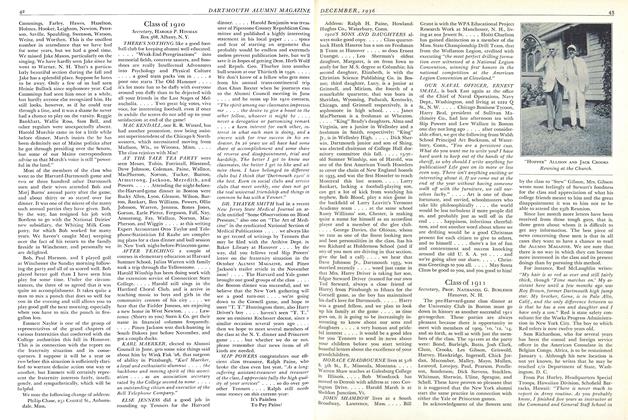
The Secretary sat in at the Norwich and Holy Cross games at Hanover. He made a mental note of the difference between these games. They were extremes, In every way, except actual scoring, Dartmouth won the Holy Cross game. But Holy Cross accepted the gift which led to their score with alacrity and intelligence. With the same degree of reluctance with which Caesar thrice declined the proffered crown, the victor's rooters declined to remove Dartmouth's goal posts. They laid loving hands thereon, looked thoughtfully at the Dartmouth horde, and then refrained.
Joel Harley declares that he has forgotten all the astronomy he was taught at Dartmouth by Prof. Edwin Frost; but nevertheless, he is arranging to publish a series of stories about the stars, which he is writing for children. He is beginning the study of astronomy anew. He will undoubtedly find that he will recall more of his astronomy under Prof. Frost than he now realizes. Harley confesses thus:—
"We are still playing with our grand-child, wife and I. We have her with us thissummer while her mother is abroad, andshe keeps us hopping to keep up with her." Joel's interest in the class of '95 has been growing. He says:—'"lt really begins to lookas though there was still life left in theold boys if stimulated in the right way.More power to you."
In 1893, while a sophomore at Dartmouth, Harley made frequent entries in a note book. Among other entries he recorded a list of books which our respected "Clothes-pins" recommended for reading, as part of a liberal education and cultural growth. Probably not many of us can recall a half-dozen titles of this list. But a glance at the list itself will, quite likely, bring recollection to many of our class. Here is the list:
History Gibbon's Decline and Fall of Roman Empire. Parkman's Montcalm and Wolfe. Gardiner's History of England. Freeman's Students History of England. Higgins' Larger History of U. S. Prescott's Ferdinand and Isabella. Motley's Dutch Republic. Croesy's 15 Decisive Battles. Bancroft's History U. S. Fisher's Outlines of Ancient History.
Essays Emerson's Essays. Lamb's Elia Dobson's 18 Cent. Essays. Burke's Sublime and Beautiful. Arnold's Essays and Criticisms. Bacon's Essays. Irving's Sketchbook. Holmes' Autocrat of Breakfast Table. Ruskin's Sesame and Lilies. Carlyle's Satires.
Poems Longfellow's Poems. Longfellow's Evangeline. Emerson's poems Bryant's poems. Shakespeare—Eng. Keat's Endymion Browning's Selections. Lanfrey's Napoleon. Brace's Gesta Christi. House of Seven Gables—Hawthorne. Cooper's Pathfinder and Pilot.
Miss Jewett's Tales of New England. Goldsmith's Vicar of Wakefield. Thackeray's Vanity Fair. Blackmore's Lorna Doone. Holmes' Life of Motley. Hughes' Alfred the Great. Johnston's Hist, of American Politics. Lowell's Vision of Sir Launfal. Whittier's Snowbound. Howe's poems (Howe, Julia Ward). Stedman's poems. Paradise Lost. Tennyson's Idylls of the King. Palgrave's Golden Treasury. Hugo's Battle of Waterloo. Emerson's Sermon on Ethics. Poe's Tales. Bret Harte's Luck of Roaring Camp. Scott's Ivanhoe. Dickens' Bleak House. Charlotte Bronte's Jane Eyre. Holmes' Life of Emerson. Life of Kingsley. Schuyler's Peter the Great. Nath. Hawthorne and Wife by Hawthorne. Bryce's American Commonwealth.
This list compares favorably with the famous five-foot book shelf sponsored by the late Dr. Eliot, formerly president of Harvard.
The Secretary and Mrs. Stevens attended the wedding of their youngest son, Paul, on November 7. He was married to Margaret Stewart of Flushing, N. Y., at the Little Church Around The Corner in New York City. It was also the 36th anniversary of his parents' wedding. The bride is a graduate of Hunter College. Paul is a graduate of the University of Vermont. (He balked at attending Dartmouth, though entered there when his brother, Roland Jr., was a Dartmouth senior.) He is employed in the executive department of the Universal Pictures Corporation, Rockefeller Center, New York. He and his young bride will make their home in New York City.
The above is intended more particularly for the information of '95 men and ladies and their sons and daughters, who were at our class supper at my home a year ago last June. Paul was there.
An obituary of Henry N. Chase appears in this issue.
In response to the Secretary's letter, extending sympathy of the class, Mrs. Chase writes as follows:
"Please accept our thanks for your sympathy as well as that of Henry's other classmates. A good husband and father hasbeen taken from our home, and it is indeeda great loss to us. He had not been wellsince last February, and though unable towork during the summer, yet we did notexpect the hasty summons."
When Joe Ford heard that Paul Stevens was to attack New York for a job, his big heart pumped up the following warm response:
"Dear Steve:—
"If that boy Paul Stevens comes down to New York hunting up a job, have him come in and see me on general principles. I don't know what I can do to be of any help, but of course I will be interested in lending a hand, if possible.
"He could use our office for the usual convenience of telephone, stenographer, and a place to hang his hat, etc., and if I can supplement any promising leads with a word of my own, I will be prepared to do what I can.
"I don't know as I have any right to express an opinion on the prospects of his landing a job, but general business is no doubt improving. If he is prepared to settle down in New York for some time in planning his attack for an opening, I think he should have just as good a chance as any other youth just out of college. There seem to be plenty of them who come to New York to get a start."
Secretary, White River Junction, Vt.