Letters to the Editor
Can This Be Treason?
To the Editor: For some reason, possibly the shuddering memory of New Hampshire winters, Dartmouth men have been descending on Acapulco with the same enthusiasm and in only slightly smaller numbers than the northern wildfowl which plunk into the warm costal lagoons. Acapulco is a hot and rather dirty, but delightful, little town three hundred dusty miles southwest of Mexico City. The big harbor, once the sea port of the conquistadores, is shielded by great rocky cliffs from the booming rollers out of the Orient. There are palms and pigs and burros; tropical fish swim radiantly in the coral; the water is clear as plate glass and warmly soothing; the sand is like table salt; the white clouds brush the mountains and the hot sun bakes the land.
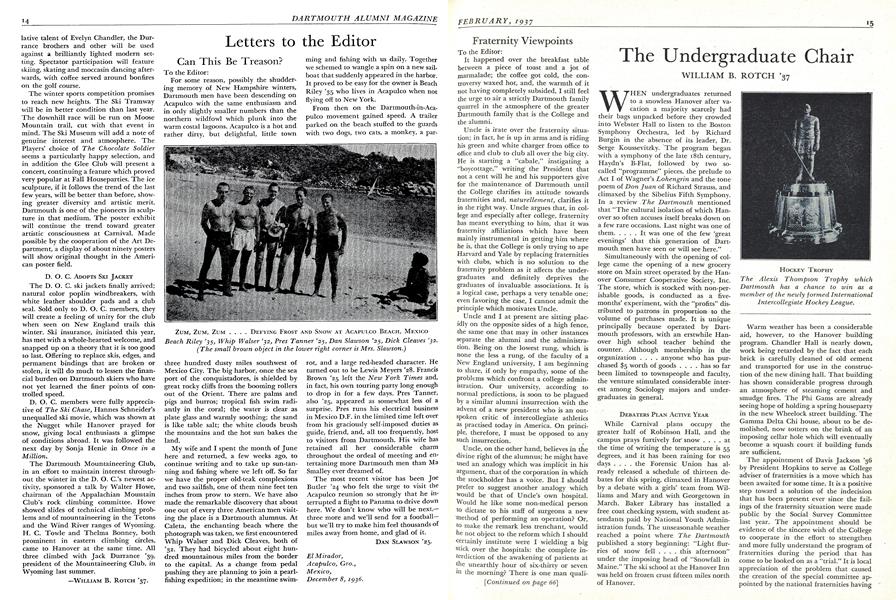
My wife and I spent the month of June here and returned, a few weeks ago, to continue writing and to take up sun-tanning and fishing where we left off. So far we have the proper old-teak complexions and two sailfish, one of them nine feet ten inches from prow to stern. We have also made the remarkable discovery that about one out of every three American men visiting the place is a Dartmouth alumnus. At Caleta, the enchanting beach where the photograph was taken, we first encountered Whip Walser and Dick Cleaves, both of '32. They had bicycled about eight hundred mountainous miles from the border to the capital. As a change from pedal pushing they are planning to join a pearlfishing expedition; in the meantime swiming and fishing with us daily. Together we schemed to wangle a spin on a new sailboat that suddenly appeared in the harbor. It proved to be easy for the owner is Beach Riley '35 who lives in Acapulco when not flying off to New York.
From then on the Dartmouth-in-Acapulco movement gained speed. A trailer parked on the beach stuffed to the guards with two dogs, two cats, a monkey, a parrot and a large red-headed character. He turned out to be Lewis Meyers '28. Francis Brown '25 left the New York Times and, in fact, his own touring party long enough to drop in for a few days. Pres Tanner, also '25, appeared as somewhat less of a surprise. Pres runs his electrical business in Mexico D.F. in the limited time left over from his graciously self-imposed duties as guide, friend, and, all too frequently, host to visitors from Dartmouth. His wife has retained all her considerable charm throughout the ordeal of meeting and entertaining more Dartmouth men than Ma Smalley ever dreamed of.
The most recent visitor has been Joe Butler '24 who felt the urge to visit the Acapulco reunion so strongly that he interrupted a flight to Panama to drive down here. We don't know who will be next,— three more and we'll send for a football— but we'll try to make him feel thousands of miles away from home, and glad of it.
El Mirador,Acapulco, Gro.,Mexico,December 8, 1936.
Fraternity Viewpoints
To the Editor It happened over the breakfast table between a piece of toast and a jot of marmalade; the coffee got cold, the controversy waxed hot, and, the warmth of it not having completely subsided, I still feel the urge to air a strictly Dartmouth family quarrel in the atmosphere of the greater Dartmouth family that is the College and the alumni.
Uncle is irate over the fraternity situation; in fact, he is up in arms and is riding his green and white charger from office to office and club to club all over the big city. He is starting a "cabale," instigating a "boycottage," writing the President that not a cent will he and his supporters give for the maintenance of Dartmouth until the College clarifies its attitude towards fraternities and, naturellement, clarifies it in the right way. Uncle argues that, in college and especially after college, fraternity has meant everything to him, that it was fraternity affiliations which have been mainly instrumental in getting him where he is, that the College is only trying to ape Harvard and Yale by replacing fraternities with clubs, which is no solution to the fraternity problem as it affects the undergraduates and definitely deprives the graduates of invaluable associations. It is a logical case, perhaps a very tenable one; even favoring the case, I cannot admit the principle which motivates Uncle.
Uncle and I at present are sitting placidly on the opposite sides of a high fence, the same one that may in other instances separate the alumni and the administration. Being on the lowest rung, which is none the less a rung, of the faculty of a New England university, I am beginning to share, if only by empathy, some of the problems which confront a college administration. Our university, according to normal predictions, is soon to be plagued by a similar alumni insurrection with the advent of a new president who is an outspoken critic of intercollegiate athletics as practised today in America. On principle, therefore, I must be opposed to any such insurrection.
Uncle, on the other hand, believes in the divine right of the alumnus; he might have used an analogy which was implicit in his argument, that of the corporation in which the stockholder has a voice. But I should prefer to suggest another analogy which would be that of Uncle's own hospital. Would he like some non-medical person to dictate to his staff of surgeons a new method of performing an operation? Or, to make the remark less trenchant, would he not object to the reform which I should certainly institute were I wielding a big stick over the hospitals: the complete interdiction of the awakening of patients at the unearthly hour of six-thirty or seven m the morning? There is one man quali- fied to run a hospital: he is a doctor; and there is one man qualified to run a college, and he is an educator. A layman, especially one who is prone to think still i undergraduate terms, knows no more about runing a college than about running a hospital; education is as much a profession as surgery, and the stockholder should not expect to interfere. Do not think that I am naively setting up a dogma of the infallibility of the educator; what I object to is inept criticism from unqualified sources.
The alumnus may be justly proud of the fact that he is responsible in a large measure for the greatness of American "liberal education, that he is the sole instrument of the autonomy of American colleges. Editorially the New York Times said on New Year's morning: "President Butler, in hisaddress last year to the graduates of Columbia, said that the university has disappeared from every totalitarian State, thatfor the time being university life beginsthis side of the Rhine, and that it is to theschools of France atid Belgium, the Netherlands and Scandinavia, Great Britain andthe United States, that the coming generation must look for free, disinterested guidance. In these alone . ... is human progress possible." Although there are certain factions in this country which would not hesitate to accuse President Butler of wishing to deviate the Rhine from its natural course, one cannot fail to endorse this plea for the autonomy of American higher education, making the reservation that autonomy would be ineffective without academic freedom.
The advice of an alumnus like Uncle is, and should always be, welcome; but he should not set himself up as an authority more potent than the administration. By this abuse of power he is, if only on a small scale, seriously jeopardizing the autonomy of the college. Fraternities and subventioned football are minor issues; in more weighty matters we have seen the autonomy of some colleges and universities dangerously threatened and even considerably impaired by ill-advised alumni intervention. It is, as I have said, the principle that is my chief concern, and I must continue to believe that Uncle's "cabale," sauf son respect, is indeed unfortunate.
Brown University,Providence, R. 1.,January 2, 1937.
More about "Squash"
[The following letter has been forwardedby Walter E. McCornack '97.]
Dear Mr. McCornack: While not a subscriber to the Dartmouth ALUMNI MAGAZINE, I see it occasionally through the courtesy of a friend.* I notice in your letter in the December number you remark that you do not know how "Squash" and "Tony" received their nicknames. I can tell you as regards the former, at least as the story went the rounds at the time the event occurred.
I was a member of the class of 1890, N. H. College, at Hanover, before that institution moved to Durham. Dr. C. S. Little was a member of the class of 1891, Chandler Scientific School, before that institution was merged with Dartmouth.
The elderly professor of Botany in both institutions was known among the boys as "Aunty" Jessup, presumably by reason of his somewhat mild and effeminate manner, and did not always receive the respect due his scholastic attainments. It was reported that one day in his Chandler class he was showing some cuts or plates illustrating various types of plant structure, and asking the class to identify these botanically. Pointing to one, he asked Little to identify it, whereupon the latter promptly replied that he thought it looked like a squash—and "Squash" Little he was ever after.
I have a clear picture in my mind of Little's physical appearance as a football player as you describe it in your letter.
I also had some knowledge of his later professional career at the time he served as organizer and superintendent of a home for a group of its mental unfortunates built by the State of New Hampshire and located in the vicinity of my home town in that State.
N. H. College, 1890; T.S.C.E., 1895. Admin. Bldg., Balboa Park,San Diego, Calif.
* [We do not approve of this.—ED.]
Here's to Norwich!
To the Editor To the best of my memory, this is the first time in the fifteen years I have been out of college that I have ever presumed upon your time and attention. And I would not do so now, were it not for the fact that I think you hold a key position in the alumni body and can accomplish what I think ought to be done.
Yesterday's newspaper carried the football schedule for next year together with the announcement that Norwich would not be on the schedule.
To those of us who have followed Dartmouth teams for a number of years, the absence of Norwich from our schedule will be like the passing of an old friend. Something irreplaceable will be missing on the day of the season's opening game. Many of the Norwich men who have played against Dartmouth will also regret the absence of the game, I am sure; and those of us who were simply men in the stands will recall the picture we have of the entire Norwich cadet corps marching down the gridiron, on to a game that was always characterized by sheer courage and clean sportsmanship.
My purpose in writing to you at this time is not to question the decision that removed Norwich from the schedule, nor to bemoan the penalties of football prosperity. I am writing simply to ask that some tangible recognition be made of a great relationship.
I should like to suggest that you jointly sponsor a movement to have many Dartmouth men contribute small sums and have presented to the authorities at Norwich some appropriate gift in recognition of the spirit of the Norwich teams and men who made the annual trip to Hanover. I suggest that the gift bear some inscription appropriate to the thought behind it, if only the words
TO THE CADETS OF NORWICH FROM
THE MEN OF DARTMOUTH IN APPRECIATION AND ADMIRATION
Like the cup that was presented to Sir Thomas Lipton by the American public, this gift should come from the small donations of the many rather than from the large donations of a few. And perhaps the Norwich group will share the feelings of Sir Thomas who said in accepting the gift, "You have made me feel that I have almost won."
Rhode Island State College,Kingston, R. 1.,January 9, 193'].
ZUM, ZUM, ZUM .... DEFYING FROST AND SNOW AT ACAPULCO BEACH, MEXICO Beach Riley '35, Whip Walser '32, Pres Tanner '25, Dan Slawson '25, Dick Cleaves '32(The small brown object in the lower right corner is Mrs. Slawson.)