Class of 1895
The following is taken from the Rutland (Vt.) Herald of January 28, 1937.
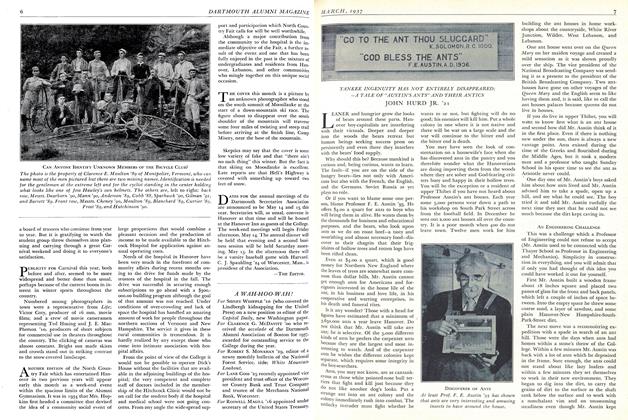
"Life is bliss with the ant family unlessthe females of the household decide tomake trouble, according to professor F. E.Austin of Hanover, N. H., authority onant life, who addressed members andguests of the Friendly Circle at the organization's 'family' banquet last night.
"The speaker, formerly a professor ofengineering at Dartmouth College, is nowa retired citizen. A few years ago he startedbuilding little houses for ants, composedof two sheets of glass with dirt in between,called 'Ant Palaces.' In the palaces he hasqueen rooms, banquet halls, watch towers,tunnels, and ether necessary conveniences.
''During his talk, Austin exhibited several palaces, a fire house, and other homearrangements for ants and crickets.
"All information about the outsideworld is communicated to the ant throughits antenna, in much the same manner asan antenna functions in radio, ProfessorAustin said. 'The ant is blind and isguided by sense of smell and instinct.'
"In describing the life of ants, thespeaker termed their organization as wonderful as their organisms, and lauded thespecies as past masters at what human beings call political economy."
Well towards fifty years ago, while a student in St. Johnsbury Academy, I heard a lecture entitled "Acres of Diamonds" by the eminent lecturer, Russell H. Conwell. He urged boys budding into manhood to look about them for life's opportunities. He insisted that it was unnecessary for boys and men to seek their fortunes in some distant state; that there were opportunities surrounding them at home. "Look aboutyou '' he said, "and seize the opportunitiesllght under your nose." He cited various "istances of unexpected success where failure had discouraged men. For instance he told of someone in South Africa pickIng up a rough sort of stone, not knowing its value, which was later found to be a diamond, and which was sold in the rough for more than two thousand dollars. This led to further search and the consequent discovery of diamond fields near Kimberly, "Acres of Diamonds."
The immediate point of all this is to call attention to a rather remarkable and recent application of the lecturer's advice —"look about you."
Classmate Austin at the low ebb of fortune looked about and surveyed the near field of opportunity. He is an ingenious man, and he applied his ingenuity, in a little shop of his own building near his house, to the making of a device for studying the habits and life history of ants. John Hayes '95 obtained a patent on it, and now the Austin Ant Palace is becoming famous throughout America. Not long ago while walking along Tremont St., Boston, I noticed a throng of people standing in front of a large shop window looking intently, pointing, and talking. On wedging into the crowd, I saw an Austin Ant Palace. The ants were busily working, lugging grains of sand from below to a ramp of sand they were building above. Austin is now making and selling thousands of these interesting devices, on which is inscribed "Go to the ant, thou sluggard.Consider her ways and be wise."
The class is indebted to Louis Benezet '99 for the information quoted below from his letter to the Secretary.
"I read with interest your inquiry in the ALUMNI MAGAZINE regarding the origin ofthe nickname P. I. for Fred G. Folsom andHenry C. Morrison.
"You may remember that these two,along with Pat Conway and Parson Folsom, who is no relation to Fred, came fromOldtown, Me. Right near his village waslocated a reservation of Penobscots. As aresult, Morrison and Folsom were nick-named Penobscot Indians, which wasfinally shortened to P. I.
"It seems strange that the class of '95generally does not know this, for I heard itabout the time I entered college."
It may be that most of the class did know this and that I just didn't. I remember that "Phin" Wheeler dubbed me "How- somever," and that Dan Watson and a few others made use of "Phin's" invention. But it was too long and heavy a device for popular use. Why "Phin" thus decorated me I never knew. He declared I used the word in an Old Chapel oration; but I always thought he imagined all this.
Fred Cleaveland attended the mid-winter session of the House of Delegates of the American Bar Association at Columbus, Ohio, in January. Fred is president of the Bar Association of New Hampshire and is an accredited member of the House of Delegates. He reports that he met a great many distinguished members of the legal fraternity and listened to interesting discussions. The Omaha delegates spoke well of Charlie Pollard of our class, whom they seem to know very well.
The December number of Journal ofthe Patent Office Society contains a fourteen page article by John Hayes, entitled "The Inventive Concept."
Morrison has regained his health and plans to retire from teaching June go.
In a recent letter from Albion Wilson he says:
"This morning I had a brief note fromWesley O'Leary's wife, saying Wesley haddied and his funeral was held last Saturday. It is the first I have heard from him inover two years. Her note was very shortand simply said he was taken much worseabout two weeks ago and that he died lastweek. He has been in poor health for something like two years, but I do not know thenature of his trouble nor the immediatecause of his death."
Mrs. O'Leary writes in part as follows: "Wesley was one of the original members of the National Occupation Conference and continued on the executivecommittee until his death. This executivecommittee directed the expenditures ofconsiderable sums of money from theCarnegie Foundation, which were spent ongrants for occupational research and vocational guidance.
"The heart condition which caused hisdeath was brought on by overwork andstrain in Washington at the time whenHoover threatened to withdraw federalAid for vocational education. Wesley ledthe fight which saved the aid, which wasso necessary for the continuance of thework, but paid a high price.
"The degree of Doctor of Science was anhonorary one given him in recognition forhis services to vocational education."
Wesley's obituary appears in this issue of the MAGAZINE.
Secretary, White River Junction, Vt.