1885*
Henry Austin recently wrote the Secretary that he and our classmate Arthur Whitcomb attended the "annual Florida Dartmouth dinner which was held in St. Petersburg, on the evening of Friday, February 24. The attendance was about fifty, including Dartmouth graduates and their families; Herbert Gage 'B7 was elected president and Stephen Chase '96 vice president, which insures the continuing success of the organization.
The Secretary recently learned that a movement is on foot among the many admirers of our classmate Richard Hovey, to pay some appropriate recognition of his seventy-fifth birthday, which occurs on May 4 next, Hovey died in New York City, on February 24, 1900, when he was less than thirty-six years of age; when we consider the quantity and quality of the literary work which he accomplished in his brief life it is well fitting that some such observance of his birthday be made.
Our classmate E. F. Philbrick, now residing at 1760 Orchid Ave., Hollywood, Calif., was a roommate of Dick's during a part of our college course, knew him well, and had high regard for his literary ability. In view of this proposed movement in recognition of Hovey's birthday, the following tribute from Philbrick, which he wrote the Secretary some time ago, will, I trust, prove of interest, and I am, therefore, happy to quote it quite fully.
"Hovey owed everything to his motherhis good looks, his poetic ability, his general culture, his capacity for work—all came from her.
"Her command of English was unusual, and to great personal charm was added sound common sense; she was a woman who had met trouble face to face, but she had never lost courage. Her hope for the future lay in her ambition for her son.
"Hovey came to Dartmouth with a good fit in the required subjects, and also with a breadth of culture that he got from his mother's friends. He wrote poetry before he went to college; his mother encouraged him in his early work and was always his sympathetic critic.
"Hovey relied on hard work, not on inspiration—he wrote and rewrote—filed, polished, and often threw away. Every word must be musical, colorful, and must carry on the rhythm. His method was like that of Robert Louis Stevenson. His refusal to be satisfied with anything less than perfection was an inheritance from his mother.
"Hovey's future place in American literature is not easy to forecast as a whole; his larger works are not likely to get a strong hold on many people; still it has happened that a time comes when such poems are reborn in public favor.
"But his lyrics! These are another story. Nothing finer has been written. Love of out-of-doors, virility, rhythm, color—Hovey has everything. Every anthology that has appeared for years contains one or two of his lyrics. They are going to last. "I end by quoting what seems to me to be his best poem;
" 'THE SEA GYPSY 'I am fevered with the sunset, I am fretful with the bay, For the wander-thirst is on me, And my soul is in Cathay.
There's a schooner in the offing With her topsails shot with fire, And my heart has gone aboard her For the Islands of Desire.
'I must forth again tomorrow. With the sunset I must be Hull down on the trail of rapture In the wonder of the sea.' "
Fund Contributors for 1938
Contributors: 10 (50% of graduates). Total gifts: $268.10 (151% of objective). OTIS E. HOVEY, Class Agent.
1885
Austin, Henry H. Bayley, Edwin A. Brooks, John P. Chase, Charles F. Currier, Richard S.
Floyd, Charles W. Hovey, Otis E. Hudson, Samuel H. Philbrick, Eliphalet F. Rockwood, Wilbur J.
Secretary, Kimball Bldg., Tremont St., Boston
More From This Issue
-
 Feature
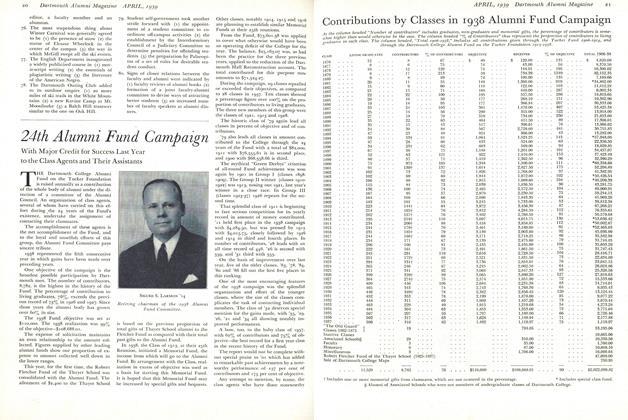
Contributions by Classes in 1938 Alumni Fund Campaign
April 1939 -
 Feature
Life of a Class Agent
April 1939 -
Cover Story
24th Alumni Fund Campaign
April 1939 -
 Feature
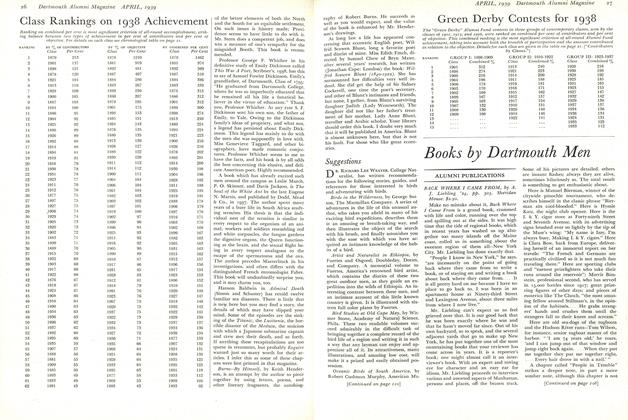
Glass Rankings on 1938 Achievement
April 1939 -
Feature
Thayer School Report
April 1939 -
Feature
Green Derby Contests for 1938
April 1939