1897
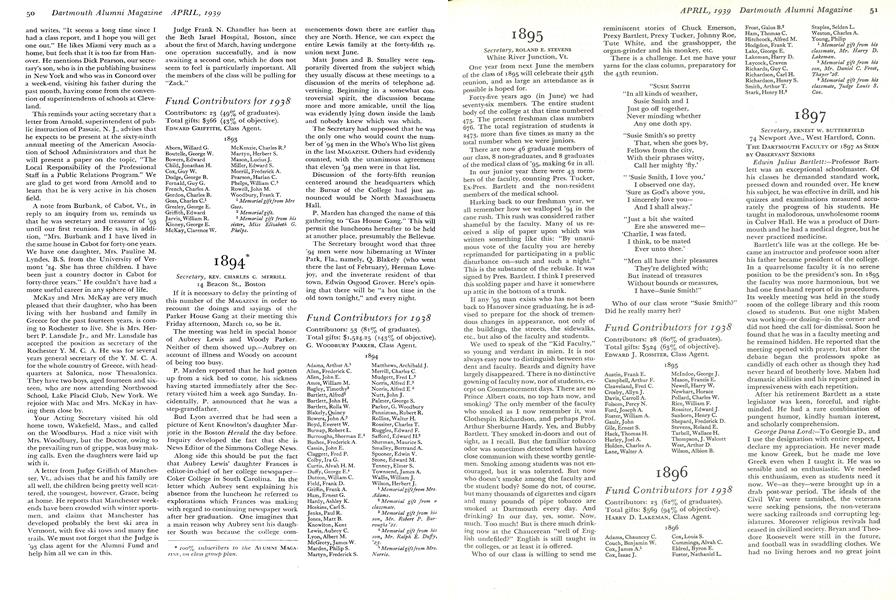
THE DARTMOUTH FACULTY OF 1897 AS SEEN BY OBSERVANT SENIORS
Edwin Julius Bartlett:—Proiessor Bartlett was an exceptional schoolmaster. Of his classes he demanded standard work, pressed down and rounded over. He knew his subject, he was effective in drill, and his quizzes and examinations measured accurately the progress of his students. He taught in malodorous, unwholesome rooms in Culver Hall. He was a product of Dartmouth and he had a medical degree, but he never practiced medicine.
Bartlett's life was at the college. He became an instructor and professor soon after his father became president of the college. In a quarrelsome faculty it is no serene position to be the president's son. In 1895 the faculty was more harmonious, but we had one first-hand report of its procedures. Its weekly meeting was held in the study room of the college library and this room closed to students. But one night Maben was working—or dozing—in the corner and did not heed the call for dismissal. Soon he found that he was in a faculty meeting and he remained hidden. He reported that the meeting opened with prayer, but after the debate began the professors spoke as candidly of each other as though they had never heard of brotherly love. Maben had dramatic abilities and his report gained in impressiveness with each repetition.
After his retirement Bartlett as a state legislator was keen, forceful, and rightminded. He had a rare combination of pungent humor, kindly human interest, and scholarly comprehension.
George Dana Lord,:—To Georgie D., and I use the designation with entire respect, I declare my appreciation. He never made me know Greek, but he made me love Greek even when I taught it. He was so sensible and so enthusiastic. We needed this enthusiasm, even as students need it now. We—as they—were brought up in a drab post-war period. The ideals of the Civil War were tarnished, the veterans were seeking pensions, the non-veterans were sacking railroads and corrupting legislatures. Moreover religious revivals had ceased in civilized society. Bryan and Theodore Roosevelt were still in the future, and football was in swaddling clothes. We had no living heroes and no great joint interests and enthusiasms. Cynicism was a badge of educational enrollment.
Then came George D. Lord, striding up and down the classroom, with watch chain flopping and hair disheveled as he led us through an ancient land where men were men without being ashamed and beauty was beauty without being a W.P.A. gift. Schliemann never knew that we were digging at Hissarlik with him. We saw the Greece of Homer and Heroditus and Plato only in the years 1893 and 1894, but they are more real to many of us than the streets of New York or the federal buildings at Washington.
Professor Lord was in the Dartmouth line. He bore the names of two presidents and was the descendant, I believe, of one. In the college he was a tutor, an instructor, a professor. He had a home to students most amazing. The dining room was said to be in the cellar and the bathroom in the attic. This was not the traditional assignment of vital accommodations in the country homes from which we came. He had below his house in a protected vale a garden, "never with winds was it disturbed nor by the driving wind nor by the crushing snow but over it the upper air spread cloudless," as kin to the dwelling to which Athena went.
Professor Lord prepared for his classes as for a public service. He organized the class period so that work was not interrupted, and he was impatient with shiftless work, and with those who deported themselves without appropriate seriousness. To him in retirement and now almost the only representative of our faculty, there remains the garden and I hope satisfying memories of 1897.
William Patten:—At the June, 1893 meeting President-elect Tucker declared to the board of trustees that if Dartmouth was to become an institution and not a college it must have a department of biology. Trustees Quint and Fairbanks were shocked at this proposal. There was Biblical authority for the existence of the department of botany, since Solomon knew the hyssop on the wall; but biology deals with unclean things named by Moses, the beetle, the lizard, and abominations that have more than four feet and go about on their belly. Since to touch such things made unwashed nomads unclean until evening, they had no place in a Christian college. Trustees Kimball and Streeter demurred, they had been officers and agents of the Boston and Maine railroad, and they feared no abomination or creeping thing. Trustee Richardson pointed out that biology dealt with subjects that no high-minded professor could discuss with students without embarrassment—to him. Dr. Tucker replied that the professor whom he had in mind had studied at Leipsic and Naples and was immune to embarrassment. He added that the candidate's doctorial dissertation accepted at Harvard had been "The Morphology of the Brain and Nervous System of Limulus." That settled the matter, but Trustee Smith was disappointed when he looked up Limulus in the dictionary.
William Patten came to Dartmouth. He and his courses were a success from the beginning. He was a scientist who kept on learning, a professor who kept on teaching. He never had cases of student discipline. He spoke before no women's clubs, and he was no speaker for headlines in the pseudoscientific columns of the popular magazines.
Let us see what he did to our class. Our total registration was 130, and 21 became physicians. Such an outpouring, if it had continued, would have provided family doctors in Grafton, Easton, and Weathersfield Center.
Medicine is not easy upon the doctors. Of the 21 doctors nine have died and no one is divorced. With dentists it is different. Statistics show that in e/ery 21, two are murdered, three divorced, and the rest live to advanced years. In our group there are six or eight whose skill and learning has brought them recognition that has no local limitation. Doubtless Patten was proud that Chase became a great surgeon, McFee a great specialist, Folsom a great institutional executive, but he was equally proud of the country work done by Joe Towle and Byron Sanborn and the city activities of Kelly in Indianapolis and Christophe in Manchester.
Fund Contributors for 1938
Contributors: 50 (75% of graduates). Total gifts: $1,201 (101% of graduates). MORTON C. TUTTLE, Class Agent.
1897
Adams, Benjamin F. Appleton, Fred S. Bacon, Arthur A. Bacon, Theodore H. Bailey, Edward P. Bolser, Charles E. Boyd, J. Merrill Brown, Jay D. Brown, Maurice F. Butterfield, Ernest W. Carr, Edward G. Cass, Edgar D. Chase, Henry M. Christophe, Herman Conlon, James H. Drew, Frank E. Folsom, Ralph P. Foss, George E. Gibson, Hamilton Ham, William H. Heald, Franklin E. Holt, Hermon, Jr. Johnson, Frank C. Keating, John F. Kelly, Walter F.
Lull, Henry M. McCornack, Walter E. McFee, William D. Marshall, Benjamin T. Meserve, John S. Morrill, Albert H. Mosher, Loren A. Noyes, Frank H. Pillsbury, Charles H. Rowe, Brainard A. Ryan, Joseph F. Sanborn, Byron Shattuck, Harold B. Sibley, J. Otis Simpson, Joseph O. . Smith, Selden C. Temple, Winfield Tent, George E. Thorne, John T. Thyng, Herbert M. Tracy, Charles A. Tuttle, Morton C. Ward, Roy J. Watson, Albert P. Wood worth, Edward K.
Secretary, 74 Newport Ave., West Hartford, Conn.
More From This Issue
-
 Feature
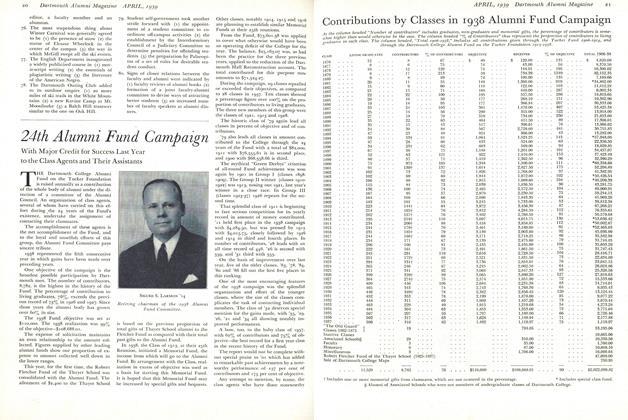
Contributions by Classes in 1938 Alumni Fund Campaign
April 1939 -
 Feature
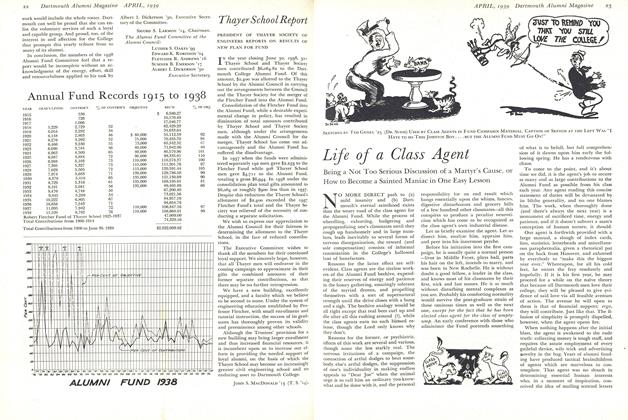
Life of a Class Agent
April 1939 -
Cover Story
24th Alumni Fund Campaign
April 1939 -
 Feature
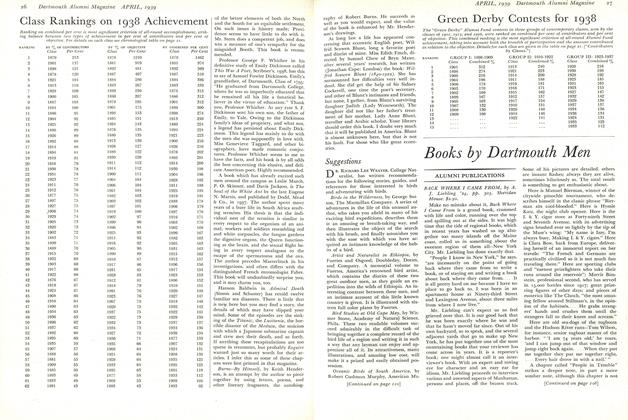
Glass Rankings on 1938 Achievement
April 1939 -
Feature
Thayer School Report
April 1939 -
Feature
Green Derby Contests for 1938
April 1939