The Things We Have in Common
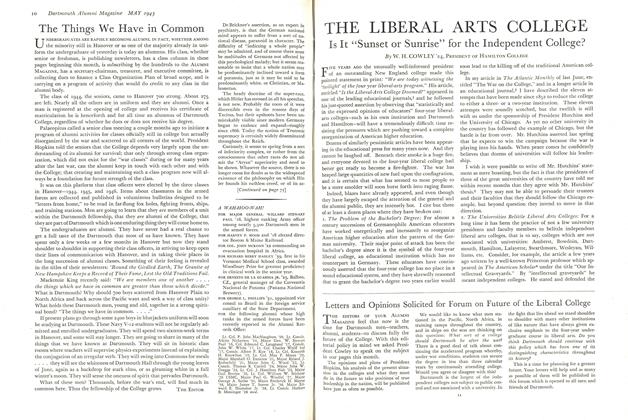
UNDERGRADUATES ARE RAPIDLY BECOMING ALUMNI, IN FACT, WHETHER AMONG the minority still in Hanover or as one of the majority already in uniform the undergraduate of yesterday is today an alumnus. His class, whether senior or freshman, is publishing newsletters, has a class column in these pages beginning this month, is subscribing by the hundreds to the ALUMNI MAGAZINE, has a secretary-chairman, treasurer, and executive committee, is collecting dues to finance a Class Organization Plan of broad scope, and is carrying on a program of activity that would do credit to any class in the alumni body.
The class of 1944, the seniors, came to Hanover 700 strong. About 275 are left. Nearly all the others are in uniform and they are alumni. Once a man is registered at the opening of college and receives his certificate of matriculation he is henceforth and for all time an alumnus of Dartmouth College, regardless of whether he does or does not receive his degree.
Palaeopitus called a senior class meeting a couple months ago to initiate a program of alumni activities for classes officially still in college but actually disorganized by the war and scattered to all corners of the world. President Hopkins told the seniors that the College depends very largely upon the understanding of its alumni for survival; that only through strong class organization, which did not exist for the "war classes" during or for many years after the last war, can the alumni keep in touch with each other and with the College; that creating and maintaining such a class program now will always be a foundation for future strength of the class.
It was on this platform that class officers were elected by the three classes in Hanover—1944, 1945, and 1946. Items about classmates in the armed forces are collected and published in voluminous bulletins designed to be "letters from home," to be read in far-flung fox holes, fighting fronts, ships, and training stations. Men are going to learn that they are members of a unit within the Dartmouth fellowship, that they are alumni of the College, that they are part of Dartmouth which is one enduring thing they will come home to.
The undergraduates are alumni. They have never had a real chance to get a full taste of the Dartmouth that most of us have known. They have spent only a few weeks or a few months in Hanover but now they stand shoulder to shoulder in supporting their class officers, in striving to keep open their lines of communication with Hanover, and in taking their places in the long succession of alumni classes. Something of their feeling is revealed in the titles of their newsletters: 'Round the Girdled Earth, The Granite ofNew Hampshire Keeps a Record of Their Fame, Lest the Old Traditions Fail.
Mackenzie King recently said: "We are members one of another . . . .the things which we have in common are greater than those which divide." What is Dartmouth? Why should 700 boys scattered from Hanover Plain to North Africa and back across the Pacific want and seek a way of class unity? What holds these Dartmouth men, young and old, together in a strong spiritual bond? "The things we have in common "
If present plans go through some 2400 boys in bluejackets uniform will soon be studying at Dartmouth. These Navy V-12 students will not be regularly admitted and enrolled undergraduates. They will spend two sixteen-week terms in Hanover, and some will stay longer. They are going to share in many of the things that we have known at Dartmouth. They will sit in historic class rooms where teachers will supervise physics experiments instead of explaining the conjugation of an irregular verb. They will swing into Commons for meals .... they will see the whiteness of Dartmouth Hall through the young leaves of June, again as a backdrop for stark elms, or as gleaming white in a full winter's moon. They will sense the oneness of spirit that pervades Dartmouth.
What of these men? Thousands, before the war's end, will find much in common here. Thus the fellowship of the College grows.
THE EDITOR