1897
The College is looking forward to the future with a new program of more help for the boys who need help for paying the higher prices for education, realizing that it is the business of the College to provide education. It costs more to find the derivation of the particle "an" in the Greek language and it is worth less to know how this particle comes into the language, and this intimate study of the Greek language is probably less important in College thinking today than it was in our time.
It is important, however, that such things as a student must learn so that he can be classed as an educated man, shall find their place in his preparation for a flying goal in success. It costs more to educate, and it costs more for everything we buy, and then again those who are successful in making the big strike in the world of business are tapped pretty heavily by the taxing power of the town, the state and "Uncle Sam." This new program to let the urge to help the College by giving something now and also a bequest tor payment to the College after we get through using money, means that we are going to add our names to those who are remembered by the College because they have remembered the College in their wills.
When I first began to think about this as a new plan to keep up with the fast rising of prices and to keep the balance of the in and out intact, it seemed like a good proposition and I've just got to admit it is going to be good for the student, good for the College and good for us "guys" who are being tapped. The thing I like best about it is that, when it gets going, and that is not going to be long, the feeling that we must get aid from "Uncle Sam" will change. X do not want that guy with the striped pants to get his leech-like hold on this old gal-Alma Mater. I want her to stop making "goo goo" eyes at "Uncle Sam and this bequest program is just the right way to get the old gal to cut out that socialistic flirtation.
I have just finished my business visit to Hanover. I take this trip every year and have for about 40 years. It is one of the in-between times of College activities when the fraternities take in the new men. About 450 men are taken into the fraternities each year—mostly sophomores. It is one of the times when the college alumnus, who comes close to his fraternity, can actually get the picture of students in their activities and way of thinking somewhat. I have been doing this for a long time.
I recall the boys of 1913-18, when the spirit of war was the all-prevailing-influence, and a group of 4-F boys who were sad that they couldn't go. Again in 1919 when the young officers came back. One actually wore spurs at the fraternity house ready to give orders to the alumni on how to run a fraternity. No thought about the amount of expenditures or anything of that kind. From 1921 to 1929 there was a very decided dilettante spirit among the fraternity members. They were responsive and helpful in many ways. Then a new change from 1929 to 1937—everybody poor mouth and the W.P.A. introducing socialism into America, and then, when the hard times began to wear off, they changed again. X like to think of the age from 1941 to 1945 as the age of hate. The houses were closed for two years and when they came back in 1945 and the war brides became a part of the picture, fraternities became very thoroughly responsive to the alumni and happiness seemed to be prevailing over all the College; and then this new war upset them again, and it might well be called the period of doubt.
I think the period we are in now is just changing a little, but it has been a pretty bad period. I think criticism of the colleges by everybody for selling out the games in basketball, over-emphasis on making football profitable, and the spirit of "I'm going to war, I don't care," has prevailed.
There was an editorial in the New YorkHerald Tribune the day I sat with the boys at the banquet table, and I read this to them. It was the one about shoeless Joe Jackson being among those who sold out the Black Sox to the Cincinnati Reds, and the small boy heroworshiper with tears in his eyes begging the finest and most natural hitter of all times in these pitiful words, "Say it ain't so, Joe, say it ain't so."
I think the average college boy feels that way about it when the teams are sold out. The one thing that is uppermost in their thoughts and feelings today is doubt. These boys are hungry for leadership. They don't want their idols broken like Shoeless Joe Jackson was. They need an honest Joe Jackson today.
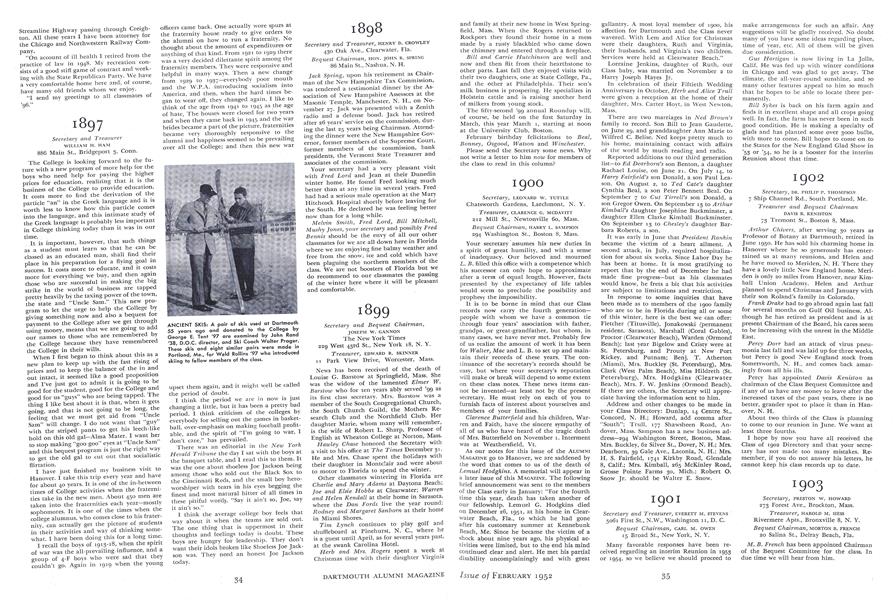
ANCIENT SKIS: A pair of skis used at Dartmouth 55 years ago and donated to the College by George E. Tent '97 are examined by John Rand '38, D.O.C. director, and Ski Coach Walter Prager. These skis and eight similar pairs were made in Portland, Me., for Weld Rollins '97 who introduced skiing to fellow members of the class.
Secretary and Treasurer 886 Main St., Bridgeport 3, Conn.