A Review of the Intramural Year Through March
ORGANIZED intramural athletics are a relatively new activity at Dartmouth. Next year, 1952-53, will mark the 25th year that the Intramural Department has been sponsoring dormitory and fraternity athletic competition in the College.
The Intramural Department is a branch of the Physical Education Department from which it receives faculty help. However, intramurals are administered completely by students, and are subsidized by the College. Dartmouth is almost alone among colleges in having a student-run intramural program, and participation records and student enthusiasm indicate that such a program has been successful.
In spite of various drawbacks such as adequate facilities in some sports and the lack of professional officiating, the intramural program achieves its goal of providing athletic competition for students in harmony with the aims of a liberal education. In a time when overemphasis in sports is so widespread, the value of voluntary association in an intramural program becomes all the more meaningful. Although there is still a certain amount of pressure on athletes to play for their fraternities, the intramural program at Dartmouth remains a voluntary, informal opportunity for men to participate in organized sports.
When one thinks of sports at Dartmouth, one usually thinks of hard-charging Big Green elevens, spirited basketball quintets, and championship ski teams. Most of us have only watched the performances of these Dartmouth teams. Many of us, on the other hand, have played in one intramural sport or another and have gotten some measure of enjoyment out of it. Last year's participation figures indicate that 64% of the student body (over 1800 students) at Dartmouth took part in intramural sports—each man, of course, in varying amount. This figure surprises many, but some idea of the extent of interfraternity and interdorm competition is given by the fact that every day from October until June, with only a few exceptions, there are at least six games held in major sports, whether it's football or softball on the green or basketball or volleyball in the gym. Add to these the innumerable minor sports which run concurrently and some conception of the total is reached. All told, 15 different sports are offered throughout the year.
Intramurals still do not have the recognition that they should have on the Dartmouth campus, which leads inevitably to misconceptions concerning the operating methods of the department and consequently to penalties for neglecting department rules (mostly on eligibility). From this arises one of the tasks facing students in the department in the future. The goal of any intramural system should be to attain a balance between it and the professionally staffed, often heavily subsidized intercollegiate athletic setup—with proper emphasis accorded to both.
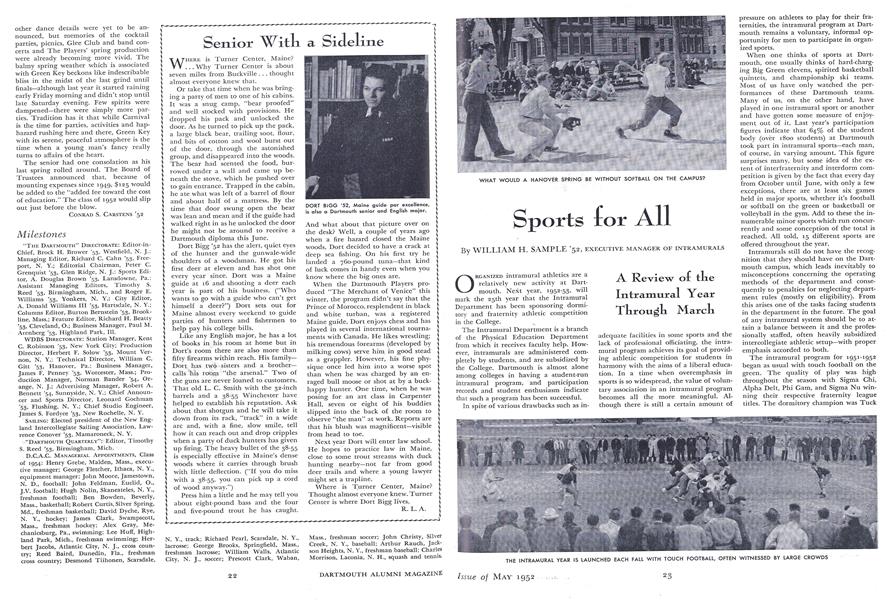
The intramural program for 1951-1952 began as usual with touch football on the green. The quality of play was high throughout the season with Sigma Chi, Alpha Delt, Phi Gam, and Sigma Nu winning their respective fraternity league titles. The dormitory champion was Tuck School (by virtue of a win over Ripley), but the Terrors never got to play in a college championship. The AD—Sigma Chi fraternity final was called at the end of 14 scoreless periods on account of rain, darkness, the imminence of Houseparty Weekend, and the general agreement that the teams should share the crown. Neither team was able to score in 140 minutes of touch football—equivalent to 3½ games.
The football skills contest went to AD due to the outstanding individual performance of Fred Gieg with strong support from Bill Biggs. Lord Hall was dorm champ with Bud Pulis and Bob Alvord. In handball Psi U, with Emil Schnell and Gene Howard, beat Sigma Chi's Dick McMahon and Charlie Curtis for the fraternity crown and then Pete Robinson and Jack Crowell of New Hamp for the college championship.
Golf was somewhat hampered by bad weather in the late fall. Sigma Chi, however, was able to win the fraternity championship over Phi Gam by the score of 2 and l. Bob Griswold and Kent Klinemas played for Sigma Chi. No dorm champion was established but Tuck, with Bill Bobbs and Dick McFarland, and Streeter were the finalists.
Basketball began soon after Thanksgiving and after two or three weeks it became apparent that AD (the defending college champs) and Psi U in League One and Phi Gam and Beta in League Two were the teams to beat. In the fraternity final, Phi Gam topped Alpha Delt, 40- 37, due to gome fine clutch shooting by Bill Randall in the final minutes. In the dorm competition Hitchcock and Topliff met in the dorm final. Bob Smith of Topliff won the game almost single-handedly with 22 points. In the college final, a wellplayed and exciting game, Phi Gam won, 49-45, but only by holding Smith to 10 points.
A recap of the basketball season must include the feats of Phi Gam's Pete Burnside. This lanky lefthander was the big man all season for the College Champs and would undoubtedly have made a handsome addition to Doggie Julian's varsity. Consistent high-scoring, strong rebounding, and court finesse made Pete the most valuable man in this winter's basketball campaign. He made the League Two all-star team (chosen by the teams themselves) as did Eric Gundersen of Zeta Psi, Dave McLaughlin, Bill and Bayard Johnson of Beta, Randall of Phi Gam, and Ev Parker of Theta Chi. In addition to Hart and Boyer of AD the League I all-stars were Ronnie Lehrman of Sigma Chi, Len Larrabee o£ Kappa Sig, and Dick Lena of AD. In addition to Smith, Grady, and Anderson, the outstanding performers in dorms were Al Edmundson of New Hamp and "Stretch" Johnson of Streeter (who scored 49 points in one game and took the intramural scoring title).
Occom Pond obliged with good ice just long enough for the completion of fraternity hockey. Unfortunately no dorm champion was crowned. In the single elimination AD came out over DTD in a heated final game in Davis Rink by the score of 4-3 after trailing 3-1 early in the second period. Tom Blomquist scored all four goals with but one assist, while John Newey had 24 saves in the AD goal.
Fraternity track once again ended in a deadlock, this year between Beta and Delta Tau Delta with 15 points apiece. Monk Robinson of DTD was the outstanding performer of the meet and was directly responsible for 10 points as he took firsts in the two dashes—running the 50 in 5.8 seconds and the 100 in 10.7. His century mark tied a record set by Bob Krieger '41. In addition, Robinson anchored the winning DTD relay team. Other medal winners were: 50-yd. low hurdles, Don McMichael of Sigma Nu; 440-yd. dash, Ed Boyle of Psi U; 880-yd. run, Phil Cook of Theta Chi; high jump, Jack Pierce of Theta Delt; broad jump, Jim Flom of Beta; and the shot put, Jack Tukey of Beta.
The foul-shooting contest was expanded this year along the lines of the football skills contest. Instead of just the customary foul shot, three different types of shots were required: foul shots, hook shots, and set shots. Sigma Chi and Topliff won the fraternity and dormitory championships. Ronnie Lehrman of Sigma Chi was the outstanding individual performer with 23 out of a possible 30, followed by Bob Comer of New Hamp with 22, and John Mitchell of Theta Chi with 21.
Fraternity swimming ended in a tie between SAE and DU. The individual winners were: 50-yard freestyle, Mike Korjeff of DU; 100-yard freestyle, Stan Rosenberg of TEP; 100-yard backstroke, Tom Mconnon of Chi Phi (McConnon broke his own college record in this event); 100-yard breaststroke, Bob Lonsbury of Zeta Psi; igo-yard medley relay, Chi Phi; 200-yard free style relay, SAE; diving, Gordy Nichols of Theta Delt.
In skiing, an intramural event run by the DOC, Gamma took the team championship. SAE, Theta Chi, Theta Delt and Sigma Chi followed in that order. Sabe Abell of Theta Chi won both the slalom and downhill. In the cross country, Dalton Dulac of SAE was first.
Alpha Delt won the fraternity pingpong championship handily from Kappa Sig. Tom Allen, Jim Cobb, and Kent Calhoun did not lose a match throughout their schedule. Tuck School won the dorm title over College Hall.
This summarizes the intramural year through spring vacation, with softball, tennis, and dorm swimming yet to be run off. In overall intramural point totals, Alpha Delt, Theta Chi, and Psi U are at the top of the fraternity standings, within five points of each other, and Tuck School leads the dormitories.
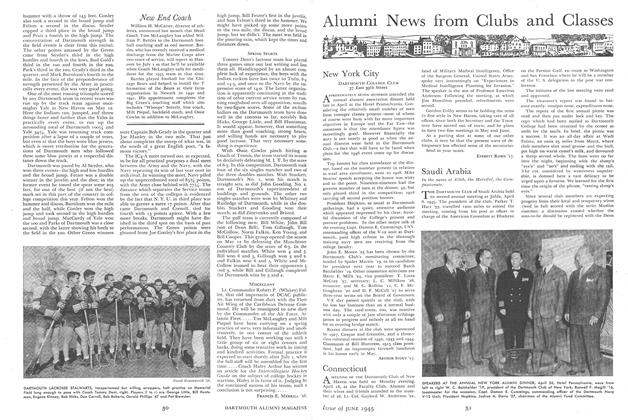
WHAT WOULD A HANOVER SPRING BE WITHOUT SOFTBALL ON THE CAMPUS?
THE INTRAMURAL YEAR IS LAUNCHED EACH FALL WITH TOUCH FOOTBALL, OFTEN WITNESSED BY LARGE CROWDS
WINTER ACTION: PHI GAM AND TOPLIFF BATTLE FOR THE COLLEGE BASKETBALL TITLE
BEHIND THE SCENES of Dartmouth's successful, student-run program of intramural sports is a lot of managerial planning. Above, Bill Sample '52 of Philadelphia (second from right), executive manager and author of this article, is shown leading one of the frequent skull sessions at the gym.
EXECUTIVE MANAGER OF INTRAMURALS